My 101-year-old neighbor was prepared to go to prison for stealing merchandise worth several thousand dollars. Even when the judge pressed him to explain his actions, he refused to speak. But I knew the secret Walter was hiding. And when I finally revealed the truth, no one in that courtroom could hold back their emotions.
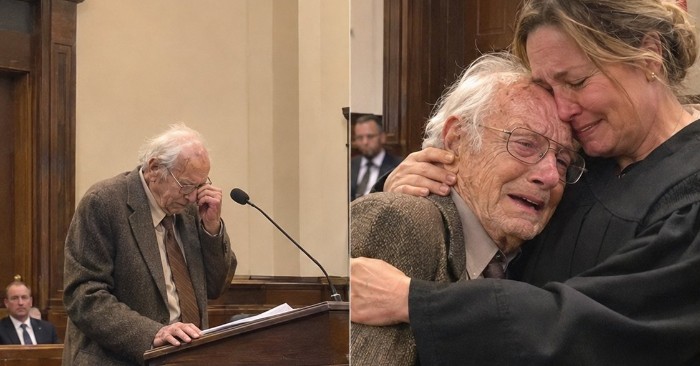
“Mr. Walter, do you understand that you could go to prison for this?” the judge asked.
“Yes, Your Honor.”
“Then why do you refuse to explain your behavior?”
Walter gripped his walking stick tightly with both hands.
“I stole those things. I’m guilty.”
The judge studied my frail neighbor thoughtfully.
“At 101 years old, you should be sitting comfortably at home enjoying your remaining years instead of standing before my court.”
Walter lowered his head.
“I’m sorry, sir.”
The judge looked at the photographs spread out on the table in front of him.
“Baby clothes. Canned food. School supplies.”
He picked up another photograph.
“Because of your advanced age, the store employees warned you several times instead of taking action. But you kept returning and stealing more merchandise. Even after they told you that another incident would result in criminal charges. Why?”
Walter remained silent.
“We’re talking about merchandise worth more than two thousand dollars. Surely you understand why the store eventually filed a complaint.”
“Yes, sir.”
“Then give me at least one reason why I shouldn’t send you to prison.”
Walter’s voice trembled.
“I don’t have one, Your Honor.”
That was when I couldn’t remain silent any longer.
“Yes, he does!”
Walter turned toward me in alarm.
“Margaret, please sit down.”
I’d lived next door to Walter for thirty years.
But I’d never seen him look so frightened.
“Your Honor,” I said, “this man made me promise never to tell anyone. But I cannot allow him to go to prison without you knowing the truth.”
I reached into my handbag and took out a folded sheet of paper.
“Please. There’s something you absolutely need to know.”
The judge gave me permission to speak.
I pointed toward a young woman sitting in the back row.
A little boy was sleeping against her shoulder.
“That woman’s name is Sarah. She’s raising three children entirely on her own.”
Sarah looked up in confusion.
“Her husband left her two years ago,” I explained. “She works cleaning office buildings. But sometimes she barely earns enough to feed her children.”
Walter closed his eyes.
“Margaret, please.”
But I wasn’t going to stop.
“The things Walter stole weren’t for himself. He took them to Sarah’s house.”
Sarah stared at me.
“What?”
“For months, he’s been leaving groceries, clothes, and school supplies outside your front door.”
She shook her head in disbelief.
“He told me he paid for everything with his pension.”
“And you believed him because he kept telling you not to worry about the money.”
The judge turned toward Walter.
“Is that true?”
“Yes, sir.”
“Why didn’t you tell the court?”
Walter glanced toward Sarah.
“She’s spent months making sure I didn’t go hungry. I didn’t want her standing here feeling responsible for what I did.”
Sarah covered her mouth with one hand.
But I wasn’t finished.
“Your Honor, there’s something else. Sarah wasn’t the first person who needed help.”
I unfolded the paper.
“This is a note Sarah wrote to Walter last winter.”
Sarah immediately recognized her own handwriting.
I began reading.
Dear Walter,
Please stop trying to give me money for dinner. My children are happy that someone is looking after you. You’re part of our family now.
The judge frowned.
“Dinner?”
“Sarah was feeding Walter long before he started leaving groceries at her doorstep.”
The previous winter, Walter had become seriously ill.
His wife had passed away many years earlier.
He had no close relatives living nearby who could take care of him.
One day, Sarah noticed that his curtains hadn’t been opened for two days.
Worried, she went over and knocked on his door.
When Walter finally answered, she discovered he was far too weak to prepare food for himself.
From that day forward, she brought him a warm meal almost every evening.
Sometimes, she even invited him to have dinner with her and the children.
Walter rarely accepted those invitations.
He believed Sarah was simply bringing him leftovers from her family’s dinner.
And every time, he thanked her for whatever food they could spare.
It never occurred to him what those meals were actually costing Sarah.
He repeatedly tried to give her money.
But Sarah refused every time.
Then, one evening, Walter noticed something strange.
As he later told me, Sarah had brought him chicken and potatoes that night.
When he asked whether she’d eaten herself, she simply smiled.
“I’m not hungry tonight.”
A few days later, her oldest daughter came over with another container of food.
“Has your mother eaten yet?” Walter asked the girl.
She shook her head.
“Mom says she’s not hungry again. She says we kids need the food more because we’re still growing.”
I looked at the judge.
“Those weren’t leftovers, Your Honor. Sarah was giving Walter her own dinner.”
I wiped tears from my eyes.
“When he discovered that, he couldn’t sleep at night anymore.”
Walter’s chin began trembling.
“She was feeding me food she couldn’t even afford for herself,” he said quietly.
Then Walter told the judge how everything had started.
At first, he’d used his own money to buy groceries for Sarah and her children.
He left the bags outside her door because he knew she’d never accept direct financial assistance.
But eventually, his savings began running out.
He sold his old wristwatch.
Then some other personal belongings.
Finally, he had almost nothing left.
And at some point, he started stealing.
“Every time I told myself I had to stop, I thought about those children,” he whispered.
I turned back toward the judge.
“I found out when I saw Walter coming home one afternoon carrying several shopping bags. Eventually, he confessed that he’d taken the items from the supermarket without paying.”
I held up Sarah’s letter.
“He showed me this note and begged me not to tell Sarah what he’d done.”
By then, Sarah was crying.
“Walter, I never asked you to do anything like this.”
“I know, sweetheart.”
“You should have talked to me.”
“Then you wouldn’t have let me help.”
“And now you might go to prison because of us.”
Walter looked at her.
His eyes were filled with tears.
“No. I stole those things. I’m the only one responsible for that.”
For a moment, nobody said anything.
Then Sarah suddenly stood up.
“Your Honor, there’s something Walter doesn’t know yet.”
Walter raised his head.
“My children call him Grandpa Walter,” Sarah said.
A faint smile crossed Walter’s face.
“Not when he’s around. They’re afraid he might think it’s silly.”
Sarah wiped her cheeks.
“But every evening, they set our dinner table for five people. One place for me. Three for the children. And one for Walter.”
Walter stared at her in disbelief.
“They call me Grandpa?”
Sarah nodded.
“My youngest asks every evening whether you’re coming to dinner. He won’t let me put your plate away.”
Walter covered his mouth with one hand.
“I thought they were only happy to see me because I always brought them something.”
Sarah shook her head.
“Walter, they were saving a chair for you long before you ever brought us groceries.”
Her voice trembled.
“We needed those groceries. I’m not going to pretend otherwise.”
She paused briefly.
“But my children need you far more than they need those groceries. They need their grandpa.”
The judge postponed the sentencing decision so that a plan could first be developed to compensate the store for its losses.
I promised to speak with our neighbors.
Together, we intended to raise money to reimburse the store and make sure neither Walter nor Sarah’s family would have to go hungry in the future.
But Walter barely seemed to notice any of that.
He kept looking at Sarah.
As though he still couldn’t believe that, all this time, a place had been waiting for him at their family dinner table.
A few weeks later, I visited Sarah at home.
When I entered her kitchen, Walter was already sitting at the table.
Five plates had been set out.
Sarah’s youngest son climbed onto the chair beside Walter and took his hand.
“Grandpa Walter?”
“Yes, my boy?”
“You don’t have to bring us anything anymore.”
Walter swallowed.
“Then what should I bring?”
The little boy smiled.
“Just yourself.”
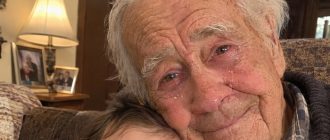
I watched Walter smile as tears streamed down his cheeks.
For years, he’d lived alone.
He’d believed that, at his advanced age, he had very little left to offer anyone.
But now he had a family waiting for him every evening.
A family that set out his plate and saved his chair.
And the only thing they wanted from him was for him to come home.
Because sometimes the most precious thing one person can give another isn’t money or food—it’s the feeling of finally belonging somewhere.