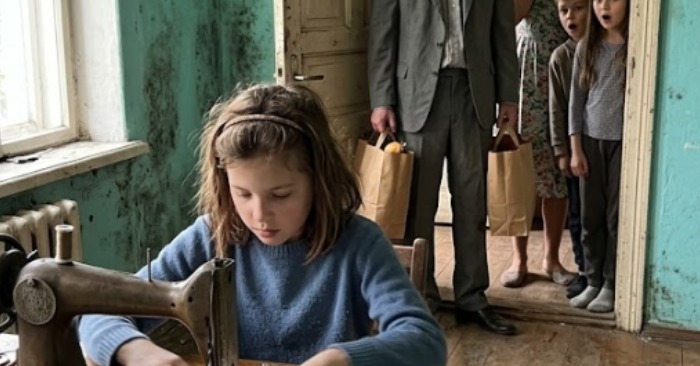
A wealthy landlord arrived to collect payment — and instead found a young girl sewing just to survive, uncovering a truth he had never been prepared to face.
Rain followed Daniel Brooks all the way from the city center, streaking across his windshield as if trying to wash away something invisible. He barely noticed it. Weather rarely affected him. Collecting rent had long since become routine: numbers, signatures, brief polite nods.
He owned this building — a worn-out three-story walk-up on the outskirts that looked like it could collapse at any moment. He kept it only because his financial advisor had called it “recession-proof,” which really meant the tenants had nowhere else to go.
Daniel stepped into the narrow, stuffy hallway. The air was thick with dampness, oil, and dust that hadn’t settled in years. He checked his phone: apartment 3C — his final stop. He knocked once, firm and practiced.
No answer.
He knocked again.
The door creaked weakly and slowly opened.
Sunlight filtered through a cracked window, falling onto an old, timeworn table. Sitting there was a small girl, no older than nine or ten, hunched over a sewing machine. Her hair was tangled, her face smudged with dirt. A strip of fabric was tied around her wrist, darkened with dried blood. Every press of the pedal echoed with a heavy, rhythmic clatter.
Daniel froze.
The girl didn’t look up. Her fingers carefully guided a faded piece of blue fabric beneath the needle, her jaw clenched with a level of concentration far too heavy for someone so small.
“Where is your mother?” he asked, surprised to hear himself speak.
She paused, the machine groaning before falling silent. Slowly, Emily lifted her tired eyes — far too mature, far too aware for a child her age.
“She’s sick,” she whispered. “Please… I just need to finish this seam.”
Daniel glanced around the room: a thin mattress on the floor, a cold, unused stove, no toys, no television. Beside the machine were neatly stacked pieces of fabric.
“What are you sewing?” he asked.
“Dresses for a shop on Maple Street,” Emily replied. “They pay per piece.” His chest tightened. “You shouldn’t have to do this.”
“If I don’t sew, we won’t eat,” the girl said quietly, gripping the fabric.
From the back room came a faint, wet cough. Daniel took a step forward, then hesitated. He knew about hardship — but only as statistics, as numbers on paper.
“I came for the rent,” he said, hearing the emptiness in his own voice.
Emily nodded and held out an envelope with trembling hands. “It’s all here. I counted it three times.”
Daniel didn’t take it. His gaze returned to the sewing machine. Old, worn, familiar — his grandmother had one just like it. He remembered sitting beneath her table, listening to the steady rhythm of the needle as she hummed softly. The memory struck him harder than he expected.
“What’s your name?” he asked.
“Emily.”
“How old are you?”
“Nine… almost ten.”
He noticed her wrist. “What happened?”
“The needle slipped,” she said gently. “It’s okay.”
He looked toward the back room. “May I?”
Emily nodded.
The room was dim. A woman lay beneath a thin blanket, pale and weak. She stirred faintly as he entered.
“I’m sorry… I’ll pay. My daughter is helping,” she whispered.
Daniel returned to the main room, a heavy weight settling in his chest. He quickly typed a message on his phone and slipped it back into his pocket.
“Emily,” he said, crouching down to meet her eyes, “stop sewing.”
Her eyes widened. “I can’t—”
“You can,” he said softly. “Just for today.”
He picked up the envelope and gently handed it back to her. “You don’t need to pay rent this month.”
Her mouth fell open in shock.
“I’m not finished,” he added. “Tomorrow, a doctor will come. Groceries will be delivered. The machine stays — but not like this.”
Tears streamed down her face. “Why?”
Daniel swallowed hard. He had walked past countless doors, dismissing struggle as laziness, never imagining a child working to keep the lights on.
“Because you’re a child,” he said quietly. “And I forgot what that means.”
He left without waiting for a reply.
That night, Daniel couldn’t sleep. The image of Emily’s small hands guiding the fabric haunted him. By morning, he had made a decision.
Apartment 3C was only the beginning.
Quietly, he launched a program: rent relief, medical care, school support, childcare vouchers. He built partnerships with local businesses and opened a workshop on Maple Street with fair wages and strict worker protections.
Emily’s mother recovered. Emily returned to school.
Months later, Daniel came back — not as a landlord, but as a friend.
Emily opened the door, her hair neatly brushed, a shy but bright smile on her face.
“I made something for you,” she said, handing him an embroidered handkerchief — blue, with tiny white flowers.
Daniel accepted it carefully. “It’s beautiful.”
“I like sewing,” Emily said softly. “Just… not when I’m scared.”
He nodded, understanding more than ever before.
As he walked away, he realized something had changed — not just in that apartment, but within himself.
The numbers would change.
But his life already had.
All because, on a rainy day, he knocked on a door — and for the first time, truly saw who was behind it.