When a baby is born, they depend completely on their parents for love, safety, and support. Sadly, not every child receives that kind of beginning. For Xueli Abbing, life started with a heartbreaking moment.
She was born in China with albinism, a genetic condition that causes the skin, hair, and eyes to have very little pigment. Because of her appearance, her biological parents abandoned her as a baby, leaving her outside the door of an orphanage.
The orphanage staff gave the little girl a special name: Xueli. In Chinese, “Xue” means snow, and “Li” means beautiful — a name chosen to reflect her unique appearance and the beauty they saw in her.

Fortunately, Xueli’s story didn’t end there. She was adopted by a loving Dutch family, who gave her the care and encouragement every child deserves. Growing up, she learned to embrace her differences rather than hide them.
At the age of 11, Xueli received an unexpected opportunity.

A designer in Hong Kong invited her to take part in a fashion project called “Perfect Imperfections,” which aimed to highlight the beauty of people who look different from traditional models.
“It was an amazing experience,” she later shared. People with albinism often face stigma and discrimination around the world. In some countries, harmful myths even put them in danger.

Because of this, Xueli has always been aware of how lucky she was to find a safe and supportive home.
“I’m lucky I was only abandoned,” she once said.
Her unique appearance eventually caught the attention of photographers and fashion professionals. One London-based photographer helped introduce her to the modeling world, and soon she achieved something remarkable.

Xueli appeared in Vogue Italia in 2019 — one of the most respected fashion magazines in the world.
At the time, she didn’t fully realize how big the achievement was. “I didn’t know how important the magazine was,” she said. “It took me a while to understand why everyone was so excited.”
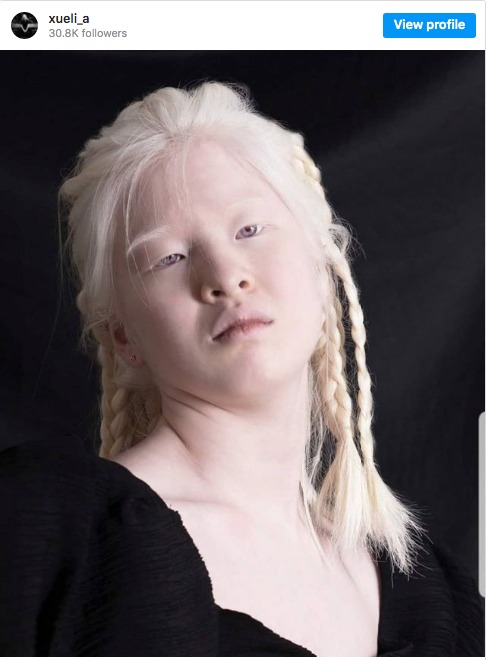
Today, Xueli hopes to use her platform to raise awareness about albinism. She wants people to understand that it is a genetic condition — not something mysterious or cursed, as some harmful myths claim.

She also prefers the phrase “a person with albinism” instead of labeling someone simply as “an albino.” More importantly, she hopes her story will help change the way the world sees beauty.
Because sometimes the people once rejected for being “different” grow up to show everyone just how extraordinary they really are.