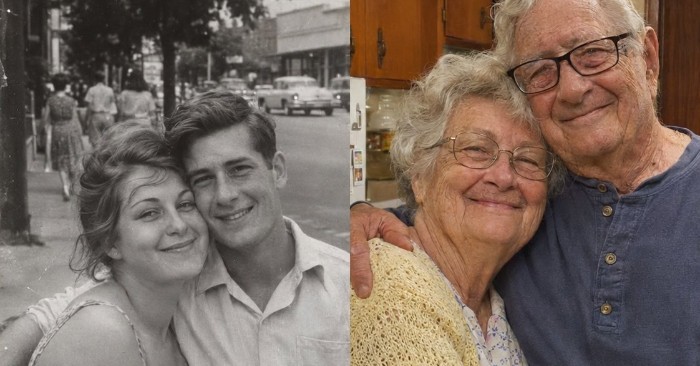
For sixty years, I believed I knew Irene better than anyone else in the world. But after her death, I discovered she’d been carrying a secret for nearly half our marriage. The deeper I looked into her past, the clearer it became that the truth wouldn’t simply change my memories. It would force me to reconsider what the life we’d built together had actually meant.
Three days after Irene’s funeral, a stranger appeared on my porch and informed me that I had never legally been her husband.
I was eighty-six years old, barefoot, and holding a coffee cup I’d prepared out of habit for a woman who would never come home again.
“What did you just say?”
The man, who had introduced himself as Mr. Geller, adjusted the envelope in his hands.
“Irene instructed me to give you this after her passing.”
“Irene didn’t have a lawyer.”
“Actually, sir, she did. She first came to see me several years ago.”
That unsettled me.
Irene had always told me everything.
At least, that’s what I’d believed.
“What is going on here? Why did my wife hire you?”
Mr. Geller extended the envelope toward me.
“I’m sorry, but Irene specifically requested that I deliver this letter only after her death.”
I refused to take it.
“What aren’t you telling me?”
The man hesitated.
Then he said something that made the ground seem to disappear beneath my feet.
“Your wife? Sir, legally speaking, you and Irene were never married. Did you genuinely not know? Please open the envelope. It will explain everything.”
For a moment, I seriously wondered whether grief had somehow damaged my hearing.
Irene and I had celebrated our sixtieth wedding anniversary only a few months earlier.
We’d raised three children and spoiled five grandchildren.
I’d held her hand as she peacefully took her final breath.
“Give me the envelope.”
“Robert…”
“Give it to me.”
He handed it over.
My name was written on the front.
In Irene’s handwriting.
The sight of it alone nearly brought me to tears.
It was the same handwriting I’d eagerly looked for on letters when I’d been stationed overseas, far from home.
I tore open the envelope.
The first line read:
Robert, there’s something I should have told you forty-six years ago.
I read the sentence.
Then I looked at Mr. Geller.
Afterward, my eyes returned to Irene’s letter.
The next line made me freeze.
I was married once before I ever met you.
I lowered myself onto the little bench beside our front door.
“Married?”
Mr. Geller said nothing.
I looked up at him.
“Did you know about this?”
“I knew what Irene told me. Everything else is explained in her letter.”
So I continued reading.
Irene had married her high school sweetheart when she was eighteen.
The marriage had lasted only a few months.
They argued constantly, eventually separated, signed paperwork, and went their separate ways.
But the divorce had never been properly finalized in the legal records.
Irene believed the matter had been completely settled.
And then she met me.
That part of our story didn’t need to be explained in Irene’s letter.
I remembered it perfectly well myself.
I’d first seen her at college.
She was sitting three rows ahead of me, laughing with a friend, and she looked so beautiful that I stared at her for far too long.
Eventually, she noticed.
Months later, I finally gathered the courage to ask her on a date.
She simply smiled and said, “Well, that certainly took you long enough.”
“I had to work up the nerve.”
“Mostly, you needed to stop staring at me and actually say something.”
Remembering that moment made me smile despite everything.
Not long afterward, I joined the Army.
When I learned I’d be sent to Vietnam, I told Irene I didn’t want to leave without marrying her first.
She looked at me seriously.
“Are you asking because you’re scared?”
“I’m asking because I love you.”
“Good answer.”
A week later, Irene wore a white summer dress decorated with tiny pale-blue flowers.
After the ceremony, we went to a modest diner and ate hamburgers because we couldn’t afford anything more expensive.
A few days later, I had to leave.
Her letters followed me halfway around the world.
About a year later, I finally came home to her for good.
And from that moment on, we built a life together.
Three children.
Five grandchildren.
A house overflowing with memories.
Sixty years side by side.
On our final anniversary, Irene had squeezed my hand beneath the table and whispered:
“Not bad for a wedding followed by hamburgers at a cheap diner.”
Two months later, I was holding that same hand when she died.
I returned my attention to the letter.
When I married you, I believed with every part of my heart that I was legally free to do so.
At last, I could breathe again.
She hadn’t known.
She hadn’t deliberately deceived me.
But then I read the next sentence.
Fourteen years later, I discovered I had been wrong.
I folded the page.
Mr. Geller took a step toward me.
“Robert?”
I stood up.
“Not now.”
“Irene wanted you to receive some additional documents.”
“I can’t read another word while you’re standing here in front of me.”
He nodded understandingly and placed his business card on the small table beside the door.
“If you’d like the remaining information, please call me.”
After he left, I stared at the closed front door for a long time.
Then I looked again at Irene’s handwriting.
“My God, Irene. Who were you, really? You lied to me all these years? How could you do this to me?”
My voice echoed through the empty house.
Irene had always answered me before.
This time, there was only silence.
I called our daughter Penelope.
There was no possible way I could sit alone with what I’d just discovered.
Penny, as we called her, was our middle child and lived closer than either of her siblings.
Just like her mother, she could tell from my voice whenever I claimed I was fine when I clearly wasn’t.
She answered on the second ring.
“Dad?”
“Penny, could you please come over?”
Her voice immediately changed.
“What happened?”
I looked at the letter in my hand.
“Your mother left me something.”
“What did she leave?”
“I’m not entirely sure yet. And that’s exactly the problem. Please, sweetheart.”
“I’m on my way.”
Twenty minutes later, Penelope walked in carrying her handbag.
She took one look at me and immediately closed the door behind her.
“Dad, tell me what’s going on.”
I held up the letter.
“Your mother was married before she married me.”
Penelope stared at me.
“Before you?”
“When she was eighteen.”
“Did you know?”
“No. I had absolutely no idea.”
She sat beside me.
I unfolded the letter again.
“She thought her first divorce had been finalized. Fourteen years after our wedding, she discovered it hadn’t been.”
Penelope’s expression turned serious.
“So when you married Mom…”
“…she was still legally married to another man.”
Neither of us spoke for a long time.
Then I read the next sentence.
I contacted him.
My stomach twisted.
“She found him.”
Penelope moved closer.
“Does it say why?”
I kept reading.
Irene explained that the man had been just as shocked as she was.
He’d also believed their divorce had been legally finalized years earlier.
“Why didn’t she tell me back then?”
Penelope shook her head.
“Maybe she explains it farther down.”
Near the end of the letter, Irene had written:
You’ll find everything else in the box where I kept the documents I was most afraid you might discover someday.
I stood up so suddenly that Penelope immediately followed me.
“Do you know which box she’s talking about?” she asked.
“I think I do.”
Upstairs in our bedroom, I opened a closet and reached behind our usual folders of important documents.
My hand touched cardboard.
I pulled out a small box I’d never seen before.
Penelope stood beside me as I opened it.
Inside was another envelope bearing my name.
The first document confirmed Irene’s story.
The second clearly established that her first marriage had still been legally valid when we exchanged our vows.
Penelope touched my arm.
“Dad, there’s another page.”
I unfolded it.
The date at the top made my heart race.
Forty-six years earlier.
It was a short letter from the man Irene had married at eighteen.
Irene,
I had no idea either. Just tell me what I need to sign so we can finally get this matter properly settled.
Penelope studied my face.
“Does that help at all?”
“A little.”
There was nothing romantic in those words.
No secret affection.
Nothing suggested Irene had been living another life behind my back.
But then I opened the final document.
My relief lasted perhaps ten seconds.
“What is it?” Penelope asked.
“This says her first marriage was legally dissolved forty-six years ago.”
She moved closer.
“Doesn’t that mean Mom was free to marry you after that?”
“Yes.”
Penelope looked from the document to me.
“But she never did.”
I slowly sat down on the edge of the bed.
“Fourteen years could have been a mistake. But forty-six years was a choice.”
The following morning, I personally called Mr. Geller.
“I found the documents.”
There was a brief pause at the other end.
“Then you know more today than you did yesterday.”
“And I know enough to want you here tomorrow to answer my questions.”
“I could come by this afternoon.”
“Tomorrow will give me time to decide what I need to ask.”
He agreed.
When Mr. Geller arrived the next day, I spread the old divorce documents across the table between us.
“Let’s start with these. Irene eventually became legally free to marry. Why didn’t that automatically make our marriage valid?”
“Under the law applicable here, a marriage that was invalid when it took place did not automatically become legally valid afterward. Once Irene’s first marriage ended, the two of you would have needed to marry again.”
“So for forty-six years, we were free to marry each other, and we never did.”
“Legally speaking, yes.”
I absentmindedly rubbed my wedding ring.
“Did Irene understand that?”
“Yes.”
That answer hurt more than anything else.
“When did she first come to you?”
“Many years later, when she began putting her personal affairs in order for the future.”
“Did she ever explain why she didn’t marry me again?”
Mr. Geller shook his head.
“She said she owed that explanation to you. Not to me.”
I looked at Irene’s letter lying on the table.
Now I knew there had been a way to fix everything.
But she hadn’t taken it.
After Mr. Geller left, I finally read Irene’s letter all the way to the end.
She remembered how strongly I’d insisted on marrying her before my deployment to Vietnam.
I’d wanted to leave knowing that we truly belonged together.
Irene knew how much the word “wife” meant to me.
And that was precisely why she’d kept postponing the truth.
With every year that passed, it became harder to tell you.
I lowered the letter and noticed another page beneath the documents.
Robert,
I can marry you now. I should be able to write those words with nothing but happiness. But first, I need to explain why I couldn’t do it before.
There was nothing after that.
The rest of the page was blank.
That afternoon, Penelope found me sitting on our bed with the unfinished letter in my hands.
“She tried to tell me.”
Penelope sat beside me.
“And then she stayed silent for forty-six years.”
She examined the page.
“That doesn’t undo what she did.”
“No.”
“But she was afraid.”
“I’ve been afraid plenty of times in my life, too.”
Penelope looked at me.
“And you still told her the truth.”
I lifted the letter again.
“She loved me.”
Penelope nodded.
“Yes. And she kept all of this from you at the same time.”
“Both things are true, sweetheart. But knowing that doesn’t help me very much right now.”
That night, I removed my wedding ring and placed it beside Irene’s.
I stared at the two rings for a long time.
Then I turned our wedding photograph facedown.
I no longer doubted that Irene had loved me.
I simply didn’t know how much secrecy and fear a love like ours could endure.
The next morning, I stopped desperately trying to understand why Irene had made the choices she did.
Instead, I began thinking about what I wanted to do with the truth she’d left behind.
I called Mr. Geller again.
“Did Irene ask you to make sure I forgave her?”
“No.”
“What exactly do you think I’m supposed to do?”
“She wanted you to learn the truth after her death.”
I looked at my wife’s unfinished letter.
“Then she chose the only moment in sixty years when I can’t ask her a single question.”
I fell silent briefly.
“What happens now?”
“Legally speaking?”
“No. I mean her gravestone. Is there anything else that requires my decision?”
Mr. Geller explained that the inscription on her headstone still needed my final approval.
After we’d discussed the details, I said:
“Please send me everything I need to sign. I don’t want to be surprised by my own life ever again.”
Penelope came to visit that afternoon.
This time, I handed her Irene’s letter without immediately reaching to take it back.
She read the final passage.
I have no right to ask you to forgive me for this.
I loved you every single day. But I also lied to you for far too many of those days.
I wish I’d had the courage to tell you the truth while I was still alive and able to face your reaction.
Penelope lowered the page.
“What are you going to do now, Dad?”
“I’ve spent three days wondering what your mother really was to me.”
“And?”
“That was the wrong question.”
She waited.
“I know exactly who she was to me. She was the woman I loved. But she was also the woman who faced a problem we could have solved together and chose to let fear make the decision instead.”
“Can you live with both of those truths?”
“I can decide what I’m going to do with them.”
A few days later, Penelope accompanied me to finalize the inscription for Irene’s headstone.
The draft read:
“Beloved Wife”
I’d already requested that the word “wife” be removed.
Now I studied the original inscription again.
“Would you like me to say something?” Penelope asked.
“No.”
I thought about the courthouse Irene could have taken me to forty-six years earlier.
A single afternoon.
A few signatures.
A painful truth, but one we could have faced together.
Instead, she’d carried that truth for so long that the secret eventually became too heavy for her to speak aloud.
“Leave the inscription as it is,” I finally said.
Penelope turned toward me in surprise.
“Are you sure?”
“Yes. She lied to me, and I’m not going to pretend that never happened. But I’m not going to allow a legal failure to rewrite my entire life, either.”
I looked at the draft again.
“The law can tell me what we weren’t in a legal sense. But it cannot dictate what our sixty years together meant.”
On the drive home, I said to Penelope:
“Your brother and sister need to know.”
“Would you like me to be there?”
“No, sweetheart. You’ve already carried enough of this with me. I’ll handle it.”
That evening, I called my other two children.
I didn’t soften any of the dates.
And I didn’t hide the fact that their mother had known about the problem for forty-six years.
Polly became completely silent.
Eventually, Joey asked:
“Does this change anything about us?”
“No.”
“But does it change Mom?”
“Yes.”
“How?”
“She was more afraid than I ever understood. And I wish she’d trusted me enough to tell me the truth.”
Joey was silent for a moment.
“Do you still think of her as your wife?”
I looked toward my wedding ring resting on the table.
“Yes.”
Then I added:
“But that doesn’t mean I’m no longer angry with her.”
Finally, Polly spoke.
“You don’t have to decide everything today, Dad.”
“For the first time in my life, I’m not even trying to.”
After the phone calls, Penelope checked in to see how I was doing.
“Would you like some company?”
“Not tonight.”
“Call me if you change your mind.”
“I will.”
The next morning, I went into the kitchen.
As I did every morning, I automatically reached for two coffee cups.
Then I stopped.
Slowly, I returned Irene’s cup to the shelf.
I made only one cup of coffee.
Afterward, I walked into the living room and turned our wedding photograph faceup again.
I picked up my wedding ring.
Irene had taken away my chance to decide for myself what her truth meant for us while she was still alive.
There was nothing I could do to change that.
But I could make sure her fear didn’t get to make the final decision about our life together, too.
I slipped the ring back onto my finger.
Then I looked at her photograph.
“I’m still angry with you,” I said.
I settled into my armchair beside hers and drank my coffee.
Irene and I had argued and laughed.
We’d raised children, buried friends, survived difficult times, and built a life together that no missing legal document could erase.
Her lie was part of that life, too.
I hated that fact.
But it was part of our story nonetheless.
For the first time since Mr. Geller’s visit, I no longer felt the need for Irene to answer me.
She had made her decision.
And now, I’d made mine.