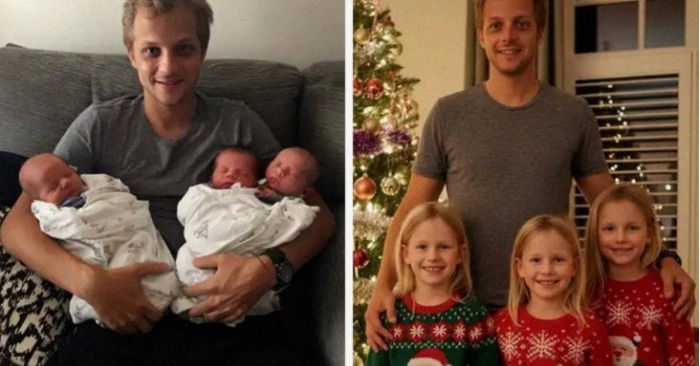
My sister died bringing three little girls into the world—a world their biological father never wanted them in. I became their parent overnight. For eight years, I carried that responsibility alone, and eventually life stopped feeling like a constant emergency. It became steady. Familiar. Safe.
Until one afternoon, the latch on our gate swung open and the man who had vanished before they took their first breath came back, determined to claim what he had once discarded.
It hadn’t started with the girls. It started years earlier, on the day I begged my sister not to marry him.
“Please don’t do this, Jen,” I said quietly. “Chris isn’t the man you think he is.”
She turned to face me in her wedding gown, mascara already smudged, tears gathering in her eyes. The dress hung too loosely on her frame. She’d been shrinking for months—physically and emotionally—but I’d pretended not to notice.
“You don’t get it,” she whispered, her hands shaking.
“I get it perfectly,” I said. “Marrying Chris is a terrible idea.”
“I love him,” she insisted. “He screws up, sure—but he always comes back.”
I recognized the tension in her face, that small line between her brows I’d brushed away since we were kids, whenever life scared her.
“He doesn’t come back because he chooses to,” I said gently. “He comes back because it’s convenient. And a wedding won’t change that.”
She grabbed my hands like she was afraid I might disappear next.
“Please,” she said. “Just stay with me. Even if you don’t trust him—trust me.”
Those words landed harder than anything else she could’ve said.
I swallowed every warning still burning in my chest and nodded.
What choice did I really have? I was her older brother. I’d always been the one who stood between her and the world.
We were opposites in every way. Jen saw life in bright shades and loud laughter. She dreamed of a crowded house, chaos, children everywhere—love spilling out in every direction.
As a kid, she played “mom” with her dolls, lining them up and gently scolding them when they “misbehaved.”
I imagined a life without responsibility: money, travel, freedom — and someday, opening an animal shelter.
But to me, Jen was my little princess. The one person I would protect without hesitation.
After the wedding, life with Chris turned out exactly as I’d feared.
He appeared and disappeared, promised every time that he’d changed, then vanished again the moment things got hard.
He’d be gone for weeks, then suddenly show up with flowers and apologies.
Jen took him back every single time.
“He’s trying,” she told me once over coffee in her tiny apartment. “He just… needs to figure things out.”
“He’s twenty-eight,” I said. “What exactly is there left to figure out?”
She changed the subject.
Jen tried for years to get pregnant — and failed over and over.
Each negative test broke her a little more.
Still, she stayed determined. She worked two jobs, saved every cent, and paid for IVF herself. Chris didn’t help. Well — not beyond the easiest part.
He showed up for the appointment, did what was required, then disappeared for a weekend with his friends.
“That’s just how he handles stress,” Jen explained.
And then the miracle happened.
“Triplets,” Jen sobbed into the phone when she told me. “I’m going to be a mom!”
“Triplets? Wow… that’s incredible.”
But worry immediately settled in my chest. Three babies. One Jen. One useless husband. “Is Chris happy?”
The pause on the other end told me everything.
“He’s… processing it,” she finally said.
Processing. Sure.
Later I learned he’d panicked. And shortly before the birth, he left her.
He told her outright that three babies had never been part of his vision. This wasn’t the life he wanted. He wanted freedom. Options. Himself.
Every part of me wanted to track him down, scream in his face, make him feel even a fraction of the fury and pain he’d caused. But Jen was still here then—and she needed me more than my anger did. So I stayed. I swallowed it all and stood by her side.
She was only thirty-two weeks along when everything unraveled.
The stress pushed her body into labor too early. I rushed her to the hospital, tires screaming against the pavement, heart pounding so hard I could barely hear the radio. The moment we arrived, chaos swallowed us—machines beeping, nurses calling out vitals, doctors moving fast.
Then a cry cut through the noise.
High-pitched. Fragile. Almost unreal.
The first baby was born.
And then Jen’s body gave out.
I remember someone shouting that her blood pressure was crashing. Someone else yelled for emergency equipment. Hands moved everywhere at once. Too fast. Too late.
Her fingers slipped from mine, suddenly slack. I yelled her name, over and over, until someone pulled me back—away from the bed, away from her.
I never got to say goodbye.
She was gone.
Two more babies survived the delivery.
Three impossibly small girls were left behind—everything that remained of my sister.
Chris was already nowhere to be found.
His phone number was disconnected. His family claimed ignorance, said they didn’t know where he’d gone—only that he’d packed up and vanished from town.
So I adopted my nieces.
I gave them the names Ashley, Kaylee, and Sarah—the ones Jen had carefully written in a notebook, each surrounded by tiny, hopeful hearts. I came across that notebook while sorting through her belongings, when every object still felt too heavy to touch.
Whatever future I had imagined for myself ended the day my sister died. And yet, somehow, time kept moving.
We made a life out of what we could afford. Long drives with no real destination, nights in budget motels, dinners that came in paper bags far too often. We laughed about it, turned it into an adventure.
On weekends, we volunteered at the local animal shelter. The girls fed wriggling puppies, argued endlessly over whose turn it was to hold the kittens, and came home smelling like hay and happiness.
For eight years, that was our world.
For eight years, we were a family.
I believed that meant we were protected.
I was wrong.
Our neighborhood was the kind people call peaceful without thinking about it. Tree-lined streets, trimmed lawns, neighbors who waved.
Mrs. Hargreeve lived next door. She watched the girls whenever work kept me late. She showed them how to crochet scarves that came out lopsided and how to bake cookies that were somehow both burnt and undercooked every single time.
The girls called her Granny, and no one ever questioned it.
Across the street was Simone, quieter, gentler in her presence. When one of the girls got sick, she left homemade soup on our porch. Sometimes boxes of old books appeared there too—always with a note saying her niece had outgrown them.
I cooked her dinner once in a while to say thank you. And sometimes, when she laughed with the girls or caught my eye across the table, I found myself wondering whether life might—one day—offer us something more than survival.
Then, one afternoon, while the girls and I were in the yard throwing a ball for our dog, a car slowed and stopped at our gate.
At first, I assumed it was just another delivery.
The gate opened, and my vision nearly went dark.
It was him. Chris.
The man who had walked away from my sister and disappeared before the girls ever took their first breath was standing in front of us again.
He wore a pleasant smile, his arms loaded with three brightly wrapped boxes and matching little flower bouquets. Like this was a celebration. Like he had earned the right to be here.
Two massive men stood just behind him, broad shoulders, identical dark shirts, faces blank and unreadable. They didn’t need to say why they were there. Their presence said enough.
Chris didn’t even acknowledge me. He lowered himself to the girls’ level instead, his voice soft and practiced.
“Hi, my sweethearts. I brought you something special. Why don’t you come over to my car with me? I want to show you.”
Before I could move, the two men stepped in sync, cutting off my path.
One of them lifted a palm—not touching me, but close enough to make the message clear.
“Sir, let’s keep this calm. No need to complicate things.”
The girls stood stiff behind them, eyes wide. Biscuit started barking wildly, hackles raised, sensing the danger long before any of us said it out loud.
“I know this is unexpected,” Chris continued, his tone warm and reassuring—aimed only at the children. “But I’m your dad.”
Dad.
The word slammed into my chest, sharp and breath-stealing.
“Girls!” I shouted, panic ripping through my voice. “Come here. Right now.”
They faltered. Just for a second.
That was all he needed.
“I know I’ve been gone,” he said quickly. “I want to fix that. Come with me, and I’ll tell you everything.”
Ashley frowned. “Why don’t we know you?”
He chuckled softly. “Because adults make mistakes.”
I tried to step forward again, but the two men shifted in perfect sync, cutting me off without ever laying a hand on me.
They knew exactly what they were doing—how to stop me without crossing a line.
“Girls, run!” I shouted. “Get away from him!”
Kaylee and Ashley took off instantly.
Sarah froze.
Ashley spun around, grabbed her sister’s wrist, and yanked her toward her. “Move! Now!”
That’s when a sharp, commanding voice sliced through the chaos.
“What on earth is happening here?”
Mrs. Hargreeve was standing at the gate, which hung wide open, her eyes locked on the scene in front of her.
She was still holding a basket of freshly picked tomatoes. The girls sprinted straight to her and wrapped themselves around her legs, shaking.
Chris straightened up, irritation flashing across his face before he forced a smile.
“I’m their dad,” he said smoothly. “I stopped by to see them. They’re just a little overwhelmed.”
“They’re sobbing,” Mrs. Hargreeve replied coolly. “And I’ve lived next door for eight years. I’ve never laid eyes on you.”
At last, I managed to slip past the men.
“You walked away from them,” I said, pointing directly at Chris as I closed the distance. “You left before they even came into this world.”
“I’m not interested in a debate,” he snapped. “I just need them with me for a short time.”
“For what reason?” Mrs. Hargreeve shot back.
His expression hardened, the muscles in his face pulling tight.
“There’s money involved,” he said flatly. “An inheritance on my family’s side. But it comes with conditions… I need custody.”
It felt like the floor vanished beneath my feet.
“You’re talking about our children like they’re bargaining chips,” I screamed. “Are you serious right now?”
He lifted his hands as if he were explaining something reasonable. “It’s temporary. Once everything is finalized, they can come back to you.”
“No,” I said, my voice breaking but fierce. “Not now. Not ever. Get out of my house, Chris. You don’t get to stand here and say this.”
That was the moment something in him snapped.
He lunged forward and grabbed Kaylee and Sarah by the wrists.
They screamed.
“Let go!” I roared and charged.
The two men moved again, but this time I ducked, shoved past them, and placed myself between Chris and the gate.
“You’re not taking my girls anywhere. You left them. I adopted them. They’re mine.”
Kaylee and Sarah sobbed, trying to pull free. Ashley pounded his arm with her small fists, and Biscuit barked wildly around his legs.
Then another voice spoke.
“I called the police,” Simone said, phone in hand. “They’re on their way.”
Chris’s face drained of color. The two men exchanged a look. One muttered a curse.
“That wasn’t the deal,” he said under his breath.
Then they turned and ran.
Chris tried to follow, but Simone stepped in front of him.
I could hardly believe my eyes.
She sprinted to the gate just as Chris did — but she got there first. She slammed it shut and held it closed.
Chris stepped back as if to jump the fence, but I was already there.
The distant wail of sirens swelled, the sound rolling toward us until it felt like it filled the whole street.
Chris met my eyes, and for the briefest moment his face flickered—like something inside him cracked. Maybe it was remorse. Maybe it was panic.
“You’ve got it all wrong,” he said.
“I don’t,” I told him, my voice steady. “This is exactly who you’ve always been.”
When the officers pulled up, the neighbors erupted at once—voices overlapping, fingers pointing, everyone trying to give their version first.
One policeman walked straight to me, crouched to the girls’ level, and studied them before looking back up.
“Are you their legal guardian?” he asked.
“Yes,” I said, drawing all three of them in tight against my chest. “I am.”
Chris started yelling—about entitlement, about money, about how none of this was supposed to happen—while the officers snapped cuffs around his wrists and guided him away.
I let his words blur into noise. All I could focus on was the weight of the girls in my arms and the air moving in and out of my lungs.
Ashley tilted her face up to mine. “Are we okay now?”
“We are,” I promised. “You’re okay.”
Kaylee swallowed hard. “Is he… is he really our father?”
I hesitated, searching for the least damaging truth. I thought of Jen—what she would have chosen, what she would have protected, and what she would have insisted we face.
“He’s the one who helped bring you into the world,” I said softly, “but he disappeared before you ever took your first breath.”
Sarah’s arms locked around me even tighter.
“You’re our dad,” she whispered. “You’re the only one we want, Uncle Josh.”
Mrs. Hargreeve ushered us inside while the police wrapped things up outside. She set the girls up with snacks and distractions, doing her best to make a terrible moment feel ordinary.
Simone didn’t leave. She didn’t try to fill the silence with speeches. She simply sat beside me, reached for my hand, and held on.
Has anything like this ever hit close to home for you? Share your thoughts in the Facebook comments.