My mother had carried something with her for six years without my knowing about it. I discovered it on the day a stranger kicked her wheelchair in a crowded department store. But when I finally learned why my mother had kept that object all those years, I realized I’d been remembering the worst day of our lives completely wrong.
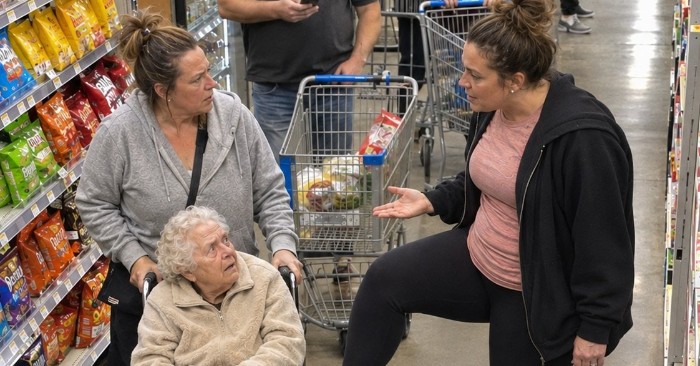
The woman had been following us through the department store for almost ten minutes.
At first, she’d muttered to herself that some people would do absolutely anything to receive special treatment.
Then she’d followed us all the way to the accessible checkout.
Finally, she loudly accused my mother of pretending she couldn’t walk.
Mom ignored her.
That apparently made the woman even angrier.
“You’re not fooling anyone!” she snapped.
When my mother still didn’t respond, the stranger suddenly stepped forward and kicked her wheelchair so hard that its front wheels briefly lifted off the floor.
For one terrifying second, I thought Mom was going to fall out.
But she grabbed the armrests and managed to steady herself.
The woman pointed at her triumphantly.
“See? She can move perfectly well when she wants to!”
I immediately stepped between them.
“Touch her again, and you’re going to be in serious trouble!”
The woman folded her arms.
“Then stop pretending she needs special treatment.”
My mother was eighty years old.
She hadn’t been able to walk for six years.
And we’d come to that department store for one perfectly innocent reason.
My daughter Mia was turning twelve.
Mom wanted to choose her birthday present herself.
That was all.
I’d already tried steering her toward three different merchandise displays.
Each time, she’d reminded me that she was perfectly capable of deciding where she wanted to go.
Now it seemed as though half the department store was watching us.
“Ma’am,” a security guard said as he approached, “please lower your voice.”
“Tell her to stand up!” the stranger demanded. “Then you’ll see!”
My hands were trembling with anger.
Mom’s hands remained completely steady.
She slipped two fingers into the pocket of her cardigan.
Then she pulled out a worn brown leather case.
“Perhaps this will clear things up,” she said.
I recognized the case.
It was where she kept her medical information.
Emergency contacts.
And various identification cards she occasionally needed when traveling.
Now she opened it with the same calm hands she’d once used to braid Mia’s hair.
As she did, a small folded piece of paper slipped out from behind a plastic card.
Its edges had already turned yellow.
It fell directly beside my shoe.
I bent down to pick it up.
On the front, beneath a faded drawing of musical notes, were the words:
“SPRING CONCERT”
Six years ago.
My breath caught.
I recognized the school emblem.
And the crooked purple circle around one particular name.
Mia.
She’d been six years old when she’d circled her name.
Three days before the concert, Mia had brought the program booklet to Grandma.
Mom had promised to take good care of it.
I hadn’t known she still had it.
Or that she carried it everywhere.
I turned the paper over.
There was something written on the back in Mom’s handwriting.
Small, careful letters.
Then I read the first three words.
My stomach tightened.
But before I could read any further, someone suddenly grabbed the back of my sweater so violently that I nearly fell against Mom’s wheelchair.
I spun around.
The strange woman behind us had turned deathly pale.
Her shopping basket slipped from her hands.
A glass jar fell to the floor and shattered.
But she was no longer looking at my mother.
Her gaze was fixed on the entrance.
“Oh my God,” she whispered.
Then her knees gave way.
As she collapsed, she raised a trembling hand and pointed toward a man standing near the entrance doors.
The security guard caught her just before her head struck the floor.
I followed the direction of her finger.
The man was wearing a loose gray shirt.
For a brief moment, something dark and angular was visible beneath the fabric near his hip.
A concealed weapon.
The security guard had noticed it too.
His expression changed instantly.
He reached for the radio on his shoulder and spoke so quietly into it that I couldn’t make out a single word.
The man near the entrance looked toward the checkout counters.
I folded the concert program without reading any further and slipped it into my pocket.
The security guard spoke into his radio again.
A brief crackle answered him.
Then an announcement came through the ceiling speakers.
“Attention, all employees! Lock the entrance doors immediately!”
The man at the entrance raised his head.
For a moment, nobody moved.
Then a woman screamed.
The man in the gray shirt reached beneath his clothing.
“Get down!” someone shouted.
People threw themselves behind sales counters.
A rack filled with scarves toppled over.
Mom’s wheelchair stood completely exposed in the middle of the aisle.
I immediately grabbed the push handles.
“Mom, we have to get out of here!”
“I can move myself.”
“Please. Not now.”
I pushed her toward a narrow passageway between the merchandise displays.
The woman who’d accused Mom earlier shoved her way past a cashier.
“Get out of my way!”
She tried to squeeze past the wheelchair.
I stepped into her path.
“There’s room on the other side.”
She glared at me furiously before finally hurrying away.
Mom reached one arm backward and touched my wrist.
“Slow down.”
But I didn’t slow down.
I couldn’t.
Six years earlier, I’d watched an ambulance take my mother away.
I’d stood beside the completely wrecked car.
I’d watched the paramedics lift her onto a stretcher without being able to do anything to help her.
I never wanted to stand there feeling that helpless again.
Ahead of us, a green emergency exit sign glowed above a corridor.
I headed straight for it.
“Not that way,” Mom said.
But I kept pushing.
“Please, Mom. We’re almost outside.”
The corridor led back toward the front of the department store.
I saw glass doors.
A security shutter that was being lowered.
Then the man in the gray shirt moved across the entrance area.
His hand was still beneath his shirt.
We were heading directly toward him.
“Stop,” Mom said.
I tried to turn the wheelchair sharply around a display table.
But one of its wheels struck a metal table leg.
The wheelchair jolted violently.
Mom gasped in alarm.
For half a second, I froze.
Then I pulled the wheelchair backward.
“YOU’RE NOT LISTENING TO ME!”
Mom’s voice wasn’t particularly loud.
But it didn’t need to be.
My fingers tightened around the rubber push handles.
For a brief moment, the department store disappeared around me.
Instead, I heard another voice.
My own.
From six years earlier.
Back then, I’d repeatedly begged Mom to change her mind.
I swallowed hard.
“Okay, Mom. Which way should we go?”
She pointed across the aisle.
“Over there. That employee is opening a staff passageway. Look!”
A young cashier stood beside a narrow door, waving people through in small groups.
An emergency exit sign glowed behind her.
From where the armed man was standing, he couldn’t see the passageway.
I released the push handles.
Mom began moving the wheels of her wheelchair herself.
“Stay beside me,” she said.
Not behind me.
Beside me.
Together, we headed toward the cashier.
I desperately wanted to take control of the wheelchair again.
Every part of me wanted to.
But Mom knew exactly where she was going.
At the doorway, several stacked boxes narrowed the passage.
She maneuvered her wheelchair skillfully between them without touching either wall.
I followed her.
For the first time that day, I wasn’t deciding where my mother should go.
I was trusting her.
Another security guard stood at the end of the hallway.
“Keep moving,” he said. “The emergency exit is open.”
Behind us, there was a loud crash.
Then we heard screams.
I flinched.
Mom continued moving steadily forward.
The cashier held the door open while we went down a short ramp into the loading yard.
Outside, employees were guiding customers behind a concrete wall, as far away from the building as possible.
Someone called an ambulance for the woman who’d fainted earlier.
Mom stopped beside a loading dock.
“Are you hurt?” I asked immediately.
“No.”
“What about your shoulder? When the wheelchair hit that table?”
“I’m fine.”
I crouched in front of her.
“Are you sure?”
Mom studied me for a long time.
“Sweetheart, I’m frightened. But that doesn’t mean I’m fragile.”
I lowered my eyes.
A police siren sounded nearby.
Then another.
An officer instructed us to remain behind the concrete wall while emergency responders secured the entrance area.
We waited.
I kept checking Mom’s expression.
And she kept watching mine.
Eventually, she took my hand.
It was warm.
Alive.
I held it far too tightly.
Mom gently squeezed my fingers.
“You’re hurting me, darling.”
I immediately loosened my grip.
“Sorry.”
“I know.”
We sat there while police officers moved around the building.
Finally, an officer approached our group.
“The man has been arrested,” he explained. “You’re safe here now.”
I looked at Mom.
Only then did I realize I was crying.
She wiped a tear from my cheek.
“You always do that,” she said quietly.
“Do what?”
“You keep looking at me as though I might disappear at any moment.”
I tried to laugh.
But it sounded more like a sob.
Mom’s gaze fell on my pocket.
“You picked up my paper.”
I touched the folded concert program through the fabric.
“Yes.”
“Thank you. I thought I’d lost it.”
“Mom, why do you still have that?”
She looked surprised.
“Because Mia gave it to me.”
“That was six years ago.”
“I know.”
The words she’d written on the back were still waiting to be read.
I looked at her.
“May I read it?”
Mom hesitated.
Then she nodded.
I carefully unfolded the program.
The purple circle around Mia’s name had faded over time.
On the back, beneath a date from Mom’s hospital stay, were five lines.
“That day, I couldn’t hear her sing.”
“For a while, all I could think about was everything I’d lost.”
“Then she came to visit me and sang the entire song beside my hospital bed.”
“I almost missed a whole lifetime of moments like that.”
“I’m so grateful I’m still here.”
The words blurred before my eyes.
Suddenly, I remembered Mia standing beside the hospital bed in her yellow school dress.
She’d been afraid to touch her grandmother’s bandaged hand.
So she’d sung instead.
Very quietly at first.
Then louder and louder as Mom began to smile.
I’d been standing near the door back then.
But I’d forgotten that smile.
For six years, whenever I thought about that day, all I could picture was the wrecked car at the intersection.
A hospital hallway.
A wheelchair.
All the things Mom could no longer do.
I never thought about what she still had.
Or what she’d been carrying with her all these years.
“Did you write this in the hospital?”
Mom nodded.
“After Mia visited me.”
“Why do you keep it in your medical information case?”
She ran her thumb across the worn leather.
“Because I was afraid I might forget someday.”
“Forget what?”
“That losing something doesn’t mean you’ve lost everything.”
My throat tightened.
I stared at the concert program.
Six years.
For six years, I’d checked every doorway.
Every curb.
Every stranger’s hand that reached toward her wheelchair.
And throughout all that time, Mom had carried this little piece of paper with her.
Not as a reminder of what I’d done to her.
But as a reminder of what she still loved.
“Mom,” I said.
She looked up.
“There’s something I need to tell you.”
She waited.
I could have stopped right there.
Just as I’d done countless times before.
On evenings when Mom called to tell me she’d made herself some tea and was going to bed.
But the paper trembled in my hands.
“That morning,” I began. “The day of the concert.”
Her expression softened.
“What about it?”
“You told me you didn’t want to go.”
“I had a headache.”
“And you’d barely slept.”
“That’s true.”
I pressed my lips together.
“You called me and said you’d rather stay home. But I kept trying to talk you into going.”
Mom watched me.
“I said Mia would be terribly disappointed.”
“She was very excited about the concert.”
“I insisted it was only a short drive.”
My voice broke on the last word.
“You told me you were tired. And I still wouldn’t let it go.”
Mom’s smile disappeared.
“I remember you asking me to come.”
“I didn’t just ask.”
I could barely breathe.
“I made you feel guilty until you finally said yes. And then you got into your car.”
I waited for Mom to say something.
But she remained silent.
“The other driver ran the red light,” I whispered. “But if I’d just let you stay home, you never would have been at that intersection.”
I covered my mouth with my hand.
“I think about it every single day.”
Mom’s eyes filled with tears.
“Every day?”
I nodded.
“For six years.”
She stared at me as though I’d just confessed to carrying a heavy stone inside my chest for years.
And in a way, that was exactly what I’d been doing.
“Oh, sweetheart,” she said.
I shook my head.
“Please don’t tell me it doesn’t matter. Because it does.”
“Of course it matters.”
She took my hand.
“What happened that day changed my life.”
Those words hurt.
But she continued.
“However, you weren’t the one who drove through that red light.”
“I pressured you to leave.”
“You wanted your mother to hear her granddaughter sing.”
“You’d said no.”
“And then I said yes.”
I looked at her.
Mom held my gaze.
“I was tired. And I was sad about missing the concert. But I changed my mind because I love that little girl. You didn’t take away my ability to decide for myself.”
“But you lost so much.”
“Yes.”
She didn’t try to make it sound better than it was.
“I miss being able to simply walk out into my garden. I miss dancing in the kitchen. And some mornings, I miss being able to stand up without having to think about it.”
Tears ran down her cheeks.
“I’m allowed to miss those things.”
“I know.”
“And I’m still allowed to love the life I have today.”
I couldn’t answer.
Mom tapped the concert program.
“That little girl came to my hospital bed and sang every single verse. She was trembling so badly. She thought that if she got every note right, it would make me well again.”
Mom laughed through her tears.
“But I couldn’t have cared less about the notes.”
I remembered Mia’s yellow dress.
Her tiny hands clasped together in front of her.
And Mom’s smile.
The smile I’d forgotten for all those years.
“Back then, I thought I’d lost everything,” Mom whispered. “And then Mia started singing.”
I lowered my head.
For six years, I’d treated every ordinary risk as though it might mean failing my mother all over again.
I’d called it love.
Perhaps part of it really was love.
But another part was fear.
“When you grabbed my wheelchair in the department store earlier, I knew you were frightened,” Mom said.
“I almost pushed you straight toward an armed man.”
“Yes.”
“I’m sorry.”
“I know you were trying to help.”
She paused.
“But sometimes you need to ask me first.”
I looked at her hands resting calmly on the wheels of her wheelchair.
The same hands that had once taught me how to tie my shoes.
That had held Mia when she was a baby.
And that had opened the leather case earlier without trembling while a stranger screamed at her.
“When you told me I wasn’t listening, it reminded me of that morning,” I said.
“I did the same thing again.”
Mom squeezed my hand.
“I keep thinking I can somehow prevent anything terrible from ever happening to you again,” I admitted.
“You can’t promise me that.”
“I know.”
“And I can’t promise you that either.”
She squeezed my hand again.
“But we can stop being afraid of every ordinary day.”
After the police secured the building, the department store doors were reopened under supervision.
A store manager began accompanying customers back inside to collect the purchases they’d left behind.
Suddenly, I heard a familiar voice.
“This is ridiculous! I haven’t done anything wrong!”
It was the woman from the checkout line.
She was standing near the entrance, arguing with the security guard.
When she spotted Mom, she immediately pointed at her.
“There she is! Ask her!”
The store manager stepped between them.
“We’ve reviewed the footage from our security cameras,” he explained calmly. “You kicked this lady’s wheelchair.”
“Because she was only pretending!”
“That’s enough,” the manager interrupted firmly. “You are banned from this store effective immediately.”
The woman opened her mouth again.
But the security guard was already escorting her away.
I turned toward Mom.
“Do you want to press charges?”
Mom watched the woman disappear.
“Maybe. But right now, I’d rather buy my granddaughter’s birthday present.”
I let out a surprised laugh.
“After everything that’s happened today?”
“Especially after everything that’s happened today.”
I stood up and moved behind her wheelchair.
My hands automatically reached toward the push handles.
But then I stopped.
Mom noticed.
She waited.
“Would you like me to push you?” I asked.
“Not yet.”
She began moving her wheelchair herself.
“There’s a little music shop across the street. I’d like to look at something there.”
I walked beside her.
We stopped at the pedestrian crossing and waited for the light to turn green.
I watched the traffic.
Mom did the same.
When the signal changed, she moved forward first.
And I stayed beside her.
In my pocket was the folded concert program.
Six years earlier, Mia had circled her name with a purple pen because she wanted Grandma to find her more easily on the crowded stage.
Grandma had never made it to that stage.
But Mia had found her anyway.
In a hospital room.
And that day, for the first time in six years, I remembered her singing before I remembered the accident.