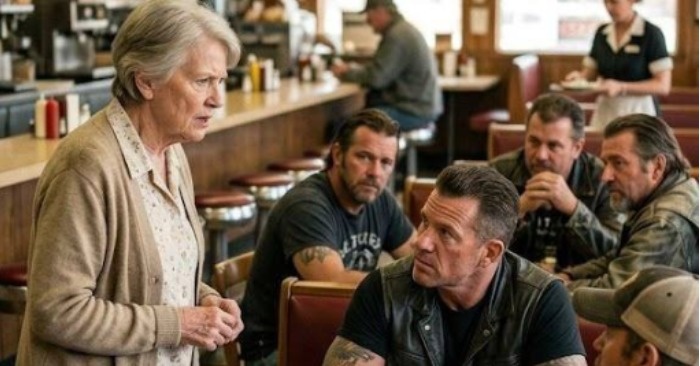
Most of the diner’s patrons that afternoon made a conscious effort not to look toward the booth at the back of the room.
Some kept their eyes fixed on their coffee cups. Others suddenly found their phones far more interesting than usual. A mother by the window gently drew her little boy closer, probably without even realizing it herself.
The reason was obvious.
Six large bikers were sitting in the diner’s longest booth.
Leather vests. Heavy boots. Faces marked by thousands of miles on the road and years of harsh weather.
The low rumble of their motorcycles had rolled across the parking lot just minutes earlier, making the diner’s windows vibrate and announcing their arrival long before the door had even opened.
Most people assumed men like them always brought trouble with them.
But one person in the diner was watching them very carefully.
Her name was Margaret Callahan.
She was ninety-four years old.
And her hands were shaking.
A woman who rarely knew fear
Margaret sat alone at a small table in the corner, near the wall.
Her white hair was neatly pinned into a soft bun. A light blue cardigan lay neatly over her floral blouse, and a small silver brooch caught the light at her collar.
A half-eaten piece of apple pie sat untouched in front of her.
For several minutes her gaze had been fixed on the group of bikers.
Her fingers trembled around the warm ceramic mug she held.
But the shaking had nothing to do with her age.
Margaret Callahan had spent her entire life proving that she was stronger than people thought.
She had raised three children while working full-time at the public library in Franklin, Kentucky.
When her husband Robert lost his sight in the early 1960s, Margaret quietly learned to drive long distances herself, so she could take him to medical appointments across the state.
When Robert died seven years ago, she handled all practical matters completely on her own.
Not because she had no choice.
But because she believed her children should be spared the burden of the last heavy responsibilities.
Margaret Callahan had once fixed a burst water pipe at three in the morning because the plumber couldn’t come until the next day.
She was not easily intimidated.
Which meant that the fear in her hands that afternoon was real.
And it mattered.
The Table Everyone Avoided
The bikers in the booth spoke loudly, but not angrily.
They laughed freely, their voices rough but relaxed.
The largest of them sat closest to the aisle.
He was a broad-shouldered man in his early fifties, with a streaked gray beard and alert eyes that missed very little.
His name was Grant Mercer.
Among the other riders, he was simply called Bear.
Bear had spent most of his life on the open road.
He had crossed highways in Texas, Colorado, Arizona, and the long, empty stretches in between.
Men like him had seen both the best and the worst in people.
He almost immediately noticed that Margaret was watching them.
But he said nothing.
Not yet.
The Choice That Changed Everything
Margaret slowly set her mug down.
She drew a calm breath.
Then she did something that made nearly everyone in the diner stop in their tracks.
She stood up.
Her steps across the floor were slow but sure.
Each soft click of her shoes against the tiles sounded louder than the last.
Conversations died out.
Forks froze mid-air.
Even the waitress behind the counter looked up.
Margaret walked straight to the bikers’ table.
When she reached it, she lightly placed one hand on the edge of the booth for support.
Grant Mercer looked up at her.
Their eyes met.
For a brief moment, neither said a word.
Then Margaret asked a question no one in the diner would ever forget.
“Would you be willing to pretend that one of you is my son today?”
The entire room went silent.
A question no one had expected
Grant Mercer studied the elderly woman for a few calm seconds.
Over his years on the road, he had heard his share of strange requests.
But this one was different.
He leaned back slightly in his seat.
“Ma’am,” he said gently, “are you in trouble?”
Margaret shook her head once.
“Not yet,” she replied quietly.
Then she added words that carried far more weight than their soft tone suggested.
“But I will be in about twenty minutes.”
The other bikers exchanged quick glances.
A younger rider with sandy hair leaned forward.
“What happens in twenty minutes?” he asked.
Margaret hesitated.
Then she told them the truth.
The Man With the Papers
Margaret explained that someone would be coming to the diner that afternoon.
Her nephew.
His name was Victor Langley.
Recently, he had started visiting her more often after many years of distance.
At first, his attention seemed caring.
He brought groceries.
He offered to drive her to appointments.
He spoke of helping her manage her finances.
But slowly, his questions began to change in nature.
He asked about the value of her house.
He asked about her savings.
He asked what plans she had for the future.
And now he was coming with paperwork.
Documents he claimed were meant to “protect” her.
But Margaret understood something few others did.
She had worked as a librarian for thirty-four years.
She knew how to read thoroughly.
And she knew when someone was hiding the truth behind complicated phrasing.
Those papers would give him control over her house.
And everything she owned.
The Waitress Who Knew
Behind the diner counter stood a waitress named Danielle Foster.
She had worked at Meadowbrook Diner for more than ten years.
She knew many of the regulars by name.
Margaret Callahan was one of them.
Danielle also knew something the bikers didn’t yet.
Three days earlier, she had overheard a phone call.
Margaret had been sitting in the same window booth when her nephew called.
Danielle had been wiping a nearby table when she heard Victor’s voice over the speaker.
His tone had been confident.
Almost smug.
He had been speaking with another person in the room with him.
And what Danielle heard made her stomach turn.
“As soon as she signs the papers, the house will legally be under my control.”
Danielle froze.
It was not a misunderstanding.
It was a plan.
And it was set to unfold that afternoon.
A Table That Became Family
Grant Mercer listened to Margaret’s story without interrupting.
When she finished, he sat quietly for a moment.
Then he shifted slightly and made room beside him in the booth.
“Sit down, ma’am,” he said softly.
Margaret blinked in surprise.
“What?”
Grant smiled faintly.
“If I’m your son today,” he said, “you don’t need to stand.”
The other bikers immediately understood.
One of them waved the waitress over.
Another slid a milkshake toward Margaret.
A third began telling a story about a dog he had once rescued from a roadside shelter.
Within minutes, the table felt like a large family gathering.
Laughter.
Conversation.
A warm and effortless atmosphere.
Margaret felt something she hadn’t experienced in a long time.
Safety.
The Arrival
Exactly eighteen minutes later, the diner door opened.
Victor Langley stepped inside.
He was in his early forties.
His shirt was neatly pressed.
A leather folder rested under his arm.
He carried himself with the confidence only someone has when they believe everything is already decided.
But when his eyes fell on Margaret’s table, he froze.
Six bikers.
Margaret sat calmly among them.
A milkshake in front of her.
And Grant Mercer had his arm resting casually along the back of her booth.
Victor forced a smile.
“Aunt Margaret,” he said cautiously, “I didn’t know you had company.”
Margaret smiled back.
“Just family,” she replied.
Then she gently patted Grant on the arm.
“Victor, this is my son Grant.”
The word “son” hung in the air.
Grant reached out his hand.
Victor hesitated before taking it.
Grant’s grip was firm.
Very firm.
“Nice to meet you,” Grant said calmly. “Mom has told us a lot about you.”
A Plan That Fell Apart
Victor placed the folder on the table.
“I just need a few minutes with Aunt Margaret to go over some documents,” he said.
Grant leaned slightly forward.
“What kind of documents?”
Victor’s smile tightened.
“Family matters.”
A biker on the other side of the table chuckled softly.
“Looks like the family’s already here.”
The others said nothing.
But their presence spoke louder than words ever could.
Calm.
Steady.
Unshakable.
At that moment, Victor realized something.
What he had planned for that afternoon would no longer unfold the way he had imagined.
He closed the folder.
Slowly.
“Perhaps we can discuss this another time,” he said.
Then he stood up.
And walked out of the diner.
A Quiet Victory
Margaret sat completely still for a moment after the door closed behind him.
Then she let out a long exhale she hadn’t even realized she had been holding back.
Grant lifted his coffee mug slightly.
“Looks like your son arrived just in time.”
Margaret laughed softly.
A warm, genuine laugh.
And for the first time in weeks, she began to feel the weight on her shoulders lighten.
Ten Thoughts Worth Remembering
Sometimes those who appear toughest on the outside understand kindness the deepest.
The world often judges by appearances, but true character reveals itself when a vulnerable person needs help.
Courage doesn’t always look like grand speeches or dramatic actions; sometimes it’s just an elderly woman standing up and asking for help.
There are moments in life when strangers become the family we truly need.
Kindness often shows up in the most unexpected places and from the most unexpected people.
Standing beside someone who cannot stand alone is one of the quietest yet strongest acts a person can offer.
A community’s strength becomes visible when ordinary people choose to protect one another instead of looking away.
Even in the hardest moments, a single supportive act can restore a person’s sense of safety and dignity.
The smallest signs of solidarity can completely change the course of another person’s life.
And perhaps most importantly, the world becomes better every time someone chooses compassion over indifference.