The little girl stood barefoot behind the roses.
She could not have been older than eight.
Her hair was tangled.
Her knees were dirty.
And she was wearing a red coat far too large for her.
Clara made a sound I had never heard from her before.
Not a scream.
Not a word.
Something broken between the two.
She rushed down the steps.
“Lily?”
The girl ran into her arms.
Clara dropped to her knees among the flowers and held her so tightly that several bouquets fell against them.
I could not move.
The child had called my wife “Mom.”
Clara had never told me she had a daughter.
I looked again at the drawing in my hand.
The woman had Clara’s dark hair.
The child wore a red coat.
And the man’s face had been scratched away so violently that the paper was torn.
“Daniel,” Clara said without looking at me, “please go inside.”
I stared at her.
“Who is she?”
Lily buried her face against Clara’s shoulder.
Clara closed her eyes.
“She’s my daughter.”
The words struck harder than any accusation could have.
For nine years, I had shared a home with this woman.
I knew how she took her coffee.
I knew which songs made her cry.
I knew she slept with one foot outside the blanket.
But I had not known she had a child.
“You told me you had never been married.”
“I wasn’t.”
“You told me you had no children.”
“I know.”
The hurt in her voice did not soften mine.
“You lied to me.”
Lily flinched.
Clara immediately pulled her closer.
“Not here,” she whispered. “Please.”
We carried the flowers aside and brought the girl into the house.
The power had not failed.
Someone had switched off the main breaker outside.
That realization changed the air.
I locked the doors.
Clara pulled every curtain shut.
Lily sat at our kitchen table with both hands wrapped around a glass of water.
She kept looking toward the hallway.
As though she expected someone to appear.
I placed the drawing in front of Clara.
“What promise?”
She stared at the words beneath it.
Thank you for keeping your promise. He found us again.
“I don’t know who sent the flowers,” she said.
“But you know what the message means.”
Her hands began to shake.
Before she could answer, Lily whispered, “Mrs. Hall sent them.”
Clara turned sharply.
“Your foster mother?”
Lily nodded.
“She said people would notice that many flowers.”
I felt my anger shift into something colder.
“They were not a romantic gift,” I said.
Lily shook her head.
“They were a signal.”
Clara covered her face.
For months, I had noticed her changing.
She stopped answering unknown calls.
She checked the locks twice every night.
She cried when she thought I was asleep.
I had assumed she was tired.
Then I had assumed she was hiding an affair.
I had never imagined she was afraid.
Clara finally looked at me.
“When I was nineteen, I dated a man named Evan.”
Her voice was thin.
“At first, he was charming. Then he started deciding who I could speak to, where I could go, and what I was allowed to wear.”
She glanced at Lily.
“When I became pregnant, he became worse.”
Lily stared at the table.
Clara continued carefully.
“One night, he nearly pushed me down a staircase. I left while he was asleep.”
She had no money.
No family willing to help.
No safe place that Evan did not know about.
She gave birth under another surname.
For nearly a year, she moved from shelter to shelter with Lily.
But Evan kept finding them.
“He never wanted to raise her,” Clara said. “He wanted control. Lily was the chain he could use to pull me back.”
When Lily was two, Clara was offered protection through a private network run by volunteers and former social workers.
They placed Lily with Margaret Hall, a woman in another state whose name had never appeared in Clara’s records.
Clara was told to disappear.
No calls.
No visits.
No photographs.
Nothing that could connect them.
In exchange, Lily would remain safe until Evan was gone or imprisoned.
“You abandoned her?” I asked.
Clara looked as though I had cut her open.
“I saved her.”
Lily reached across the table and took her hand.
“She wrote me letters,” the girl said.
Clara stared at her.
“You received them?”
“Mrs. Hall kept them in a box. She said I could read them when I was older.”
Clara began crying.
Not loudly.
Just silently, as though nine years of grief were finally leaking through.
“I wrote every month,” she whispered. “I never knew if you saw them.”
Lily reached into her coat and pulled out a small bundle tied with the same faded blue ribbon.
Clara recognized it immediately.
Her letters.
All of them worn soft at the folds.
That was when someone knocked on the front door.
Three slow knocks.
Then silence.
Lily slid beneath the table.
Clara froze.
I stood.
“Daniel, don’t.”
The porch camera showed a man wearing a delivery uniform.
His cap was low over his face.
He held one final bouquet.
White roses.
Clara looked at the screen.
Her knees almost gave way.
“That’s him.”
I called the police.
The man at the door knocked again.
“Flower delivery,” he called.
I said nothing.
He leaned closer to the door.
Then his voice changed.
“Clara, I know she’s inside.”
Lily began crying under the table.
Clara crouched beside her.
“You stay with me,” she whispered. “You hear me? I’m not leaving again.”
The doorknob moved.
Once.
Twice.
Then stopped.
Through the camera, we watched Evan slowly place the white roses on the porch.
He looked directly into the lens.
“You promised she would come home when she turned ten,” he said.
Clara shook her head.
“I never promised him anything.”
But Lily looked confused.
“He showed Mrs. Hall a letter.”
“What letter?”
“He said you wrote it.”
Clara went still.
Evan stepped away from the door just as police lights appeared at the end of the street.
He ran toward the backyard.
Officers caught him near the fence.
But the confrontation did not end there.
Inside his car, police found photographs of our house.
Copies of my travel schedule.
Pictures of Lily outside school.
And a letter carrying Clara’s signature.
The letter claimed Clara wanted Lily returned to Evan on her tenth birthday.
It looked real.
Even Clara admitted the signature was almost perfect.
But one detail exposed it.
The letter referred to Lily by her full legal name.
Clara had never used that name in any of her secret letters.
She had always called her “Bluebird.”
Only Evan used the legal name.
Margaret Hall arrived the following morning.
She was the one who had arranged the roses.
When she realized Evan had found Lily, she knew calling Clara directly might expose them.
She also knew a frightened child arriving alone could be overlooked.
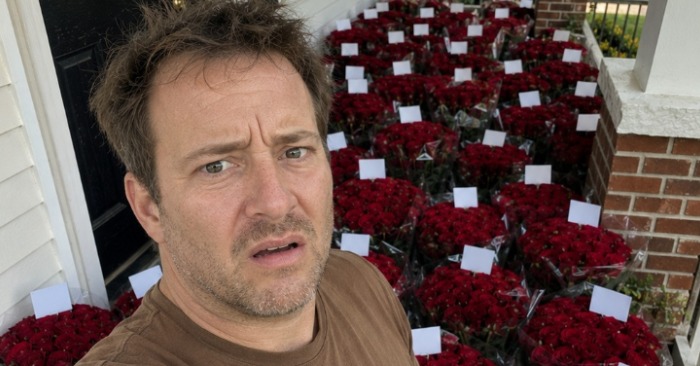
But one hundred bouquets on a quiet street would bring neighbors outside, cameras to windows, and witnesses to every movement.
The flowers were not romance.
They were protection.
Each bouquet had been purchased by a different teacher, parent, volunteer, or former shelter resident who knew Clara’s story.
Every person who sent one had been told the same thing:
Place it on the porch and remain nearby.
When Evan appeared, more than thirty people were watching from cars and neighboring houses.
He had walked into a trap built from flowers.
I should have felt relieved.
Instead, I felt ashamed.
Clara had stood among proof that an entire community believed her fear.
And I had looked at her and suspected betrayal.
That night, after Lily fell asleep in our guest room, Clara sat beside me on the porch.
Most of the roses were still there.
Petals had begun to fall across the wooden boards.
“I wanted to tell you,” she said.
“Why didn’t you?”
“Because once before, I trusted someone with the truth. Evan found us two days later.”
She looked toward Lily’s window.
“I started believing that love was safest when it knew as little as possible.”
I took a long breath.
“I thought the flowers meant you had chosen someone else.”
“In a way, they did.”
I looked at her.
She wiped her eyes.
“They meant I had chosen my daughter. Even when I had to do it from far away.”
Lily stayed with us while the court reviewed the emergency placement.
Nothing became perfect overnight.
She had nightmares.
She hid food beneath her pillow.
She asked Clara every morning whether she would still be there after breakfast.
And Clara answered the same way every time.
“Yes.”
Weeks later, the final bouquet on the porch had dried almost completely.
Lily chose one white rose and placed it inside a book.
“Why that one?” I asked.
She looked at Clara.
“Because white flowers were the ones he brought.”
Clara’s face tightened.
Lily gently closed the book.
“But now it belongs to us.”
The court eventually issued a permanent protection order.
Evan faced charges for stalking, forged documents, and violating prior restrictions.
Margaret remained part of Lily’s life.
She had been more than a foster mother.
She had been the person who kept a frightened child safe until her real mother could finally hold her again.
As for me, I learned something I wish I had understood before I stepped onto that porch.
Fear can make innocent things look guilty.
Silence can resemble betrayal.
And sometimes the person you believe is hiding love from you is actually hiding the wound that taught them love was dangerous.
The roses did not end our marriage.
They exposed the part of it that had never truly begun.
The part built on complete truth.
We had to start again.
Not as the husband who demanded answers.
Not as the wife who carried fear alone.
But as three people standing together in a house where no one would ever have to disappear to feel safe again.