If you looked at my life from a distance, you’d probably call it “resilient.”
If you lived inside it, you’d call it a long string of goodbyes.
Every morning I wake up at 4:30 in a house that sounds wrong when it’s quiet. Too much space for one person, too many memories in the corners. The third bedroom down the hall still smells faintly like strawberry shampoo and childhood.
I can’t open that door without feeling like someone pressed a heavy stone into my ribs.
My daughter’s sneakers are still by the bed, laces knotted the way she left them after school—like she might come running in at any minute, complaining she’s starving.
But Eliza isn’t coming back.
After the accident, my husband used to leave the hallway light on “just in case.” Then he stopped going near her room. Then he stopped talking much at all. Grief emptied us out until we became two strangers sharing the same air.
One afternoon he left a note on the kitchen table beside the salt shaker and half a grocery list.
The divorce papers were underneath it.
Signed.
So yes—my child was gone. My marriage was gone.
And the last thing still tethered to me was my grandfather’s diner.
It wasn’t charming in the way food bloggers pretend diners are charming. It was small in the way that makes your knees complain when you slide into a booth. The vinyl seats hissed when you sat down, like they were exhaling.
The floorboards creaked in the same spots no amount of scrubbing could hide. The linoleum had a perfect circular burn mark because my grandfather once dropped an entire tray of fried chicken and then declared the floor had “always looked like that.”
And the coffee tasted like memory—dark, bitter, honest.
But it was mine.
Grandpa Henry opened the place back when the neighborhood smelled like fresh bread and motor oil, when people knew the names of the kids three houses down and yelled through windows for dinner.
He’d stand behind the counter in a stained apron and say, “Kiddo, we don’t just feed stomachs. We feed hearts.”
Then he’d slide a plate of pancakes across the counter like he was dealing winning cards.
When he died, I stood alone in the empty diner for a long time and made a decision that felt reckless and sacred all at once.
I bought it.
My best friend Susan watched me sign the papers and said, “You’re keeping your roots in the ground, Laura. That matters.”
It did—until it didn’t.
Then came the condos and chain cafés. Then came fifteen-dollar toast and rising rent and bills that didn’t care about family history. Eggs got expensive. Utilities got mean. Credit cards got close to maxed.
I skipped my own meals, scrubbed the kitchen myself, and sent staff home early because I couldn’t afford hours.
Eventually I did what people do when they’re drowning and tired of pretending: I called a realtor.
And for the first time, I wondered if love could keep a roof up.
That night, the cold felt personal—like it had followed me inside on purpose.
The diner was dead quiet. The bell above the door hadn’t chimed in hours. The neon OPEN sign buzzed in the window and threw a pale pink glow across the empty booths, like it was trying to convince itself we still had a chance.
Earlier that morning the realtor had come through for a “walkthrough.” He was younger than I expected, polished, watch shining, calling the place “a goldmine.”
“Developers love buildings with character,” he said.
Character. That was one word for it.
After he left, I practiced what I’d say when buyers came: offer coffee, smile, do not cry.
Then, late that night, the bell finally rang.
My heart jumped so hard it actually hurt.
I lifted my head, expecting someone with a clipboard.
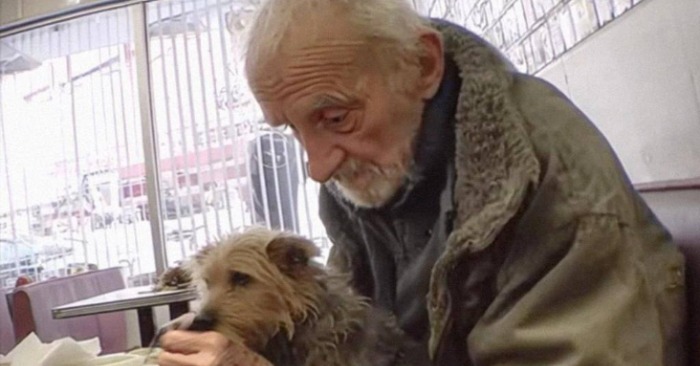
Instead, an elderly man stood in the doorway. He looked like he was bracing himself for the room to reject him. His coat swallowed his frame. His sleeves were too long. And one pant leg was pinned up where the other should’ve been.
In one hand he held a cane. With the other, he steadied himself against the doorframe like he needed to gather courage just to cross the threshold.
At his feet waddled the tiniest dog I’d ever seen—scruffy, mismatched fur, ears too big for its head, like something stitched together from spare fabric and stubborn hope.
“Evening,” the man said softly. “What’s the cheapest thing on your menu?”
He didn’t say it like a question.
He said it like he was already doing the math and already losing.
And right then, I heard my grandfather’s voice in my head: We feed people, kiddo. Not wallets.
I stepped out from behind the counter and gave him a smile I had to borrow from an older version of myself.
“Sit down,” I said. “I’ll take care of you.”
His posture stiffened. “I’m not looking for charity.”
“It’s not charity,” I told him. “It’s company. It’s been a quiet night, and I could use someone at a table.”
He hesitated. Pride fighting need in his expression.
Then he nodded once.
“Thank you,” he murmured. “Me and Pickles just needed somewhere warm.”
In the kitchen, my body remembered how to move like I still believed food could fix something. I made meatloaf the way Grandpa taught me: more onions than sensible, a thin ketchup glaze baked just right. I mashed potatoes by hand with real butter. Green beans sautéed with garlic.
And I made a tiny plate for Pickles, too—just a few bites, nothing fancy, but enough to make a dog’s whole night.
When I brought the food out, I set the plate down in front of him and crouched to place the little saucer on the floor.
Pickles stared at me like I’d performed magic.
The man’s voice cracked. “For me?”
“For you,” I said. “And that’s for him.”
Pickles cleaned the plate like it was the best thing the world had ever offered.
Maybe it was.
The man didn’t talk much, but he listened in a way most people don’t. He asked gentle questions.
“How long you been here?”
“Do you cook everything yourself?”
“Do you live close?”
And somehow, those simple questions opened something in me that had been sealed shut for years.
I found myself telling him things I hadn’t said out loud. About Eliza. About the day I learned she was gone. About my husband leaving in the quietest way possible—papers, a note, a hollow space where a life used to be.
He didn’t interrupt. Didn’t try to fix me. Didn’t offer hollow optimism.
He just nodded and said, “That must have been unbearable,” or “I’m sorry you’ve had to carry all that alone.”
When he finished eating, he reached into his coat and pulled out a few wrinkled bills.
I shook my head before he could place them down.
“No,” I said. “You paid me already.”
He looked up, confused.
“You reminded me I’m still alive,” I told him. “That’s worth more than money.”
His eyes shone, but he didn’t let the tears fall.
“Thank you,” he whispered. “For the meal… for letting Pickles inside… and for noticing me.”
Then he turned, called Pickles, and stepped back into the cold.
The bell rang once behind them.
I thought that was the end of it.
That night, locking up felt heavier than usual. The key scraped in the lock like it didn’t want to turn. I stood outside for a moment, breath fogging the air, staring at the diner like it was a friend I was about to betray.
At home, I didn’t turn on the lights. I knew the layout by grief alone.
I showered until the water went cold, then slid down to the bathroom tile and cried the kind of crying that empties you.
Later, I crawled into my daughter’s bed on top of the blanket and whispered, “Please. Just give me one good thing.”
The next morning, the sky was still undecided—gray, heavy, the streets quiet.
My boots echoed as I walked toward the diner.
I reached for my keys—then stopped.
A white envelope was taped to the front window. Corners curled slightly from the weather.
My name was written on it.
Laura.
On the back, in shaky handwriting, were two words:
From Henry.
My chest seized.
Henry was my grandfather’s name.
Hands trembling, I peeled the envelope off the glass and stepped inside. The heat wasn’t on yet. The air was sharp and cold.
I slid into the booth by the window—the one Grandpa used to sit in when he’d let me drink hot chocolate from a chipped mug twice the size of my hands.
I opened the envelope.
Inside was a ten-dollar bill.
And a letter.
Dear Laura,
I hope you don’t mind me writing. My name is Henry…
I hadn’t even asked him his name last night.
Reading it now felt like realizing I’d been handed a piece of something sacred without noticing.
He wrote about losing his leg in a factory accident. About losing his wife to cancer. About losing his son to addiction. About the slow loneliness that eats at you until you start believing you’ve become invisible.
Then he wrote this:
You reminded me I still matter. Not as a burden—just as a person.
Please don’t stop being the kind of woman who feeds more than food.
Last night you filled two plates. You also filled something in me that had been empty for a long time.
I held that paper against my chest until my breathing steadied.
Then I stood up and taped the letter right next to the register.
When the realtor called later to talk about “next steps,” I answered.
“I’m not ready,” I said. “I’m staying.”
My voice surprised me. It sounded like someone who still had a future.
“I’ll figure it out,” I added. “I’ll sell my wedding jewelry if I have to. But I’m staying.”
And for the first time in a long time, I believed myself.
Because sometimes you don’t get the miracle you begged for.
Sometimes you get a small sign taped to a door that says:
You’re still needed.