My fingers trembled as I opened the envelope.
Inside was an old school photo.
I recognized it instantly.
Our class picture.
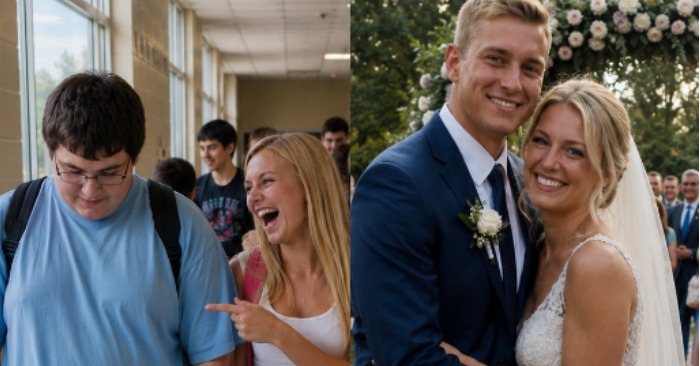
I was standing in the front row, smiling like I had never hurt anyone.
Adrian stood in the back.
Round face.
Braces.
Thick glasses.
Eyes lowered.
Like he already knew nobody wanted him there.
My throat closed.
Then I turned the photo over.
On the back, written in shaky handwriting, were the words:
“One day, someone will see me.”
I looked up at him.
“Adrian…”
He didn’t move.
His face was calm, but his eyes were full of something I couldn’t name.
Pain.
Anger.
Grief.
Maybe all of it.
“I wrote that the day you and your friends locked me in the equipment room,” he said quietly.
I covered my mouth.
I remembered.
Not clearly.
Not because I had forgotten it.
But because for years I had tried not to remember.
“We thought it was a joke,” I whispered.
He smiled without warmth.
“I missed my mother’s last hospital visit that day.”
The room spun.
“What?”
He looked toward the window.
“She was dying. My father had come to pick me up early. But nobody could find me.”
His voice cracked for the first time.
“By the time they opened the door, it was too late.”
I couldn’t speak.
The silence between us felt heavier than the walls.
“I blamed you for years,” he said. “All of you.”
Tears ran down my face.
“I’m sorry.”
He looked at me then.
“Do you know how many times I imagined hearing you say that?”
I nodded, ashamed.
“I deserve whatever this is.”
Adrian took another paper from the envelope.
Not divorce papers.
Not some cruel contract.
A letter.
Addressed to me.
“You wrote this?” I asked.
He shook his head.
“My mother did.”
My hands froze.
“She wrote letters before she died,” he said. “One for me. One for my father. And one for the person I hated most.”
I unfolded it slowly.
The handwriting was soft and uneven.
Dear girl who hurt my son,
I do not know your name. But I know you are young.
I know young people can be cruel when they are afraid of standing alone.
But cruelty does not disappear just because the bell rings and everyone goes home.
My tears fell onto the page.
If this letter ever reaches you, I hope my son has not become what hurt him.
I hope he learns that revenge keeps the wound alive.
And I hope you learn that one apology, when it is real, can save more than one person.
I lowered the letter.
Adrian’s eyes were wet now.
“I married you because I wanted you to feel trapped,” he admitted.
“I wanted you to stand where I stood.”
I swallowed.
“And now?”
He looked at the wedding ring on his hand.
“Then I fell in love with you.”
The words broke something in both of us.
“I hated myself for it,” he whispered. “Because every time you laughed, I remembered the girl who laughed at me.”
I stepped closer, but he stepped back.
“No,” he said. “Don’t touch me yet.”
I nodded.
“I won’t.”
He looked exhausted.
“I don’t know if I can be your husband.”
“I understand.”
“But I needed you to know the truth before we started living a lie.”
I wiped my face.
“Then let me tell the truth too.”
The next morning, I called my parents.
Then my old classmates.
Then the school.
Within a week, I wrote a public letter.
Not to defend myself.
Not to make people pity me.
To confess.
I named what we had done.
The jokes.
The humiliation.
The locked room.
The silence afterward.
Some people told me I was ruining my own life.
But Adrian read every word.
He said nothing.
For months, we lived separately.
Still married, but apart.
I went to therapy.
I visited his mother’s grave alone and left flowers.
Not because forgiveness was guaranteed.
But because remorse without action is just performance.
Then one evening, Adrian called.
“Can we talk?”
We met at a quiet café.
He looked different.
Lighter, somehow.
“I don’t know if I can forget,” he said.
“I’m not asking you to.”
“I don’t know if I can forgive everything.”
“You don’t have to.”
He looked at me for a long time.
“But I don’t want revenge anymore.”
My eyes filled with tears.
“That’s enough.”
Years later, we were not the perfect couple people imagined from our wedding photos.
We were complicated.
Bruised.
Careful.
But honest.
And slowly, honestly became safer than pretending.
Adrian once told me the cruelest thing people did to him was not the laughing.
It was making him feel invisible.
So I spent the rest of my life making sure he was seen.
Not as the boy I hurt.
Not as the man who wanted revenge.
But as the person he had always deserved to be.
Loved.
Heard.
And finally free.