I couldn’t move.
The metal box sat open in my lap.
Inside were envelopes.
Dozens of them.
Each one had a month written on it.
January.
February.
March.
Every month I had paid her.
Every month I had gone home with less money, less sleep, and more guilt.
But the strangest part was not the envelopes.
It was the photo.
Me at eight years old.
Standing beside my father.
My face serious.
Her hand resting gently on my shoulder.
On the back of the photo, someone had written:
“For when she finally learns the truth.”
I turned around slowly.
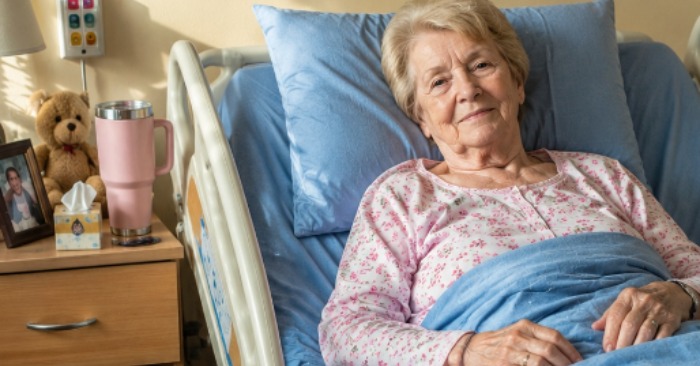
My stepmom stood in the bathroom doorway.
She looked smaller than I had ever seen her.
Not sick.
Not old.
Guilty.
“What is this?” I whispered.
She closed her eyes.
“I was going to tell you.”
“When?”
She didn’t answer.
I pulled one envelope open.
Cash.
Every dollar I had given her.
Untouched.
My throat tightened.
“You kept it?”
She nodded.
“All of it.”
“Why?”
Her hands began to shake.
“Because it was never for me.”
I stood up so quickly the box nearly slipped from my hands.
“You let me struggle for a year. I skipped meals. I worked weekends. I stopped going to the doctor because I couldn’t afford it.”
“I know.”
“No, you don’t know.”
My voice broke.
“You watched me hand you checks while pretending you needed them.”
Tears filled her eyes.
“I needed to know you were safe.”
“Safe from what?”
That was when she pointed to the bottom of the box.
Under the envelopes was a folded legal document.
My father’s name was on it.
I didn’t understand at first.
Then I saw mine.
A trust account.
A house deed.
A signature that had been crossed out.
My stomach turned.
“What is this?”
She sat down slowly, as if her legs had finally given up.
“Your mother left something for you before she died.”
The room went silent.
“My mother?”
She nodded.
“She knew your father was careless with money. So she left a small house and savings in your name. Not much, but enough to give you a start.”
I stared at her.
“I never got anything.”
“I know.”
Her voice cracked.
“Because your father took it.”
The words hit me like cold water.
“He forged papers. Sold the house. Spent almost everything.”
I shook my head.
“No.”
“I found out after he died.”
“Why didn’t you tell me?”
“Because I was ashamed.”
“You were ashamed?”
“I signed one document back then without reading it. He told me it was just family paperwork. I trusted him.”
Her tears fell harder now.
“And by the time I realized what he had done, your mother’s gift was gone.”
I looked down at the envelopes.
“So this was…”
“My way of giving it back.”
I wanted to be angry.
I was angry.
But underneath it was something worse.
Grief.
For my mother.
For the life I might have had.
For the lie that had sat quietly in our family for decades.
“You should have told me,” I said.
“I know.”
“You let me think you were using me.”
“I thought if I asked directly, you’d refuse.”
“I would have.”
She gave a sad smile.
“Exactly.”
The nurse knocked softly and entered with a folder.
“I’m sorry,” she said. “But she asked me to keep copies in case something happened.”
She handed me a second packet.
Inside was a notarized statement.
My stepmom had documented everything.
The stolen inheritance.
The money she had saved.
And one final note.
I unfolded it with trembling hands.
It was addressed to me.
You were never my stepdaughter in my heart. You were my child. I failed to protect what your mother left you, so I spent the rest of my life trying to protect you instead. Please don’t forgive me because I deserve it. Forgive me only if your heart ever feels ready.
I sat down on the edge of her bed.
For a long time, neither of us spoke.
Then she whispered:
“I didn’t spend your money.”
I looked at her.
“I saved it.”
The anger didn’t disappear.
Truth doesn’t heal that fast.
But something in me softened.
Because she had lied.
But not to take from me.
She had lied because she had spent years carrying guilt that was never fully hers.
A month later, the money went into an account under my name.
Not as forgiveness.
Not as a perfect ending.
As a beginning.
And every Sunday, I still visited her.
Some days we talked.
Some days we sat in silence.
But one afternoon, as I was leaving, she reached for my hand.
“Do you still call me Mom?”
I looked at her tired face.
The woman who had packed my lunches.
Held my fevered hand.
Sat through every school play.
And made one terrible, painful mistake trying to repair another.
I squeezed her hand.
“Yes,” I said quietly.
“But from now on, no more secrets.”
She cried then.
So did I.
Because sometimes betrayal is not the absence of love.
Sometimes it is love buried under fear, guilt, and silence.
But love only becomes healing when the truth is finally allowed into the room.