I didn’t stop that afternoon because I wanted to be a hero.
I stopped because an elderly woman was sitting on the asphalt beside a wrecked car, and something in me refused to keep driving.
Two days later, my phone rang—my mother screaming so loudly I thought someone had died—and I realized that one ordinary act of decency had set off a chain reaction I could never have predicted.
Three years ago, cancer took my wife.
She was the kind of person who made the future feel doable. We’d stay up late in the kitchen, planning the trips we’d take when our daughter, Nina, turned sixteen. We’d laugh at jokes only we understood. She made even hard days feel like they were leading somewhere.
When she died, it wasn’t just losing a partner. It was losing the framework of my life.
Grief didn’t arrive politely. It came in waves that knocked me flat—catching myself setting two plates on the table, reaching for my phone to send her something funny, remembering mid-text that there was nobody to send it to. Every corner of our house held a memory that felt precious and unbearable at the same time.
But one thing kept me upright:
Nina needed me.
She’d already lost her mother. I couldn’t let her lose me too—not to sadness, not to numbness, not to the quiet kind of disappearing.
So I made a decision that hardened into a rule: I would put every bit of strength I had left into being her parent.
No dating. No “moving on.” Not because I was bitter or afraid—because Nina was fourteen and navigating high school, hormones, and grief without her mom. She didn’t need me half-present. She needed me steady.
My drive home from work became my thinking time: dinner plans, homework questions, whether Nina’s “I’m fine” sounded real or rehearsed.
That Tuesday started like any other—until traffic abruptly slowed to a crawl.
At first I assumed construction or a fender-bender. Then I saw the silver sedan crumpled into the guardrail like it had been thrown there. Steam hissed from the hood. One headlight hung by wires, swaying slightly.
And beside it, on the shoulder, sat an older woman.
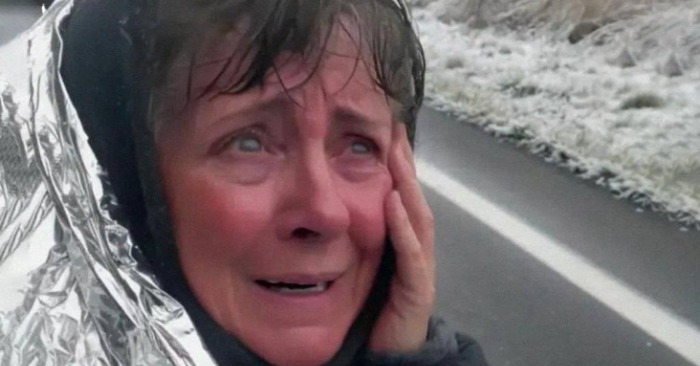
She wasn’t shouting. She wasn’t waving her arms. She was just… frozen. Gray hair plastered to her face. Hands trembling in her lap. Eyes wide with the empty, stunned look of someone whose body hasn’t caught up to what just happened.
Cars crept past, drivers glancing, then accelerating again. One after another. Like the scene was inconvenient.
Something hot flared in me—anger, maybe, or disbelief. Before I could overthink it, I pulled onto the shoulder and got out.
“Ma’am?” I approached slowly, palms open. “Are you hurt?”
Her gaze lifted in a slow, distant way, as if she were surfacing from deep water.
“The brakes,” she whispered. “They… they didn’t work. It happened so fast. I thought… I thought this was it.”
The way she said those last words—like she’d already accepted dying alone on the side of the road—hit me harder than the wreck itself.
I ran back to my trunk and grabbed the scratchy emergency blanket I keep for winter. When I draped it over her shoulders, I felt how violently she was shaking.
“You’re safe now,” I told her, crouching beside her. “Just breathe with me. In… and out.”
That was all it took.
She folded forward and began to sob—raw, tearing sounds that seemed to come from somewhere deeper than fear. I kept my hand on her shoulder and stayed exactly where I was, murmuring whatever I could think of that might sound like steadiness.
After a few minutes, she gulped a breath and managed, “I’m Ruth. I can’t believe you stopped. Nobody else did.”
“I’m Leo,” I said. “I’m calling an ambulance. You’re not alone.”
I dialed emergency services, gave our location, described her condition, and kept eye contact while I spoke—so she knew I wasn’t leaving her.
Those minutes waiting felt like an hour. Ruth kept apologizing for crying, then crying harder because she was apologizing.
When the ambulance finally arrived, the paramedics moved fast—vitals, questions, a stretcher.
As they lifted her, Ruth grabbed my forearm with surprising strength.
“I think you saved my life,” she said, voice thin. “I won’t forget you.”
“I’m just glad you’re still here,” I told her.
Then the doors shut and the siren pulled away, and I stood on the shoulder staring at the road for a long second, feeling hollow in a way I couldn’t name.
I went home, made dinner, helped Nina with algebra, tried to shake the day off.
And it would’ve stayed a strange, heavy moment—one more story you tell yourself before sleep—except two days later my phone rang while I was washing dishes.
Mom.
“Hey, Mom—”
“LEO!” she shrieked. “Turn on the news! Right now! I can’t believe you didn’t call me!”
My stomach dropped.
I grabbed the remote with wet hands and turned on the TV.
A news anchor was speaking gently to someone off-camera. Then the shot widened—
Ruth, sitting under studio lights, composed but emotional.
“It was the scariest moment of my life,” she was saying. “I was sure I was going to die there with dozens of cars passing by. Nobody stopped… until he did.”
My mother made a choked sound on the phone.
Then the station played shaky footage from a first responder’s body cam.
There I was—kneeling on the shoulder, the blanket wrapped around Ruth, my hand on her shoulder as I spoke to her.
The anchor said something like, “This man stayed with her the entire time and refused to leave until help arrived.”
Then Ruth looked straight into the camera.
“Leo,” she said, “if you’re seeing this—please come to the Oakridge Café. It’s my family’s place. I want to thank you properly.”
My mother started crying, full-on. She demanded I go, like it was a moral obligation.
I muttered, “Mom, I just helped someone,” but she didn’t care. “Promise me you’ll go.”
I promised just to calm her down.
A minute later, Nina appeared in the kitchen doorway, her own phone in hand, eyes huge.
“Dad,” she said, breathless, “you’re everywhere. Like… everywhere. People at school are posting the clip. Can we please go to that café?”
I almost said no out of reflex—because I don’t like attention, because I don’t like being watched, because grief makes you wary of anything that feels too bright.
But Nina’s face looked… alive. The kind of excited I hadn’t seen in her in a long time.
So I nodded. “Okay. We’ll go.”
Saturday morning, we pushed open the café door and stepped into warm air that smelled like cinnamon and coffee.
The place was cozy in a mismatched, lived-in way—old wooden tables, local art on the walls, a humming warmth that felt like it had nothing to prove.
And the second we walked in, the room went quiet.
Then people started clapping.
Not polite, scattered applause—real clapping, like we’d won something.
Nina stared at me like I’d suddenly turned into someone else. And I realized, with a strange sting behind my ribs, that she was proud. Not in the little-kid “my dad is strong” way.
In the teenage way that actually means something.
Ruth came out from behind the counter wearing an apron dusted with flour, her arms already open.
“You came!” she said, and hugged me like I was family.
She guided us to a booth, insisted everything was on the house, and had someone bring Nina a homemade hot chocolate that made my daughter’s eyes widen like she’d just found proof the world could still be kind.
Then a woman came out from the kitchen—early thirties, dark hair pulled back, calm eyes.
“I’m Virginia,” she said softly. “Ruth’s daughter. I don’t know how to thank you for what you did.”
And here’s the part I didn’t expect:
It didn’t turn into a big dramatic moment.
It turned into conversation.
Real conversation.
Stories, jokes, Nina chiming in, Ruth sliding extra pastries onto our table “by accident.” The kind of warmth you don’t realize you’ve been starving for until it’s right in front of you.
We went back the next weekend. And the next.
It became our Saturday thing.
And little by little, something in our house started to shift. Nina laughed more. The silence felt less permanent. I caught myself looking forward to something again—without immediately feeling guilty for it.
One afternoon, while Nina was stirring sugar into her drink, she looked at me and said, very matter-of-fact:
“Mom would want you to be happy, you know.”
I didn’t answer right away because my throat closed up.
But I didn’t argue either.
All I did was stop on the side of the road.
That was it. One choice.
And somehow, it didn’t just save a frightened woman from sitting alone in the cold—it cracked open a door in my life that I’d been holding shut with both hands.
Because sometimes the thing that changes you isn’t a grand decision.
Sometimes it’s simply refusing to look away.
If this happened to you, would you have stopped?