He was my first case where the final decision was mine alone.
A five-year-old boy, crushed by a car wreck, fading fast on a gurney while alarms tried to outshout the panic in the room. I kept him alive with my hands shaking inside sterile gloves.
Twenty years later, I walked out to the hospital parking lot after a brutal overnight shift—and that same boy, now a man, came at me like I’d stolen something from him.
And for a few terrifying seconds, I didn’t understand why.
When it began, I was thirty-three and newly promoted—an attending in cardiothoracic surgery, the world of hearts, lungs, and vessels thick as your thumb. Not the kind of work where you “monitor and see.” The kind where people live because you move, or die because you hesitate.
That night was my first overnight where I was truly it. No senior surgeon down the hall. No one to step in and quietly fix my mistakes. Just me, a pager, and the hard truth that titles don’t stop fear.
I remember walking the corridor under fluorescent lights, my white coat over scrubs, trying to look like someone who belonged in charge while my brain whispered: They’re going to figure out you’re pretending.
I had just sat down—just started to breathe—when my pager screamed.
Trauma. Five years old. Motor vehicle collision. Suspected cardiac injury.
The words “suspected cardiac injury” tightened my stomach like a fist.
I ran.
The emergency department hit me like a storm. People talking over each other. Nurses moving with sharp purpose. Machines spitting out numbers I didn’t like.
On the stretcher lay a child so small he looked borrowed from a different reality—tubes taped to his face, wires everywhere, skin too pale under harsh lights.
And the worst part? His eyelashes.
Long and dark against his cheeks, like he’d fallen asleep in the middle of a nightmare.
A deep gash split his face from brow toward cheekbone. Blood had dried in his hair. His chest rose in quick, shallow sips.
The ER physician rattled off findings, and I caught the key words like hooks:
“Hypotension. Muffled heart sounds. Neck veins up.”
My mind snapped into a single diagnosis.
Pericardial tamponade.
Blood filling the sac around the heart, squeezing it tighter with every beat until it can’t pump.
We did a bedside ultrasound. It confirmed what my gut already knew.
He was crashing.
“We’re going to the OR,” I said—somehow calmly, as if my voice belonged to a different person.
But inside, I was screaming.
Because this was it. My first real test.
And the patient was a five-year-old.
In the operating room, the world narrowed to the size of his ribcage. I could barely process the idea that there were parents somewhere in the building who had kissed him goodnight and never imagined they’d be begging strangers to save him by morning.
We opened his chest. Blood surged where it didn’t belong. I suctioned, searched, found the problem: a tear in the right ventricle.
Then worse—far worse.
A major injury to the ascending aorta.
High-speed trauma can destroy you from the inside without leaving the outside looking like enough. He’d taken the full violence of it.
My hands moved on training and pure survival instinct—clamps, sutures, bypass, repair—while anesthesia called out vitals, and I forced my mind to stay locked on the next step instead of the enormous terror behind it.
There were moments his pressure dropped so low it felt like the universe leaned in to watch whether I’d break.
I thought: This might be the first child I lose.
But he didn’t let go.
And neither did we.
Hours later, I watched his heart beat on its own again—not perfect, not gentle, but strong enough.
Anesthesia finally said the word every surgeon wants to hear:
“Stable.”
It felt like the room exhaled.
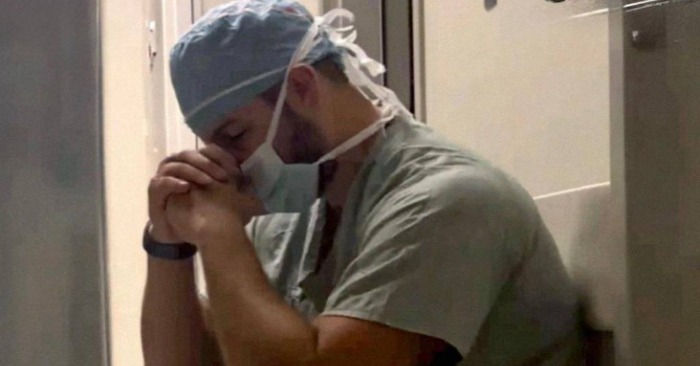
When we transferred him to pediatric ICU, I peeled my gloves off and realized my hands were trembling so badly I could barely keep my fingers straight.
Outside the unit, a couple in their early thirties waited with the kind of terror that makes you physically pale. The man paced. The woman sat frozen, hands clenched in her lap, eyes locked on the doors.
“Family of the accident victim?” I asked.
They looked up.
And the floor shifted under me.
The woman’s face—older, exhausted, but unmistakable—punched straight through the years.
Emily.
My first love.
I hadn’t said her name out loud in over a decade, but it flew out anyway before I could stop it.
“Emily?”
Her expression flickered—confusion, then recognition that sharpened fast.
“Mark?” she breathed. “Lincoln High…?”
The man beside her looked between us. “You know each other?”
“We—went to school together,” I said quickly, pulling myself back into professional mode like it was a coat I could button over my shock. “I’m the surgeon who operated on your son.”
Emily shot to her feet and gripped my arm like she might fall if she didn’t.
“Is he… is he going to make it?”
I gave the report in clean, clinical language, the way doctors do when they’re trying to keep panic from spreading. I explained the tamponade. The tear. The aorta. The surgery. The scar he’d carry.
When I told her he was stable, Emily collapsed into the man’s arms and sobbed in relief.
“He’s alive,” she whispered. “He’s alive.”
I remember standing there, feeling like an intruder in a life I’d once wanted and never got. Then my pager went off again, dragging me back into the machine of the hospital.
Before I walked away, I said, “I’m glad I was here tonight.”
Emily’s eyes met mine. For one second, we were seventeen again—summer air, football bleachers, stolen kisses, plans that felt permanent.
Then she nodded, tears still wet.
“Thank you,” she said. “No matter what happens next… thank you.”
I carried that thank-you like a talisman for years.
Her son—Ethan, I learned—recovered slowly. He spent weeks in ICU, then the regular ward. I saw him a few times in follow-up. He had Emily’s eyes and a stubborn chin, and that bright scar across his face that would never fully disappear.
Then the appointments stopped.
In medicine, that usually means the best thing: the patient went back to living.
And my life kept moving too.
Two decades passed.
I became the surgeon people requested by name. The one they called for disasters. Residents watched my hands and asked how I stayed calm.
I wasn’t always calm.
I just learned how to hide the shaking until later.
I did the normal middle-aged things too: a marriage that didn’t hold, another relationship that ended quieter. I wanted kids, but time slipped away the way it does when you tell yourself you’ll do it “once things settle down.”
Then came a morning after a brutal night shift, when I walked out toward the parking lot feeling half-dead.
And I saw my car.
Parked badly. Half blocking the lane like an idiot.
Great. Exactly what I needed.
I speed-walked toward it, keys in hand—when a voice sliced through the air.
“YOU!”
I turned.
A man in his twenties charged toward me, face red, finger shaking as he pointed like he was aiming a weapon.
“You ruined my life!” he shouted. “Do you hear me? You ruined EVERYTHING!”
It hit like a slap.
I stood there stunned—until I saw the scar.
A pale lightning bolt from eyebrow to cheek.
My brain slammed pieces together: the child on the table. The blood. The bypass. The word stable.
And now this furious stranger who wasn’t a stranger at all.
Before I could speak, he gestured wildly toward my car.
“Move it! My mom’s in the car—she’s in pain—and you’re blocking us!”
I looked past him.
A woman slumped in the passenger seat, head tilted against the window. Even from where I stood, I could see her skin looked wrong—gray, waxy, too still.
“What’s happening?” I asked, already moving.
“Chest pain,” he said, breathless. “Her arm went numb. Then she collapsed. I called 911. They said twenty minutes. I couldn’t wait.”
I didn’t ask for permission. I jumped into my car, backed out fast, waved him forward.
“Drive straight to the entrance,” I barked. “Now. I’ll get a team.”
He peeled off, tires squealing, and I sprinted back inside yelling for a stretcher.
Seconds later, she was on a gurney. I was at her side, fingers on her pulse—thin and fading.
Everything in my training screamed the same warning.
We got an ECG. Then imaging.
The results turned my stomach.
Aortic dissection.
A tear in the body’s main artery. If it ruptured completely, she’d bleed out in minutes.
Someone said vascular was tied up. Someone said cardiothoracic was occupied.
Then my chief looked at me.
“Mark,” he said. “Can you take it?”
I didn’t hesitate.
“Yes,” I said. “Get the OR ready.”
As they rolled her upstairs, something cold settled in the back of my mind. I hadn’t truly looked at her face.
Not really.
I was too busy trying to save her.
Then in the operating room, under the bright lights, I finally saw the freckles. The shape of her cheekbones. The brown hair streaked with gray.
It was Emily.
Again.
On my table.
Dying.
For one heartbeat of time, the universe felt crueler than I could stand.
Then the nurse asked, “Doctor?”
I swallowed.
“Let’s do this.”
A dissection repair is unforgiving. There are no “we’ll watch it.” It’s open the chest, clamp the aorta, bypass, replace the damaged section, pray your hands keep up with the clock.
We opened her chest and found the tear—angry, dangerous, ready to finish the job.
I worked fast, fueled by adrenaline and something deeper than pride.
There was a moment her blood pressure dropped so hard the room went quiet.
I heard myself giving commands sharper than I meant to, because fear doesn’t always come out gentle.
But we got her back.
Hours later, the graft was in place. Flow restored. Her heart calmed.
And anesthesia said it again:
“Stable.”
That word. Again.
When we finished, I stripped off my gloves and went to find Ethan.
He was pacing outside ICU, eyes bloodshot, shoulders locked with tension. When he saw me, he froze.
“How is she?” he rasped.
“She’s alive,” I said. “The surgery went well. She’s critical, but stable.”
His legs gave out. He sat hard in the nearest chair, face collapsing as relief poured through him.
“Thank God,” he whispered. “Oh my God… thank God.”
I sat beside him.
Minutes passed in silence before he spoke again, quieter this time.
“I’m sorry,” he said. “For what I said in the parking lot. I wasn’t… I wasn’t thinking.”
“It’s okay,” I replied. “You were scared.”
He nodded, then finally looked at me like he was trying to place a memory.
“Do I know you?” he asked. “Like… from before?”
“You’re Ethan,” I said.
His brows lifted. “Yeah.”
“Do you remember being here when you were five?”
He blinked, thinking. “Not really. Just flashes. Beeping. My mom crying. This scar.” He touched his cheek. “I know I almost died. I know a surgeon saved me.”
I met his gaze.
“That was me,” I said softly.
His eyes widened, stunned.
“What?”
“I was your surgeon,” I said. “My first solo night. You were the case.”
Ethan stared at me, speechless.
Then his mouth tightened and he looked away.
“I hated it,” he admitted after a long pause, voice rough. “The scar. The teasing. My dad left. My mom never dated again. I blamed the accident. I blamed the scar. Sometimes… I blamed the doctors. Like… if I hadn’t lived, none of the rest would’ve happened.”
I didn’t flinch, even though it hurt.
“I’m sorry,” I said.
He nodded once.
“But today,” he said, swallowing hard, “when I thought I was going to lose her… I’d go through every single thing again. Every surgery. Every insult. All of it. Just to keep her here.”
I exhaled slowly.
“That’s love,” I said. “It makes the cost feel worth paying.”
Ethan stood up, hesitated, and then hugged me—tight, sudden, like he’d been holding that gratitude in his body for twenty years and didn’t know how to let it out any other way.
“Thank you,” he whispered. “For then. For now. For saving her twice.”
I hugged him back.
“Your mom raised a fighter,” I said. “And you became one too.”
Emily stayed in ICU for a while. I checked on her every day. When she finally opened her eyes, I was standing beside her bed.
“Hey, Em,” I said gently.
Her mouth twisted into a weak smile.
“Either I’m dead,” she croaked, “or the universe has a twisted sense of humor.”
“You’re alive,” I said. “Very alive.”
She winced. “Don’t make me laugh. Breathing hurts.”
“You were always dramatic,” I said.
“And you were always stubborn,” she whispered.
The monitors beeped softly between us.
Then she looked at me and said, “When I’m better… will you get coffee with me? Somewhere that doesn’t smell like disinfectant?”
I smiled.
“I’d like that.”
Three weeks later she went home.
And sometimes now, Ethan joins us at a little café downtown—where the only beeping comes from espresso machines and the only scars we talk about are the ones we survived.
Because if saving a life is what someone calls “ruining” it?
Then I’ll be guilty every time.