The address led me to an old storage facility near the edge of town.
It was barely six in the morning.
The sky was still gray.
Most of the units were hidden behind rows of rusted metal doors, and the place looked abandoned except for one security light flickering above the office.
I sat in my car with the lunch bag on the passenger seat.
The brass key rested in my palm.
I kept telling myself there had to be a reasonable explanation.
Maybe someone had found the bag in an attic.
Maybe Miles had died and left instructions.
Maybe this had nothing to do with Mark.
But then I looked again at the photograph hidden inside.
It was recent.
My husband stood outside the hospital wearing the same blue jacket he had worn the morning of his heart attack.
Beside him was a tall man with silver beginning to show in his dark hair.
The man was looking toward Mark.
Mark was looking away from the camera.
On the back, someone had written:
He helped me before he knew who I was.
I had no idea when the photograph had been taken.
I had no idea why Mark had never mentioned the man.
And I had no idea how Miles knew where we lived.
The key opened unit 318.
Inside, there were no boxes of furniture.
No forgotten clothes.
No dusty appliances.
Only a metal desk beneath a single overhead bulb.
On top of it sat a locked black case.
The same key opened that too.
I lifted the lid.
The first thing I saw was a stack of medical records.
Mark’s name was printed across the top page.
My heart began pounding.
I flipped through them quickly.
His diagnosis.
His scans.
The recommended surgery.
The cost estimate.
Every private detail from the hospital.
Someone had been following his case.
Beneath the records was a sealed envelope addressed to me.
I tore it open.
The letter began with four words.
You once noticed hunger.
I had to sit down.
The handwriting was precise and controlled.
Nothing like the uneven letters Miles had written as a child.
I kept reading.
He wrote that he remembered every lunch I bought him.
Not because of the food itself.
Because I never made him explain why he needed it.
I never asked him to thank me in front of anyone.
I never announced what I had done.
I simply moved the tray toward him and acted as though sharing was normal.
For years, I had believed his family had moved away during the summer.
That was not what happened.
Miles had been removed from his home.
His mother had disappeared for days at a time.
His father had been gone for years.
There had been no food in the apartment.
No electricity.
No adult reliably present.
One afternoon, a teacher followed him home after noticing how much weight he had lost.
By the end of the week, Miles was in foster care.
He changed schools.
Then cities.
Then families.
I read the next lines twice.
The lunches you gave me kept me quiet enough to survive until someone finally looked closer.
My eyes filled with tears.
I had been eight years old.
I had no idea that a tray of food could mean the difference between enduring one more day and giving up.
The letter continued.
Miles had struggled for years.
He moved through five foster homes before finding one family that stayed.
A nurse and her husband adopted him when he was twelve.
They helped him catch up in school.
He became obsessed with medicine.
Not because he dreamed of becoming wealthy.
Because he remembered what it felt like when suffering remained invisible.
He became a cardiothoracic surgeon.
Then he helped develop a surgical technique used for complicated heart conditions.
Mark’s condition.
My hands went cold.
The surgery my husband needed was rare because only a small number of surgeons were qualified to perform it.
Miles was one of them.
I reached the end of the letter.
Your husband does not need your parents’ house.
He needs a surgical team willing to move quickly.
That team has already been assembled.
The cost has been covered.
I stopped breathing.
Beneath the letter was a hospital authorization form.
Mark’s surgery had been scheduled for Monday morning.
Three days away.
The estimated patient balance showed zero.
I stared at the number until it blurred.
Then I heard footsteps behind me.
I turned.
The man from the photograph stood in the doorway.
For a moment, I could still see the boy he had been.
Not in his clothes.
Not in his face.
In the way he kept his hands close to his sides, as though he was still trying not to take up too much space.
“Miles?”
He smiled.
It was the same small smile he used to give me across the cafeteria table.
“Hello, Anna.”
I stood so quickly the chair scraped backward.
My first instinct was to hug him.
My second was anger.
“You knew about Mark?”
“Yes.”
“How?”
“He came to see me before the heart attack.”
That stopped me.
Miles entered the unit and closed the door behind him.
“Your husband contacted my foundation six months ago.”
“What foundation?”
Miles looked toward the lunch bag.
“The one I created for children who go without food at school.”
My chest tightened.
Mark had discovered the foundation while looking for a charity to support through his company.
He had volunteered to help redesign its donation system.
He did the work for free.
During one of their meetings, Mark mentioned my name.
My maiden name.
My hometown.
The elementary school I had attended.
Miles began asking questions.
At first, Mark assumed it was coincidence.
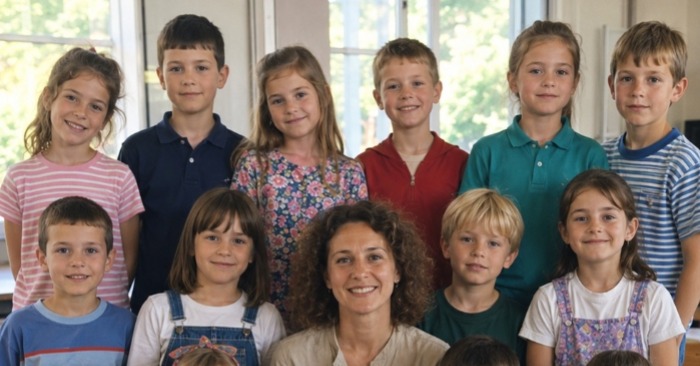
Then Miles showed him an old class photograph.
There I was.
Eight years old.
Front row.
Missing one tooth.
Mark realized immediately who Miles was.
“Why didn’t he tell me?”
“Because I asked him not to.”
I stared at him.
“Why?”
Miles lowered his eyes.
“I didn’t know whether you would remember me.”
“That shouldn’t have mattered.”
“It mattered to me.”
His voice remained calm, but I could hear the old fear beneath it.
“I spent most of my childhood learning that people who helped me eventually disappeared. I didn’t want to appear after thirty years and make you feel responsible for what became of me.”
“You thought I’d feel responsible?”
“I thought you might feel obligated.”
I looked at the medical files.
“And this isn’t supposed to make me feel obligated?”
His expression softened.
“No. This is supposed to make us even.”
I shook my head.
“We were eight. I bought you lunch.”
“You gave away the only money you had.”
“It was a few dollars.”
“To you.”
He stepped closer.
“To me, it was proof that somebody could see me and not look away.”
Neither of us spoke for several seconds.
Then another thought struck me.
“The photograph of you and Mark outside the hospital.”
Miles smiled faintly.
“That was taken three months ago.”
The day of Mark’s heart attack.
Miles had been at the hospital for a surgical conference when Mark was brought into the emergency department.
He recognized the name.
He went downstairs.
Mark was still conscious.
Still trying to make jokes.
Still more worried about me than himself.
“He made me promise not to contact you until I knew whether I could help,” Miles said.
“That sounds like him.”
“He also told me about your parents’ house.”
I looked down.
Mark knew I would sell it.
He knew I would give up the last place that still smelled like my childhood if it meant saving him.
“He didn’t want you to lose it,” Miles said.
A sharp pain moved through my chest.
“Why the old lunch bag?”
For the first time, Miles looked embarrassed.
“I kept it.”
“For thirty years?”
He nodded.
After he entered foster care, he had carried the bag from home to home.
It was one of the few objects from that time that did not frighten him.
Whenever he wanted to quit school, he looked at my handwriting.
Whenever he believed kindness was always temporary, he remembered the lunches arriving without questions.
“I needed you to recognize that this wasn’t charity,” he said.
“What is it, then?”
“A promise I made when I was eight.”
He glanced at the worn bag.
“I promised that if I ever had enough, I would return one lunch.”
I laughed and cried at the same time.
“This is considerably more than lunch.”
“I added interest.”
The surgery took place Monday morning.
Miles led the team.
I watched Mark disappear through the operating doors while terror closed around my throat.
Before Miles followed, he stopped beside me.
“I won’t lie to you,” he said. “This is difficult.”
“Is he going to survive?”
“I believe he has a real chance.”
It was not the perfect reassurance I wanted.
It was honest.
The operation lasted nearly nine hours.
I paced until my legs hurt.
I drank coffee I could not taste.
I stared at the old lunch bag sitting on the chair beside me.
When Miles finally emerged, his surgical cap was still on.
His face looked exhausted.
For one terrible second, he said nothing.
Then he smiled.
“He made it.”
My knees gave way.
Miles caught my arm before I hit the floor.
Mark’s recovery was slow.
There were complications.
Days when he could barely speak.
Nights when alarms sent nurses rushing into his room.
The surgery saved him, but healing did not happen like it does in movies.
There was pain.
Fear.
Physical therapy.
Months of uncertainty.
Miles stayed involved through all of it.
Not as the hungry boy I had once helped.
Not as a mysterious benefactor.
As a doctor.
And eventually, as a friend.
When Mark was strong enough to return home, he found the lunch bag framed above our kitchen table.
He stared at it for a long time.
“You framed garbage?”
“It is not garbage.”
Miles, standing beside him, laughed.
“It was when she gave it to me.”
Mark turned toward him.
“You know, she still steals my fries.”
“I believe it.”
The two of them had become strangely close.
Perhaps because both had tried to protect me by keeping secrets.
Perhaps because both understood how terrifying it is to owe your life to someone else.
Months later, I visited Miles’s foundation.
Children received hot lunches without having to prove they were poor.
There were no special lines.
No different-colored tickets.
No public questions.
Every child ate with dignity.
On one wall hung hundreds of small paper bags decorated by students.
Miles handed me a marker.
“What am I supposed to write?”
“Anything.”
I thought for a moment.
Then I wrote:
You never know how far one lunch can travel.
Miles read it and grew quiet.
I used to believe kindness disappeared once the moment passed.
A meal was eaten.
A coat was outgrown.
A small gesture was forgotten.
I was wrong.
Kindness can remain hidden for decades.
It can survive inside a crushed paper bag.
It can cross thirty years.
And sometimes, when you are standing at the worst moment of your life, it finds its way back to your door.