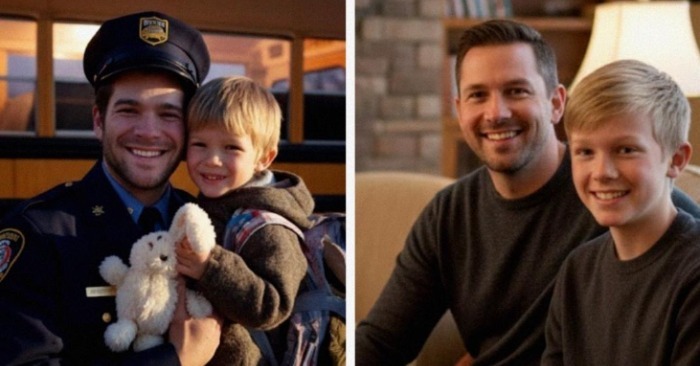
It was only a few days before Christmas when I saw him—small, moving slowly through the dark like he didn’t belong to the world around him. He was six years old, alone under a flickering streetlight, and he looked like he’d been walking for a long time.
He told me his mother had died that day. He said he wouldn’t go with strangers. So I promised him he wouldn’t be alone.
Thirteen years later, I learned we’d been living inside a different kind of lie all along—one built out of fear and love and silence—when a woman showed up to take him away.
When I was twenty-five, I drove a school bus. It paid the bills, and at that stage of my life, that was all I was aiming for. I wasn’t chasing big dreams. I wasn’t expecting miracles. I was just trying to keep my head above water.
It was a handful of days before winter break. I’d dropped off the last kid, pulled the empty bus onto the road back to the depot, and listened to the heater rattle like it always did when the temperature fell hard.
That’s when I saw him.
A tiny figure on the side of the road, moving under a streetlamp that blinked as if it couldn’t decide whether to stay on. A boy—maybe six—far too young to be out there alone in the cold and dark.
But what grabbed me wasn’t only his size.
It was the backpack.
It was huge on him, swallowing his shoulders. And it was the way he clutched a stuffed bunny to his chest like it was the only stable thing he had left.
This didn’t look like a kid who slipped outside while someone wasn’t watching.
This looked like a child running from something.
I hit the brakes. The bus hissed and rolled to a stop beside him. I opened the door.
“Hey, buddy,” I said gently. “Are you okay?”
His face looked pale under the dying streetlight. His eyes were red, but dry—as if he’d already cried everything out and had nothing left to give.
“My mom died today,” he said.
The words landed like a punch.
I swallowed hard. “I’m so sorry.”
He kept staring straight ahead. “They wanted to take me somewhere. But I didn’t want to go with them. So I ran.”
Everything in me tightened.
He needed help. Badly. But he also looked like he’d bolt if I moved wrong.
“Do you want to sit inside the bus?” I asked softly. “It’s warm. You don’t have to tell me anything you don’t want to. I just… I don’t want you out here freezing.”
He stared at the bus like it was a trap. Then he glanced behind him, as if checking the darkness for someone following.
After a long beat, he gave a small nod.
I guided him to one of the front seats and turned the heater up until the windows fogged.
“What’s your name?” I asked.
“Gabriel,” he whispered.
“I’m Marcus,” I said. “And I promise you—you’re safe right now, okay?”
He didn’t answer.
He just tightened his grip on that stuffed bunny until his knuckles went white.
I stepped off the bus to use my dispatch phone.
“I found a child walking alone,” I said, keeping my voice steady. “He looks about six.”
“Stay where you are,” they told me. “We’ll handle it.”
I climbed back on.
The second I looked at him again, my chest squeezed.
He’d curled around his bunny like he was trying to disappear into it. He wasn’t sleeping—his eyes were open—but they were blank, like his mind had stepped away because it couldn’t bear the moment.
I took off my jacket and laid it over him like a blanket.
He didn’t even flinch.
About fifteen minutes later, dispatch called again and told me to take him to an emergency intake center for children across town. Social services had been notified. Someone would be waiting.
Someone would be waiting.
I glanced at Gabriel. He didn’t react. Maybe he couldn’t hear me over the heater. Or maybe he’d just shut down entirely now that the panic had nowhere to go.
I drove slowly, carefully.
When we pulled into the center’s parking lot, Gabriel had finally fallen asleep.
I lifted him into my arms and carried him inside.
A woman rushed toward us, relief on her face.
“Gabriel!” she cried. “I’ve been so worried!”
And that’s when he exploded.
His eyes flew open and he thrashed like I was drowning him.
“I want to go home!” he screamed. “I want my mom!”
The woman reached for him. “Sweetheart, you’re safe—”
But he fought harder. His tiny hands grabbed my shirt so tightly I thought the fabric would tear.
“Please!” he cried, voice breaking. “Don’t let her take me!”
My stomach twisted.
The woman wasn’t dangerous. She was there to help. But to Gabriel, she was just another stranger trying to move him into a world he didn’t understand.
“It’s okay,” I murmured, rocking him like he was much younger than six, because I didn’t know what else to do. “You’re okay. Breathe. You’re not alone right now.”
“I want to go home,” he repeated—smaller now, shredded. “I want to go home.”
The woman looked at me, her expression tight with sympathy. “Could you stay for a little while?” she asked. “Just until he calms down?”
Of course I said yes.
What else was I supposed to do—hand him over while he screamed and clung to me like I was the last solid thing in the world?
So I stayed.
I stayed while calls were made and papers were signed.
I stayed while adults spoke in careful voices that floated over Gabriel’s head like fog, even though every word was about him.
I stayed while he sat pressed against my side, quiet now, but trembling as if his body couldn’t decide whether to fight or collapse.
And while I sat there, holding up a child I hadn’t known an hour earlier, I listened—and learned the truth.
Gabriel’s mother had collapsed at work. An aneurysm. No warning. No goodbye.
There was no family who could take him. No aunt, no grandfather, no friend willing to step in.
The woman at the center was the social worker who’d gone to the apartment to bring him into emergency care.
Gabriel had panicked. He slipped out the back door and ran.
He’d been walking for nearly two hours before I spotted him under that streetlight.
Two hours.
In the cold.
In the dark.
A six-year-old.
Eventually, they assigned him a temporary room.
When it was time for me to leave, I crouched in front of him and made a promise I didn’t fully understand the weight of yet.
“I’ll come visit you,” I told him. “You won’t be alone.”
He looked at me like he didn’t believe in promises anymore.
But the next day, I came back anyway.
And when he saw me, he ran straight at me and wrapped his arms around my waist like he’d been holding his breath since I left.
At first, I told myself I was just checking on him.
But the truth was messier.
He reminded me of my twin brother—my other half—who I’d lost when we were kids.
Same quiet way of watching people. Same habit of pretending he was fine when he wasn’t. Same instinct to shrink himself so he wouldn’t be a burden.
I lost my brother on a summer trip. A river that looked calm until it wasn’t. One moment he was there, the next he was gone, taken by a current no one saw coming. I’d spent my whole life wishing I could rewind time and grab his hand sooner.
The idea of letting Gabriel disappear into the system felt unbearable.
So before Christmas even arrived, I filed the paperwork.
I told myself it was fate that put him in front of my bus. That the universe had given me another chance to do it right. I swore I would never let go of him the way I’d let go of my brother.
That was my first mistake.
The adoption process happened quieter—and faster—than I expected. Gabriel came home with me.
In the beginning, he barely spoke.
He followed me from room to room like a shadow, watching everything I did. He slept lightly. He kept his backpack close, like he believed he might need to run again at any second.
But slowly, the air shifted.
He asked questions.
He started helping me cook.
He laughed once—unexpected, startled, like the sound surprised him too.
And the day he stopped clutching his backpack like a lifeline felt like winning something I hadn’t known I could win.
For years after that, I worked like my life depended on it.
Bus driver during the day. Taxi at night. Later, I saved enough to rent out cars on the side and build something that looked like stability.
I was exhausted all the time. Counting hours. Chasing bills.
But Gabriel never lacked safety.
And he never lacked love.
I gave him everything I had.
And I didn’t notice—never once—how carefully he was carrying a secret in his hands, protecting it from me like it could shatter.
Thirteen years passed.
One evening, I came home earlier than usual.
The second I walked in, I knew something was wrong.
Gabriel was on the couch—crying. Not a few tears. Real crying. The kind that leaves your face swollen and your chest sore.
Beside him sat a woman in her forties. Professional clothes. A folder balanced on her lap. Her expression was serious in a way that made my skin go cold.
“What’s going on?” I demanded.
Gabriel looked up at me with red, swollen eyes.
“Dad,” he said, voice breaking, “I have to go. We’re never going to see each other again. I love you. Thank you for everything.”
The room spun.
I looked at the woman. “Who are you?” I snapped. “And what did you tell my son?”
She folded her hands on top of the folder, calm like she’d rehearsed for this.
“I’d sit down,” she said. “You’ve been living in a lie for thirteen years. And you’re not going to like what you hear.”
“I’m not sitting,” I said, frozen upright. “A lie? What are you talking about?”
She pointed to the armchair across from her.
“Sit,” she repeated, not cruel, just firm.
I finally lowered myself into it like my legs had stopped working.
“Talk,” I said. “Now. Who are you? What is happening?”
“My name is Patricia,” she said. “I’m Gabriel’s school counselor.”
I blinked. “His counselor? Why are you in my house?”
She didn’t look at me. She looked at Gabriel.
“Tell him,” she said softly.
Gabriel shook his head hard, tears falling. “You said you would.”
“I will,” she answered gently. “But it needs to come from you too.”
He swallowed, shoulders shaking. “Dad… I didn’t want to lie to you. I just—”
“Lie?” I repeated, sharp. “About what?”
Patricia leaned forward.
“For thirteen years,” she said quietly, “your son has been trying to protect you from the truth.”
It hit me like a blunt object to the chest.
“That’s not possible,” I said. “That can’t be—”
She opened the folder instead and slid papers onto the table.
Letters. Reports. Notes from teachers.
I grabbed the top one and read the first lines.
My mouth went dry.
“Gabriel,” I whispered, staring at him. “What is this? Why didn’t you tell me?”
He couldn’t look at me.
So I turned back to Patricia.
“How long has this been going on?”
“Too long,” she said. “Your son is at the top of his class. For years, his teachers have urged him to apply to out-of-state programs—summer academies, advanced placements, national competitions. Travel opportunities. Scholarships. He refused all of it.”
“Why?” My voice cracked on the word.
Gabriel’s voice was barely above a whisper.
“Because every time I thought about leaving,” he said, “I pictured you in this house… alone. And I knew it would break you.”
The air left my lungs.
Patricia spoke softly, like she wasn’t trying to accuse me, only explain.
“He learned very early how afraid you are of losing people,” she said. “He’s been carrying that fear for you.”
Gabriel wiped his face with his sleeve, shaking.
“You gave me everything, Dad,” he said. “How could I repay you by leaving?”
I covered my face with my hands.
“What did I do?” I choked out. “What did I teach you?”
Patricia’s voice changed—still gentle, but more urgent.
“But that isn’t the only reason I’m here,” she said. “Last month, Gabriel was offered a full scholarship to Stanford. Tuition, housing, books—everything covered.”
My head snapped up. “A full scholarship?”
She nodded.
“He wanted to reject it,” she said. “I talked him into reconsidering. But I’m afraid he won’t accept it unless you support him.”
She stood.
“He earned this,” she said, looking directly at me now. “And it would be a tragedy if he threw it away.”
Then she left.
The door closed.
Silence poured into the room.
Gabriel sat there like a person waiting for punishment.
“I didn’t want to hurt you,” he whispered. “I want to go… but I don’t have to. I can stay—”
I was moving before I even realized it.
I crossed the room and pulled him into my arms.
“You’re going,” I said, voice thick. “And you’re not going to feel guilty for it.”
At first he went stiff—like he didn’t trust it.
Then thirteen years of control collapsed all at once.
His whole body shook as he cried into my shoulder, like the six-year-old on the sidewalk was still inside him, finally letting go.
“I’m going to miss you,” I whispered. “Every single day.”
“I’ll miss you too,” he breathed.
I pulled back and looked at him.
He wasn’t that little boy under the streetlight anymore.
He was a brilliant young man who’d sacrificed far too much—because of my fear.
“Promise me one thing,” I said.
“What?” he asked, wiping his face.
“Come home for the holidays.”
A tear slid down his cheek, but a smile finally appeared.
“Of course, Dad,” he said. “This is still my home.”
I held him tighter.
For the first time in my life, I didn’t lose someone.
I let someone go. I let him grow.
Maybe that’s what love actually is.