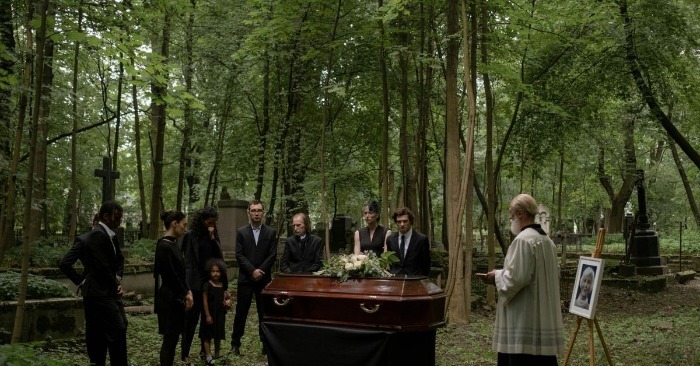
The day after my parents’ funeral, I became an adult.
Not because I had turned eighteen—though I had. I became an adult because someone tried to take the only family I had left. And I wasn’t going to let that happen.
At eighteen, I never imagined I’d live through the worst kind of loss: burying both of my parents and walking away from the cemetery with my six-year-old brother, Max, who still believed Mom was simply “on a long trip.”
As if that wasn’t cruel enough, the funeral fell on my birthday.
People kept saying, “Happy 18th,” like it mattered.
It didn’t.
I didn’t want cake. I didn’t want presents. I wanted Max to stop asking, “When is Mommy coming back?”
We were still wearing black when I knelt beside the grave and whispered a promise into his hair:
“I won’t let anyone take you from me. Not ever.”
Turns out, not everyone agreed.
“It’s for the best, Ryan,” my Aunt Diane said, her voice dripping with practiced kindness, as she placed a mug of cocoa in front of me—one I hadn’t asked for.
A week after the funeral, she and Uncle Gary invited us over. Their kitchen looked like a magazine spread: spotless counters, matching chairs, everything arranged like a set. Max sat at the table happily peeling dinosaur stickers while Diane and Gary stared at me with the same rehearsed expression—sympathy that felt more like assessment.
“You’re still basically a kid yourself,” Diane said, squeezing my arm as if we were close. “You don’t have a real job. You’re still in school. Max needs structure. Guidance… a home.”
“A proper home,” Gary added smoothly, like it was a line they’d practiced in the car.
I bit the inside of my cheek so hard I tasted blood.
These were the same people who had forgotten Max’s birthday three years in a row. The same people who skipped Thanksgiving because they “had a cruise.” And now they were suddenly eager to be parents?
The following morning, I learned they had officially submitted a custody request.
That’s when everything snapped into focus.
This wasn’t about worry or responsibility.
It was a calculated move.
Something felt wrong on a level I couldn’t ignore. Diane wasn’t fighting for Max out of affection or duty.
She wanted him for a reason she wasn’t saying.
And I was determined to uncover it. I wasn’t about to hand her a victory.
The day after the paperwork surfaced, I went straight to my college office and unenrolled.
They started to ask if I was certain.
I cut them off with a firm yes before the question was even finished.
School could wait.
My brother couldn’t.
I took two jobs.
During the day, I delivered food with a fake smile no matter how rude people were. At night, I cleaned law offices—ironic, considering I was preparing for my own legal fight.
We had to leave our parents’ house. I couldn’t afford it anymore.
Max and I moved into a tiny studio that smelled like floor cleaner and old takeout. The mattress touched one wall. The pullout couch touched the other. There was barely space to breathe.
And somehow, Max still smiled.
“It’s small,” he said one evening, wrapped in a blanket like a burrito, “but it’s warm. It smells like pizza… and like home.”
That sentence nearly broke me.
But it also kept me alive.
I filed paperwork for legal guardianship. I knew I was young. I knew the odds weren’t great. But I also knew Max needed me, and I believed that had to count for something.
Then one morning, everything cracked.
“She’s lying.”
I stood frozen in my living room, staring down at the report from Child Services like it was written in a language I couldn’t process.
“What did she say?” I managed, my voice hollow.
The social worker wouldn’t quite meet my eyes.
“She claims you leave Max alone. That you yell at him. That you hit him… more than once.”
For a second, my brain stopped working.
All I could see was Max’s face—how he laughed when I did stupid voices, how he curled against me during thunderstorms. I would never hurt him. Never.
But Diane had planted doubt.
And doubt is dangerous.
What she didn’t count on was Mrs. Harper.
Our neighbor—retired elementary school teacher—who watched Max when I worked double shifts. She marched into court like she owned the building, holding a manila folder and wearing pearls that gleamed like armor.
“That boy,” she said without hesitation, pointing right at me, “is raising his brother with more love than most parents manage in an entire lifetime.”
Then she turned her sharp gaze on the judge and said, “And I’d like to see anyone claim otherwise.”
The hearing wasn’t easy, but Mrs. Harper’s testimony bought us oxygen.
The judge postponed a final decision and ordered only supervised visitation for Diane.
It wasn’t a complete victory.
But it was enough to breathe again.
Every Wednesday and every Saturday, I had to bring Max to Diane’s house.
Every time, my stomach tightened into a hard knot, but it was court-ordered. And I refused to give them a single excuse to paint me as unstable or reckless.
One Wednesday, I arrived earlier than usual.
The house was quiet—too quiet.
Diane opened the door wearing that strained smile she always used when she wanted to appear human.
Max ran straight into me. His cheeks were blotchy. Tears clung to his eyelashes.
“She said if I don’t call her Mom, I don’t get dessert,” he whispered, gripping my hoodie like it was a life raft.
I dropped to my knees and brushed his hair back from his damp forehead.
“You don’t have to call anyone Mom except Mom,” I told him.
He nodded, but his lower lip trembled like he was trying not to fall apart.
Later, after I got him into bed, I went outside to take the trash down.
I wasn’t trying to eavesdrop. I wasn’t looking for trouble.
But as I walked past the side of the building near Diane’s kitchen window, I heard her voice—sharp, satisfied—coming through a phone speaker.
“We need to speed this up, Gary. As soon as we get custody, the state releases the trust fund.”
I stopped so fast my whole body went cold.
Trust fund?
I didn’t even know Max had one.
I waited until the call ended, then ran home and spent half the night searching. My hands shook as I read through documents.
Two hundred thousand dollars.
Our parents had set it aside before the accident—money for Max’s future. College. Life. A foundation in case something happened.
Something had happened.
And Diane wanted the money.
The next night, I went back to the same spot, the same window.
This time, I hit record.
Gary’s voice came through clearly: “Once the money’s in our account, we can ship Max off to boarding school or something. He’s a handful.”
Then Diane laughed.
A laugh that made my skin crawl.
“I just want a new car,” she said. “And maybe that Hawaii trip.”
I stopped recording and stood there shaking, my heartbeat loud in my ears.
The next morning, I sent everything to my lawyer.
After breakfast, I walked into Max’s room.
He looked up from his coloring book with cautious eyes.
“Is the bad part over?” he asked quietly.
For the first time in weeks, I felt my mouth form a real smile.
“Almost,” I told him.
At the final custody hearing, Diane walked in like she was attending a church picnic.
Pearls shining. Smile stretched too wide. A tin of homemade cookies in her hands.
She even tried to hand one to the bailiff, smiling like this was all some friendly misunderstanding.
My attorney and I came prepared with something far more powerful than baked goods.
We came armed with the facts.
The judge—a hard-faced woman who gave nothing away—sat perfectly still as my lawyer tapped a button on his phone.
The audio poured into the courtroom, dark and unmistakable.
“We should push this faster, Gary. The moment we get custody, the state unlocks the trust fund…”
Then Gary’s voice followed, casual and cold: “Once the money hits our account, we can dump Max in a boarding school or whatever. Kid’s a lot of work.”
The judge’s expression shifted in real time, like watching respect drain and revulsion take its place.
When the sound cut off, the silence that followed was suffocating—thick, final, impossible to escape.
“You attempted to manipulate this court,” the judge said finally, her voice icy, “and you used a child for financial gain.”
Diane’s smile disappeared.
Her lipstick looked cracked. Gary’s hands visibly shook.
They didn’t just lose the custody case.
They were reported for attempted fraud.
I watched the cookie tin get pushed aside—untouched.
That same afternoon, the judge granted me full legal custody of Max.
She also ordered that I be considered for housing support and specifically noted my “extraordinary effort under difficult circumstances.”
Outside the courthouse, Max held my hand so tightly I thought he might never let go.
“Are we going home now?” he asked, small voice, but steady.
I knelt, smoothed his hair back the way I always did, and fought the sting behind my eyes.
“Yes,” I said. “We’re going home.”
On the courthouse steps, we passed Diane.
Her makeup was smeared. Her mouth twisted into something bitter.
She didn’t say a word.
She didn’t need to.
Two years have passed.
I juggle a full-time job while keeping up with my online college courses. Max is in second grade now, doing great—telling anyone who’ll listen that I’m his “big brother” and his hero.
Our place is still tiny. We still bicker over what to stream. We still crack up over my awful made-up bedtime stories.
I don’t have everything figured out.
But we’re protected.
We’re independent.
We’re a family.
Because love isn’t about how old you are or how much money you make. It’s about what you’re willing to stand up for—and who you refuse to give up on.
And tonight, when Max looked at me and whispered, “You never gave up on me,” I gave him the only answer that mattered.
“Never.”