Ryan couldn’t take his eyes off the phone.
The screen wasn’t showing a message.
It was showing a video.
A security camera recording.
His mother pressed play again without saying a word.
The footage showed my front porch at 5:28 that morning.
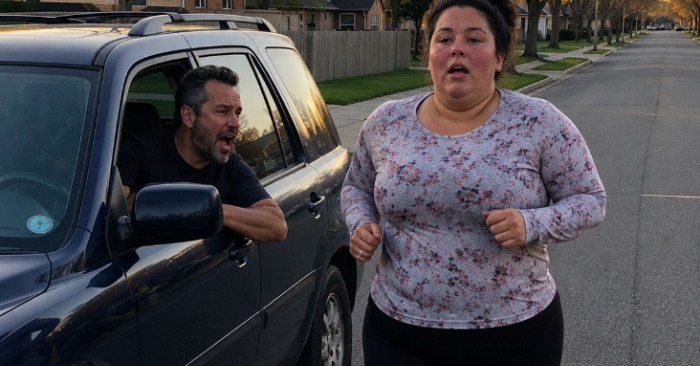
Ryan walked out carrying my running shoes.
A minute later, I followed, still moving carefully from the surgery.
The camera had no sound.
It didn’t need any.
Anyone watching could see the pain written across my face.
Then the recording showed Ryan pointing down the street.
Ordering me forward.
The next clip showed his SUV creeping behind me while I bent over, trying to catch my breath.
Finally, the video froze on one frame.
Me.
Holding my stomach.
Barely able to stand.
Ryan whispered, “Where did you get this?”
His mother answered quietly.
“Our neighbor sent it to me.”
She took another step closer.
“She thought I should know how my son treats the mother of his newborn.”
Ryan swallowed hard.
“Mom… I can explain.”
“No.”
“You can listen.”
She folded her arms.
“When your father was recovering from heart surgery, I slept in a chair beside his hospital bed for twelve nights.”
“I helped him walk one hallway at a time because his doctors told me exactly when he was ready.”
“I never forced him.”
“I protected him.”
Her voice shook.
“And yet you ignored your wife’s surgeon after major abdominal surgery.”
I stood frozen.
I had never seen Ryan speechless.
His mother turned toward me.
“Did your doctor really tell you not to exercise yet?”
I nodded.
“He said at least eight weeks.”
She closed her eyes for a moment.
Then she looked back at her son.
“You lied to me.”
Ryan tried again.
“I just wanted to motivate her.”
She laughed once.
It wasn’t amused.
“You didn’t motivate her.”
“You humiliated her.”
She reached into her purse and pulled out another envelope.
“This is why I came.”
Ryan stared at it nervously.
Inside was a contract.
The BMW he’d proudly driven every morning…
Was registered in his mother’s name.
She had helped him buy it years earlier after he lost his job.
She laid the keys on the hood.
“Give them back.”
“What?”
“You heard me.”
“Mom, please…”
“You used this car to terrorize your recovering wife.”
“You don’t deserve to drive it.”
His shoulders slumped.
Slowly, he placed the keys into her hand.
She wasn’t finished.
“I’ve already spoken with your wife’s doctor.”
My heart skipped.
“And I’ve arranged for her to stay at my house until she’s fully healed.”
Ryan looked at me in panic.
“You can’t leave.”
His mother answered before I could.
“Watch her.”
“I can.”
“You’ve been watching her every morning.”
“Now you’ll learn what it feels like when someone decides you don’t get to make the rules.”
For the next six weeks, I stayed with my mother-in-law.
She cooked.
She rocked the baby so I could sleep.
She reminded me that healing wasn’t weakness.
It was necessary.
Ryan called every day.
Sometimes I answered.
Sometimes I didn’t.
Eventually he asked to meet.
Not to argue.
To apologize.
He admitted that he’d become obsessed with appearances.
He cared too much about what other people thought.
He forgot that the woman standing beside him had just risked her life bringing their son into the world.
Trust didn’t return overnight.
It took months.
Counseling.
Actions instead of promises.
Whether our marriage survived wasn’t decided by one apology.
It was decided by what happened afterward.
Ryan never again commented on my weight.
He attended every doctor’s appointment.
He took parental leave.
He woke for nighttime feedings.
Most importantly, he learned to ask one question before offering an opinion:
“What do you need?”
Years later, our son saw an old photo of the silver sedan parked in front of the BMW.
He asked why Grandma had kept it.
She smiled and said,
“Because that was the morning our family stopped confusing control with love.”
Real love doesn’t demand that someone suffer to earn acceptance.
It protects, listens, and helps people heal—even when that means standing up to someone you love.