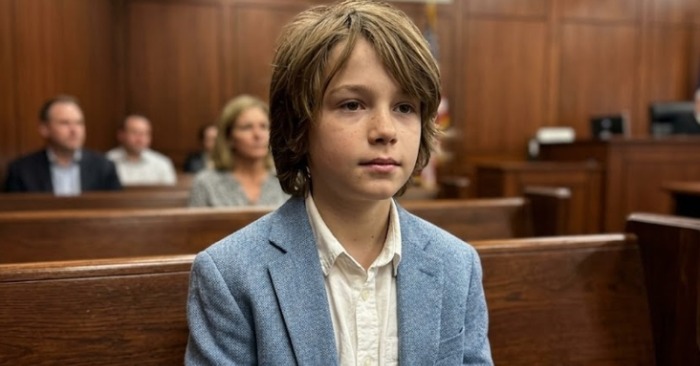
The recorder clicked.
Then my husband’s voice filled the courtroom.
Calm.
Cold.
Completely certain no one important was listening.
“Once she clears the debt, we file.”
A woman laughed softly in the background.
My husband’s mistress.
Then she asked, “And the house?”
Aidan answered without hesitation.
“The house, the car, the accounts. Even custody if we push hard enough.”
A murmur moved through the courtroom.
I felt every eye turn toward him.
Aidan stood frozen beside his lawyer.
His face had gone white.
The recording continued.
“She’ll have nothing left after paying the loan,” he said. “That’s the point.”
I stopped breathing.
For weeks, I had blamed myself.
I had thought I was foolish.
Naive.
Too trusting.
But hearing those words made something painfully clear.
This had never been a marriage collapsing.
It had been a plan.
The judge raised one hand.
The room fell silent.
“Where did you get this recording?” she asked.
Noah looked frightened now, but he did not look away.
“Dad came into my room one night because his phone was dying. He used my tablet to call her.”
Aidan’s lawyer stood.
“Your Honor, this is highly irregular. A child cannot simply bring secretly recorded material into court without—”
The judge cut him off.
“Sit down.”
He obeyed.
Noah continued.
“I was under the blanket. Dad thought I was asleep.”
My heart broke at the image.
My ten-year-old son lying still in the dark while his father discussed how to ruin me.
“What happened after the call?” the judge asked.
Noah swallowed.
“He printed some papers in the office.”
He pointed toward the plastic sleeve.
“I found one page in my school bag the next morning. Dad must have put it there by mistake.”
The bailiff lifted the documents again.
There was a transfer schedule.
A list of property.
A note about filing dates.
And one line circled twice:
Debt cleared before petition.
Aidan leaned toward his lawyer and whispered something.
The lawyer’s expression changed.
Not fear.
Calculation.
He stood again.
“Your Honor, even if these materials are genuine, they do not prove fraud. Married couples discuss finances. They make plans. They say emotional things during private conversations.”
The judge looked toward Noah.
“Is there anything else?”
Noah nodded.
Then he reached into his pocket and removed a folded envelope.
“I didn’t want to show this.”
Aidan moved so quickly that his chair fell backward.
“Noah, don’t.”
The words burst out of him.
Not angry.
Terrified.
That single reaction changed the air in the courtroom.
The judge looked at the bailiff.
The envelope was taken from Noah and handed forward.
Inside was a photocopy of a signed agreement.
The original title at the top read:
Private Repayment and Asset Transfer Arrangement.
My name appeared several times.
So did Aidan’s.
But I had never seen it before.
The document stated that after I paid the $300,000 debt, several assets would be transferred into a holding company.
The company belonged to someone named Claire Bennett.
The same woman Aidan had moved in with.
My attorney leaned toward me.
“Did you sign this?”
“No.”
My voice barely came out.
She studied the signature.
“It looks like yours.”
“It isn’t.”
The judge turned toward Aidan.
“Mr. Calloway, do you recognize this document?”
His lawyer answered first.
“My client invokes his right not to respond until authenticity is established.”
That was the moment I understood.
He was no longer trying to explain.
He was trying to survive.
The judge ordered a recess.
But before anyone could leave, she added:
“The court is referring these materials for immediate review. Neither party may transfer, sell, conceal, or encumber any marital asset.”
Aidan closed his eyes.
His lawyer began speaking rapidly into his ear.
I turned toward Noah.
He looked smaller now.
The courage that had carried him through the courtroom was fading.
I knelt beside him.
“You should never have had to do this.”
He wrapped both arms around my neck.
“I heard him say he was taking me away from you.”
My chest tightened.
“That was not your burden.”
“I didn’t want you to lose.”
I held him tighter.
“You are not evidence. You are my son.”
He began to cry.
So did I.
Across the room, Aidan watched us.
For one second, I thought I saw shame.
Then Claire appeared at the courtroom doors.
She had not been present during the hearing.
She wore dark glasses and carried a leather folder.
The moment Aidan saw her, he stood.
She did not look at him.
She walked directly toward the bailiff.
“I need to speak to the judge,” she said.
Aidan’s lawyer stepped between them.
“You should leave.”
Claire gave him a bitter smile.
“I think your client has done enough deciding for everyone.”
When court resumed, Claire was called forward.
She removed the glasses.
Her eyes were swollen.
“I was told the debt belonged to both of them,” she said. “Aidan said his wife had hidden money and refused to help.”
I stared at her.
She looked ashamed, but not innocent.
“How long were you involved with him?” my attorney asked.
“Eleven months.”
That answer hurt even though I already knew.
Claire continued.
“He told me the divorce was already agreed upon. He said the only reason they had not filed was because they were reorganizing their finances.”
Aidan shook his head.
“She’s lying.”
Claire opened the leather folder.
Inside were emails.
Text messages.
Copies of transfers.
One message from Aidan read:
Keep the company in your name until the hearing. After custody is settled, we divide everything.
The judge read in silence.
Then she asked Claire why she had come forward.
Claire looked toward Noah.
“Because I didn’t know he was planning to take the child.”
Aidan laughed bitterly.
“Now you care?”
“No,” she said. “Now I understand that there was never going to be an ‘us.’ There was only whatever you could take.”
She produced one final document.
A transfer request for the family home.
It had been prepared before I paid the debt.
The date was undeniable.
The plan had started months earlier.
The hearing changed direction completely.
The judge suspended Aidan’s custody request pending investigation.
Emergency orders froze the accounts.
A forensic accountant was appointed.
My signature on the agreement was sent for analysis.
Two weeks later, the report came back.
It had been forged.
The financial records revealed even more.
Aidan’s debt had not come entirely from a failed business, as he had claimed.
Part of it came from gambling.
Part from hidden credit lines.
And nearly $80,000 had been transferred to Claire’s company without her full knowledge, using documents she had signed for what she believed was a real-estate investment.
He had deceived both of us.
That did not make us friends.
It did not erase what she had done.
But it exposed the pattern.
Aidan did not love people.
He used whatever they trusted him with.
Money.
Signatures.
Children.
Promises.
At the final hearing, he looked different.
The expensive suit remained.
The confidence did not.
His lawyer no longer called me unstable.
He argued for damage control.
The judge ruled that the house would remain with me and Noah.
The hidden transfers were counted against Aidan’s share.
He was ordered to repay a large portion of the money I had used to clear the debt.
The forged document was referred to prosecutors.
Custody was limited and supervised until a full evaluation could be completed.
When the judge finished, Aidan turned toward Noah.
For the first time in weeks, he looked like a father rather than an opponent.
“Noah,” he said softly.
My son moved closer to me.
Aidan’s face crumpled.
“I never wanted you to hate me.”
Noah looked at him for a long time.
Then he said something no adult in that courtroom could have said better.
“You should have thought about that before you tried to make me choose.”
Aidan lowered his head.
There was no applause.
No dramatic victory.
Only silence.
Because even when justice arrives, a child still loses something.
In the months that followed, Noah began seeing a counselor.
So did I.
He stopped sleeping with the recorder beneath his pillow.
I stopped checking every bank account in the middle of the night.
Slowly, our home became a home again.
Not the same one.
Trust had left marks on every room.
But the fear was no longer running the house.
One evening, I found Noah drawing at the kitchen table.
The picture showed two people standing in front of our house.
Just him and me.
The third figure had been erased.
I sat beside him.
“You don’t have to erase your father from your life.”
He kept drawing.
“I’m not.”
He added a small figure far away near the edge of the page.
“I’m just putting him where he is right now.”
That answer stayed with me.
Because healing does not always mean bringing people close again.
Sometimes it means seeing them clearly.
Sometimes justice is not getting everything back.
It is stopping someone from taking what matters most.
My husband had believed money would decide the case.
His lawyer believed power would.
But in the end, the truth came into court inside a child’s plastic school folder.
And the bravest person in the room was the one who should never have needed to be brave at all.