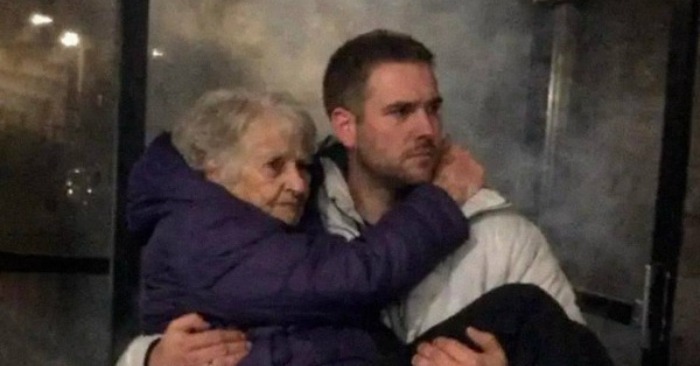
Two days after I carried my elderly neighbor down nine flights of stairs during a fire, a man appeared at my door like he’d been launched out of anger itself. He didn’t knock—he hammered. The whole frame shuddered.
When I opened the door a few inches, he leaned in with a face the color of raw meat and said through his teeth,
“You did that on purpose. You should be ashamed.”
I was thirty-six. A single dad. My son Nick was twelve, and three years ago I buried the only other person who truly made our tiny world feel complete. Since then, it’s been just the two of us—doing the math of grief and groceries, of school projects and silence, of trying to laugh without feeling guilty for it.
We lived on the ninth floor of an apartment building that had given up pretending it was young. The pipes banged like they were arguing. The elevator complained every trip like it was being asked to climb a mountain. And the hallway—no matter the hour—always smelled faintly of burnt toast, like someone was permanently failing at breakfast.
Without her, our place felt too quiet. Not peaceful quiet. Hollow quiet.
Next door lived Mrs. Lawrence.
Early seventies, wheelchair, white hair always combed into place like she still had somewhere important to be. Retired English teacher. Soft voice, razor memory. She corrected my texts—commas, apostrophes, the whole thing—and I actually thanked her because somehow her little red-pen energy made the world feel ordered again.
Nick had been calling her “Grandma L” long before he ever realized the nickname had stuck. It slipped out naturally, like the name had been waiting for her his whole life.
She baked him cakes before exams. She once made him rewrite an entire essay because he mixed up their and they’re and she took it personally. When I worked late, she kept him company so he didn’t sit alone in our apartment listening to the pipes and pretending it didn’t bother him.
That Tuesday started like any other Tuesday.
Spaghetti night—Nick’s favorite because it was cheap and because I couldn’t ruin it unless I tried. He stood at the kitchen table narrating like he was on a cooking show, doing that exaggerated “professional chef” voice that made him sound like a tiny, overconfident adult.
“More parmesan for you, sir?” he announced, raining cheese like confetti.
“That’s enough, Chef,” I laughed. “We’re heading toward a dairy disaster.”
He grinned and launched into the story of a math problem he’d cracked after fighting it for a week.
And then the fire alarm screamed.
At first I stayed still, waiting for it to quit. Our building had false alarms the way some people had seasonal allergies—regular, annoying, expected.
But this one didn’t fade.
It got louder. Meaner. Like it was trying to crawl into your bones.
And then I smelled it.
Not burnt toast. Not somebody’s microwave popcorn.
Real smoke. Thick. Bitter. Wrong.
“Jacket. Shoes. Now,” I said, voice sharp enough to cut.
Nick froze for a heartbeat, then moved—fast. I grabbed my keys and phone and yanked the door open.
Gray smoke rolled along the ceiling of the hallway like a living thing. Someone coughed hard. Someone else shouted, “MOVE! MOVE!”
Nick’s eyes flicked toward the elevator. “Can we—?”
The elevator display was dead. The doors didn’t even pretend to open.
“Stairs,” I said. “You go first. Hand on the rail. Don’t stop.”
The stairwell was chaos. Pajamas. Bare feet. A baby crying so hard it sounded like it might break. People pressed together in that panicked, confused way humans do when they’re trying to decide whether this is real or not.
Nine floors doesn’t sound like much until you’re moving down them with smoke breathing behind you and your kid right in front of you.
By the seventh floor my throat burned.
By the fifth my legs started to complain.
By the third my heartbeat was louder than the alarm.
Nick glanced back, wheezing. “You okay?”
“I’m fine,” I lied. “Keep going.”
We hit the lobby and spilled out into the cold night. People stood in clusters, wrapped in blankets, shivering, staring up at our building like it had personally betrayed them.
I pulled Nick off to the side and crouched so I was eye-level with him.
“You hurt?” I asked.
He nodded too quickly. “Are we going to lose everything?”
I scanned the crowd.
And my stomach dropped.
Mrs. Lawrence wasn’t there.
“I don’t know,” I said, and forced my voice steady. “Listen. You stay here with the neighbors.”
Nick’s head snapped up. “Why?”
“I’m going back for Mrs. Lawrence.”
He understood instantly. The fear on his face sharpened.
“She can’t do the stairs.”
“I know.”
“The elevator’s dead.”
“I know.”
“Dad,” he said, voice cracking, “you can’t go back in there. It’s on fire.”
I put both hands on his shoulders, firm.
“If something happened to you and nobody helped you,” I said, “I would never forgive them. I can’t be the person who leaves someone behind.”
His eyes shined. “What if something happens to you?”
“I’ll be careful,” I promised. “But if you come with me, I’ll be trying to protect you and her at the same time. I need you right here. Safe. Can you do that for me?”
He swallowed hard. “…Okay.”
“I love you.”
“I love you too,” he whispered, like the words were a rope he could hold onto.
Then I turned around and walked back into the building everyone else was running from.
Going up felt worse than coming down.
The stairwell was hotter. The air heavier. The alarm drilled into my skull like it was trying to split it. Smoke hung low and made the world look washed-out and wrong.
By the time I reached the ninth floor, my lungs were screaming and my legs were shaking like they might quit.
Mrs. Lawrence was in the hallway in her wheelchair, purse clutched on her lap like she’d decided dignity was the one thing she wouldn’t drop. Her hands trembled on the wheels.
When she saw me, relief cracked through her face.
“Oh thank God,” she gasped. “The elevators aren’t working. I don’t— I don’t know how to get out.”
“You’re coming with me,” I said.
“Marcus—” she stopped herself, then tried again. “You can’t roll me down nine flights.”
“I’m not rolling you,” I said. “I’m carrying you.”
Her eyes widened. “You’ll hurt yourself.”
“I can do it.”
I locked her wheels, slid one arm under her knees and the other behind her back, and lifted.
She was lighter than I expected, which somehow made it worse—like the body in my arms was proof of how fragile life really was.
Her fingers grabbed my shirt.
“If you drop me,” she muttered, “I’m haunting you.”
“Fair,” I said, teeth clenched. “But haunt me after we’re outside.”
Every step was a fight between my brain and my body.
Eighth floor. Seventh. Sixth.
My arms burned. My back screamed. Sweat stung my eyes so hard I could barely see.
“You can set me down,” she whispered. “Just for a second.”
“If I put you down,” I said through my breath, “I might not be able to pick you up again.”
She went quiet for a while.
Then, softly: “Is Nick safe?”
“Outside,” I said. “Waiting.”
“Good,” she murmured. “Brave boy.”
Those two words carried me through the next landing.
We reached the lobby. My knees nearly folded, but I kept moving until cold air hit my face. I lowered her onto a plastic chair.
Nick spotted us and sprinted over like a rocket.
“Dad! Grandma L!”
He grabbed her hand without thinking, like it was the most natural thing in the world.
Mrs. Lawrence smiled through watery eyes. “Brave boy,” she repeated.
Nick leaned close like he was giving medical instructions. “Remember what the firefighter taught us in third grade. Slow breaths. In through your nose, out through your mouth.”
She laughed and coughed at the same time. “Listen to the tiny doctor.”
Fire trucks arrived. Sirens. Shouted orders. Water. Hoses. The fire had started on the eleventh floor, we learned later. The sprinklers had done most of the work. Our apartments were smoky but intact.
“The elevators are shut down until inspection,” a firefighter announced. “Could be a few days.”
The crowd groaned.
Mrs. Lawrence went still, eyes fixed on the building.
When we were allowed back inside, I carried her up again.
Nine floors. Slower this time. Breaks on landings. My muscles shook like they were begging for mercy.
She apologized the whole way.
“I hate this,” she whispered. “I hate being… in the way.”
“You’re not in the way,” I said. “You’re family.”
Nick walked ahead, announcing each floor like we were on a hike instead of climbing a disaster.
“Seventh floor!” he called. “We’re doing great!”
When we got her settled, I checked her meds, her water, her phone.
“Knock on the wall if you need anything,” I said. “Or call. Whatever.”
Her eyes shined. “You saved my life.”
“You would’ve done the same,” I said automatically—then swallowed, because we both knew she couldn’t have carried me.
The next two days were stairs and soreness.
I hauled groceries up for her, took her trash down, moved her furniture so her wheelchair could turn easier. Nick did homework at her place again, her red pen hovering like a hawk over every sentence.
She thanked me so often I started answering with the same line every time: “You’re stuck with us now.”
For a moment, life felt almost… calm.
And then somebody tried to punch my door off its hinges.
I was making grilled cheese. Nick sat at the table muttering about fractions like they’d personally insulted him.
The first hit rattled the frame.
Nick flinched. “What was that?”
The second hit came harder.
I wiped my hands and opened the door a crack, foot braced against it.
A man stood there—mid-fifties, face flushed, gray hair slicked back like he thought anger made him look important. Expensive watch. Cheap fury.
“We need to talk,” he growled.
“Okay,” I said, keeping my voice neutral. “Can I help you?”
His eyes were sharp, hunting. “I know what you did. During the fire.”
“Do I know you?”
He leaned closer. “You did it on purpose. You’re a disgrace.”
Behind me, Nick’s chair scraped the floor.
I stepped forward, making my body the doorway.
“Who are you,” I said, “and what exactly do you think I did?”
“I know she left you the apartment,” he spat. “You think I’m stupid? You manipulated her.”
“Who?” I asked, even though I already knew.
“My mother. Mrs. Lawrence.”
I stared at him. “I’ve lived next to her for ten years. Funny—I’ve never seen you.”
“That’s none of your business.”
“You’re at my door,” I said. “It’s my business now.”
His mouth twisted. “You play hero, you live off her, and suddenly her will changes. You people always act innocent.”
The phrase you people iced my blood.
“You need to leave,” I said quietly. “There’s a child behind me.”
He leaned in close enough that I smelled stale coffee and old resentment. “This isn’t over. You’re not taking what’s mine.”
I shut the door.
Nick stood pale in the hallway. “Dad… did you do something wrong?”
“No,” I said. “I did the right thing. Some people can’t stand seeing that.”
“Is he going to hurt you?”
“I won’t let him,” I said. “You’re safe. That’s what matters.”
Two minutes later, pounding again—only this time it wasn’t on my door.
It was on hers.
I stepped into the hallway with my phone screen lit like a spotlight.
“Hello,” I said loudly, like I’d already called. “I need to report an aggressive man threatening a disabled elderly resident on the ninth floor.”
He froze, fist mid-air.
“One more hit,” I said, “and I actually place the call. Then we pull the hallway cameras.”
He cursed under his breath and stormed toward the stairwell, his footsteps angry and fast. The door slammed behind him.
I turned and knocked gently on Mrs. Lawrence’s door.
“It’s me,” I said. “He’s gone. Are you okay?”
The door opened a crack. She looked pale. Her hands were shaking.
“I’m sorry,” she whispered. “I didn’t want him bothering you.”
“You don’t apologize for him,” I said. “Do you want me to call the police? Or building management?”
She flinched. “No. That makes him worse.”
“Is he really your son?” I asked.
“Yes,” she said, voice thin.
“And… the will?” I asked. “Is it true?”
Tears pooled in her eyes. “Yes. I left you the apartment.”
I leaned against the doorframe, stunned even though I’d suspected.
“But why?” I asked. “You have a son.”
Her mouth tightened. “Because my son doesn’t care about me,” she said. “He cares about what I own. He talks about putting me in a home like he’s dropping off old furniture.”
She looked up at me, eyes shining.
“You and Nick… you bring soup. You stay when I’m afraid. You come back into a burning building. You carried me down nine flights. I want what I have left to go to someone who loves me—not someone who sees me as a burden.”
“We do love you,” I said, voice rough. “Nick calls you Grandma L when he thinks you can’t hear.”
A soft laugh escaped her. “I hear it. I like it.”
“I didn’t help you because of the apartment,” I said. “I would’ve come back even if you left everything to him.”
“I know,” she whispered. “That’s why I trust you.”
I hesitated. “Can I hug you?”
She nodded.
I stepped inside and wrapped my arms around her. She held on tighter than I expected, like she’d been holding her breath for years.
“You’re not alone,” I said into her hair. “You’ve got us.”
“And you have me,” she said gently. “Both of you do.”
That evening, we ate at her apartment. She refused to let anyone else cook.
“You carried me twice today,” she said, not unkindly but with authority. “You are not serving your child scorched cheese for dinner.”
Nick moved to set the table. “Grandma L, do you want help?”
She waved him off. “I was cooking before your dad could walk. Sit down unless you’re volunteering to write a five-page essay.”
Dinner was nothing fancy—pasta, bread, a little butter—but it tasted richer than anything I’d managed to make lately. Maybe because it wasn’t rushed or desperate. Maybe because it tasted like being home.
Partway through the meal, Nick glanced from her to me, unsure.
“So… does this mean we’re actually a family now?” he asked.
Mrs. Lawrence smiled slightly. “Only if you agree to let me correct your grammar for the rest of your life.”
Nick sighed loudly. “Deal.”
“Then yes,” she said. “We’re family.”
The dent in her doorframe is still there, left by her son’s fist. The elevator still complains on the way up. The hallway still carries the faint smell of burnt toast.
But now, when Nick’s laughter drifts through her apartment, or when she knocks just to hand me a slice of cake, the quiet in our place doesn’t feel empty anymore. It feels settled.
It feels like space.
Space that got filled back in.
Sometimes the people you share blood with vanish when it matters. Sometimes they show up only when there’s something to take.
And sometimes the person next door is the one who becomes your family—not because paperwork says so, but because love shows up when it counts.
Which moment in this story hit you the hardest? Tell us in the Facebook comments.