The pounding came again.
Three slow knocks.
Then silence.
The music continued in the activity hall.
A volunteer laughed near the refreshment table.
Someone dropped a spoon.
But around my mother, every resident had gone completely still.
The director bent toward the silver key.
My mother moved faster than I thought she could.
She placed the toe of her shoe over it.
“No,” she said.
The word was quiet.
But there was something in her voice I had never heard before.
Fear.
The director straightened.
His smile returned almost instantly.
“Eleanor,” he said gently, “you know residents are not allowed to carry service keys.”
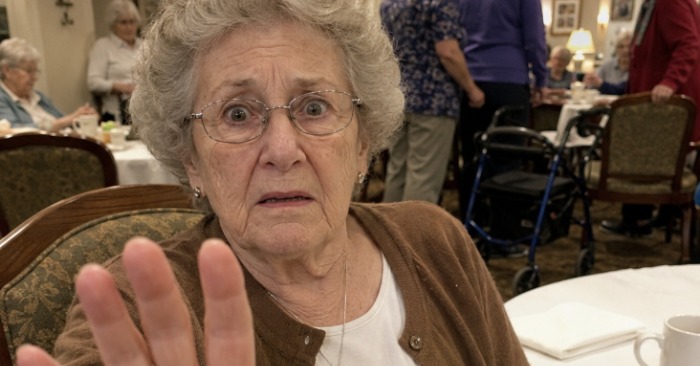
My mother gave him a vague, confused expression.
“I don’t know what you mean.”
Then she looked at me as if seeing me for the first time.
“Are you one of the nurses?”
The director glanced between us.
I understood.
She was still acting.
So I forced myself to smile.
“No,” I said. “I’m just visiting.”
My voice sounded unnatural even to me.
The director studied my face.
For a second, I thought he knew.
Then a staff member called his name from across the room.
He excused himself, but before leaving, he leaned close to my mother.
“You should return to your room soon. Too much excitement can be confusing.”
My mother smiled politely.
The moment he walked away, she bent as if adjusting her shoe and pushed the key toward me with her heel.
I stepped on it.
Neither of us spoke.
Two minutes later, I slipped it into my handbag.
My heart was pounding so hard I could barely hear the string quartet playing in the corner.
I wanted to demand answers.
I wanted to grab my mother and walk out.
But the six-word note was still crushed inside my fist.
Smile. The man beside you is watching.
So I smiled.
I accepted a paper cup of lemonade from a volunteer.
I pretended to admire the flower arrangements.
My mother moved away from me and began discussing bingo with another resident.
To anyone watching, we were strangers.
But every few seconds, she glanced toward the hallway.
Toward Room 214.
I waited until the director disappeared into his office.
Then I followed my mother into the restroom.
The moment the door closed, I turned on her.
“What is happening?”
She pressed one finger to her lips.
Then she checked beneath the stalls.
“Keep your voice down.”
“Mom, you pretended not to know me.”
“I had to.”
“Why?”
Her eyes filled with tears.
“Because they listen.”
A cold feeling spread through my chest.
“Who listens?”
“The director. Two nurses. Maybe more.”
I stared at her.
She had sounded perfectly happy during every phone call.
She told me about movie nights, exercise classes, and a resident named June who cheated at cards.
Now she looked exhausted.
“You said you liked it here.”
“They monitor calls.”
I felt as if the floor shifted beneath me.
“What?”
“They stand near the desk when we use the phones. Sometimes they listen from the medication room.”
“Why would they do that?”
My mother gripped the sink.
“Because residents started asking questions.”
“About what?”
She looked toward the restroom door.
“People have been disappearing.”
I almost laughed.
Not because it was funny.
Because the words were too frightening to accept.
“What do you mean, disappearing?”
“Transferred,” she whispered. “That is what they call it.”
She told me the first had been a retired teacher named Martin.
He complained that money was missing from his personal account.
Two days later, staff said his condition had suddenly worsened and his family had moved him elsewhere.
But his daughter later called the facility looking for him.
She had never authorized a transfer.
Then there was June.
The woman my mother mentioned in nearly every phone call.
Three weeks earlier, June had told several residents that she had seen staff entering rooms late at night and collecting prescription bottles.
The next morning, her room was empty.
The director announced that June had gone to live with relatives.
“She had no relatives,” my mother said.
My mouth went dry.
“And Room 214?”
Her eyes moved toward my handbag.
“That key opens it.”
“What is inside?”
“I don’t know.”
“Then how do you know it matters?”
“Because June gave me the key the night before she vanished.”
A knock sounded at the restroom door.
Both of us froze.
“Eleanor?” a woman called. “Are you in there?”
My mother immediately changed her expression.
Her eyes went unfocused.
“Yes?”
A nurse entered.
She was tall, with smooth blond hair and a warm smile.
She looked at me.
Then at my mother.
“Everything all right?”
I forced a laugh.
“She was helping me find the paper towels.”
The nurse looked toward the dispenser directly beside me.
Her smile tightened.
My mother stepped forward.
“I don’t know this lady,” she said. “But she seems very nice.”
The nurse watched us for another second.
Then she placed a hand on my mother’s shoulder.
“Perhaps you should rest.”
My mother allowed herself to be guided out.
As she passed me, she whispered so softly I almost missed it.
“Call your brother. Not your husband.”
Then she left.
I stood alone in the restroom, staring at my reflection.
My brother, Thomas, was a police detective in another county.
My husband was an accountant.
Why not call him?
Then I remembered something.
My husband had helped me review the nursing home contract.
The director had personally recommended the financial adviser who arranged my mother’s automatic payments.
At the time, it seemed helpful.
Now every connection felt dangerous.
I locked myself inside a stall and called Thomas.
He answered on the second ring.
“You sound upset.”
I told him everything as quickly as I could.
He did not interrupt.
When I finished, there was a long silence.
“Do not go to Room 214 alone,” he said.
“But Mom thinks someone may be inside.”
“I’m serious. Stay where other people can see you. I’m calling local police.”
“How long will that take?”
“Too long if you do something reckless.”
Before I could answer, the restroom lights went out.
The hand dryer stopped humming.
The room fell dark.
Someone tried the door.
Once.
Then again.
I held my breath.
“Hello?” a male voice called from outside.
The director.
“I believe you dropped something.”
The silver key felt heavy inside my handbag.
I did not answer.
The handle moved.
The door opened.
Emergency light from the hallway spilled across the floor.
The director stood in the doorway.
He was still smiling.
But there was no warmth left in his face.
“You should not wander into staff areas,” he said.
“This is a restroom.”
“Of course.”
He stepped inside.
I moved backward.
“Where is my mother?”
“Resting.”
“I want to see her.”
“She is agitated.”
“She was fine ten minutes ago.”
He closed the door behind him.
My brother’s voice was still coming faintly from the phone in my hand.
The director noticed.
“Who are you speaking to?”
“My husband.”
That was the first lie I told him.
For some reason, it seemed to reassure him.
He held out his hand.
“The key, please.”
I said nothing.
“Eleanor has been experiencing episodes of paranoia,” he continued. “She steals objects. Invents stories. Sometimes she fails to recognize family.”
I almost admired how carefully he had built the explanation.
Had my mother not warned me, I might have believed him.
“Why did she have a service key?”
“She took it.”
“From whom?”
His jaw tightened.
“That is not your concern.”
Then someone screamed in the hallway.
The director turned.
I pushed past him.
Residents were gathering near the entrance to the restricted wing.
My mother stood in the middle of them, gripping the metal rail along the wall.
A nurse was trying to pull her away.
My mother shouted when she saw me.
“Open it!”
The director grabbed my arm.
“Do not.”
Every face turned toward us.
I pulled away.
“Why?”
“Because Room 214 contains medical equipment. Entering would endanger residents.”
My mother laughed bitterly.
“Then why does someone cry in there at night?”
The hallway erupted in whispers.
Other residents began speaking at once.
“I heard it too.”
“Someone calls for water.”
“They move people after midnight.”
The director’s expression collapsed.
Not completely.
Just enough.
I took the silver key from my bag.
A nurse blocked the hallway.
Then the front doors opened.
Two police officers entered.
Behind them was Thomas.
I had never been so relieved to see anyone.
The director raised both hands.
“This is a misunderstanding involving residents with cognitive decline.”
Thomas looked at me.
“Do you have the key?”
I nodded.
He took it and walked toward Room 214.
The director stepped in front of him.
“You need a warrant.”
A muffled thud came from behind the door.
Then a woman’s voice.
“Please.”
No one moved.
Thomas looked at the officers.
“That is exigent circumstances.”
He unlocked the door.
The smell hit us first.
Bleach.
Medication.
Something sour beneath it.
The room had no windows.
A narrow bed stood against one wall.
On it lay June.
She was alive.
Barely conscious.
Her wrists were bruised.
An intravenous line ran into her arm.
Beside the bed were boxes filled with residents’ medication bottles, bank documents, checkbooks, and signed powers of attorney.
One officer swore under his breath.
My mother began to cry.
June opened her eyes when she heard her name.
“Eleanor?”
My mother pushed past everyone and went to her.
“I’m here.”
June started sobbing.
The director attempted to leave.
He made it three steps before an officer stopped him.
The blond nurse began insisting that June was receiving emergency psychiatric care.
But there were no medical orders.
No transfer records.
No doctor’s signature.
Only documents granting temporary control over her finances.
More rooms were searched that afternoon.
Police found forged forms, diverted prescription medication, and records showing that vulnerable residents had been declared incompetent shortly before money disappeared from their accounts.
Some had been secretly moved to cheaper facilities.
Some families had been told their relatives no longer wanted contact.
Others had been persuaded that worsening memory made visits upsetting.
The director had created confusion and then used it as proof.
My mother had realized he was watching her weeks earlier.
So she began acting forgetful.
She repeated herself around staff.
Pretended to lose things.
Allowed them to believe she was harmless.
All while collecting names, dates, and room numbers.
She had planned to give me the key during the open house.
But when she saw the director watching us, she knew she could not greet me as her daughter.
Because if he knew she had warned me, he could move June before anyone arrived.
That evening, I sat beside my mother in a hospital waiting room while doctors examined June.
I still felt hurt.
Not because my mother had pretended not to recognize me.
Because she had been terrified for weeks and believed she had to face it alone.
“Why didn’t you tell me sooner?” I asked.
She looked down at her hands.
“Because I knew you would come immediately.”
“Of course I would.”
“And he knew that too.”
She was right.
I would have stormed into the director’s office.
I would have accused him without evidence.
He would have smiled, shown me paperwork, and transferred my mother before sunset.
Instead, she waited.
She acted weaker than she was.
And she trusted me to understand six words.
I took her hand.
“I thought you were ashamed of me.”
Her face crumpled.
“Oh, sweetheart.”
She pulled me close.
For the first time that day, she said my name.
The investigation lasted nearly a year.
The director and several employees were charged with financial exploitation, unlawful confinement, fraud, and medication theft.
June survived, though she never fully regained her strength.
My mother moved into a smaller residence near my home.
At first, she refused to attend social events.
Crowded rooms reminded her of the open house.
Locked doors frightened her.
But slowly, she returned to herself.
She planted tomatoes in the courtyard.
She started a card club.
She still cheated occasionally.
She claimed it was strategy.
As for the napkin, I kept it.
The ink faded.
The paper tore along one fold.
But the six words remained visible.
Smile. The man beside you is watching.
People often assume pretending not to recognize someone is an act of rejection.
That day, it was an act of love.
My mother did not forget who I was.
She remembered exactly who I was.
She knew I would notice.
She knew I would follow.
And she knew that sometimes the bravest cry for help must look like silence.