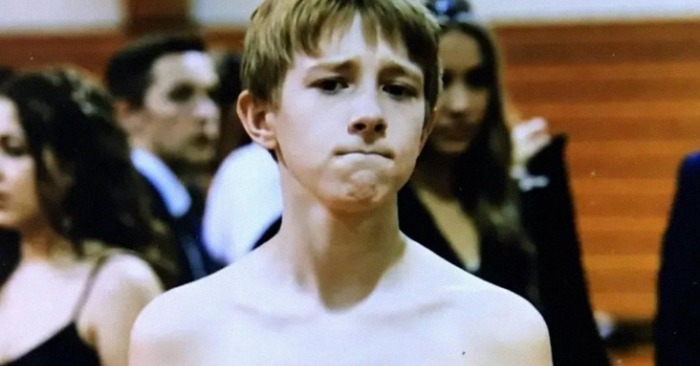
I raised my son alone from the very beginning. I was young when I got pregnant, and my parents didn’t accept it. His father, Ryan, vanished the second he learned I was keeping the baby—no calls, no support, nothing. Just gone. So it was only Liam and me, figuring life out one day at a time.
I loved him more than I knew how to say, but I worried constantly. I worried that without a father figure he’d be missing something important. I worried I wouldn’t be enough. That one day he’d look back and find a hole where something should’ve been, and blame me for it.
Liam has always been quiet and observant. He’s the kind of kid who watches everything and says very little. He feels things deeply—so deeply that sometimes it squeezes my chest just watching him move through the world. It’s like he experiences life at full volume and doesn’t know where to place all that feeling, so he locks it away. He hides behind careful smiles and short answers, keeping his heart folded up where no one can step on it.
It was always just the two of us.
As graduation got closer, Liam became even more closed off. After school he would disappear for hours.
“Just helping a friend,” he’d say when I asked where he’d been.
He guarded his phone like it contained state secrets, flipping it face-down the moment I entered a room. I tried not to push, but the anxiety ate at me every single day. I couldn’t stop the thoughts: Is he in trouble? Is someone hurting him? Is he hiding something from me because he doesn’t trust me?
One evening, he came to me and stood there shifting his weight from one foot to the other, twisting the strings of his hoodie the way he used to when he was little and scared to say something out loud.
“Mom,” he said quietly, not quite meeting my eyes, “tonight at graduation I’m going to show you something. And then you’ll understand why I’ve been acting weird.”
My stomach tightened like a fist.
“Understand what, sweetheart?” I asked, trying to keep my voice steady.
He gave me a nervous, shaky little smile. “Just… wait. Okay?”
Graduation day arrived, and I got to the auditorium early. I was trembling with pride and nerves, that feeling like your heart is too full for your ribs. The room buzzed with energy—parents snapping photos, teachers congratulating students, kids in gowns laughing and shouting names across rows.
And then I saw my son—and I froze.
Liam walked through the double doors wearing a red dress.
Not a small one. Not subtle. A full, flowing, dramatic red gown that caught the auditorium lights and shimmered as he moved. It was bold. Unapologetic. Impossible to miss.
For a second, my brain didn’t know what it was seeing. Then the reaction hit the room like a spark finding gasoline.
Laughter broke out.
“Look at him!” a boy shouted, loud enough that half the row turned. “He’s wearing a dress!”
Another voice, smug and amused: “Is this a joke or what?”
Behind me, a parent whispered far too loudly, “What is he supposed to be, a little girl?”
More voices joined in—sharp, mocking, cruel.
“Why would he wear that?”
“Someone tell him this isn’t appropriate!”
“Oh my God, this is insane,” a girl near the aisle muttered, already lifting her phone to record.
Even some teachers exchanged tense, uncertain looks—like they weren’t sure whether to intervene, pretend they didn’t see it, or panic quietly.
My hands started shaking in my lap. My first instinct was to stand up, run to him, wrap him in my arms, and pull him out of there before the room could get worse. I wanted to shield him from every laugh and whisper and stare.
But Liam kept walking.
His head was up. His shoulders were steady. His face was calm—so calm it stunned me. He didn’t rush. He didn’t shrink. He didn’t look around like he was hunting for safety.
He walked like he had already decided this was worth it.
The laughter didn’t stop immediately. It followed him in ugly waves.
“He looks like a girl!”
“This is so embarrassing!”
“Bro, what are you doing?!”
And then Liam reached the front. He stepped to the microphone on the stage.
He stood there for a moment and looked out at the crowd with those thoughtful, careful eyes he’s always had—eyes that don’t miss anything.
Slowly, the room began to quiet. The mocking faded into whispers, then into a strange, thick silence.
My heart hammered so hard I felt it in my throat. I could barely breathe. What is he doing? What is about to happen?
Liam spoke.
“I know why you’re laughing,” he said. His voice was steady, but I could hear a tremor underneath it, like he was holding a storm in place. “But tonight isn’t about me. It’s about someone who needed this.”
Silence pressed down over the auditorium like a heavy blanket. The smirks dropped. The phones paused mid-air. People leaned forward without realizing they were doing it.
Liam swallowed once, then continued.
“Emma’s mom died three months ago,” he said, and now his voice shook for real. “They were practicing a special graduation dance together. They worked on it for weeks. And after her mom died… Emma didn’t have anyone left to do it with.”
You could hear nothing but breathing.
Liam’s eyes flicked toward the curtain at the side of the stage.
“This dress,” he said, “was designed to look like what Emma’s mom would’ve worn tonight. I’m wearing it so Emma doesn’t have to stand alone. So she can still have her dance.”
The tears hit me so fast I couldn’t fight them. They spilled hot down my face before I even had a chance to wipe them away.
My quiet, guarded son—my boy who hated attention, who shrank away from crowds—had chosen to step into the center of the room wearing something that would invite ridicule, because he cared more about someone else’s pain than his own comfort.
Liam turned slightly and held out his hand.
“Emma?” he said softly. “Will you dance with me?”
A girl stepped out from behind the curtain.
She was crying so hard her shoulders shook. Her face looked overwhelmed—like she couldn’t believe this was real. But then she walked toward Liam, placed her hand in his, and nodded.
Music began—soft at first, then swelling into something tender and heartbreaking.
They started to dance.
Every step felt careful, like Liam was holding not just Emma’s hand but her grief, her memories, her whole shattered world. Emma’s tears kept falling, but she was smiling too—like something inside her that had been broken had been gently, briefly repaired.
I cried openly. I didn’t even try to hide it.
I thought about the weeks Liam must have spent planning this. The hours he disappeared after school. The secrecy. The tension he carried. The judgment he knew was coming. He had walked straight into it anyway.
Because he chose kindness over fear.
Because he chose compassion over fitting in.
As they danced, the room changed. The laughter was gone, replaced by something else entirely—respect, awe, the kind of silence that feels like it has weight.
Students who had laughed were wiping their eyes. Parents who had whispered cruel things sat frozen with hands over their mouths. Teachers were crying openly.
When the dance ended, the auditorium erupted.
Applause thundered so loud it shook the room.
Emma threw her arms around Liam and held him like she never wanted to let go. He hugged her back and whispered something I couldn’t hear. She nodded, wiping her face, trying to breathe.
Then Liam—still in the red dress—walked straight toward me.
“Mom,” he said quietly, voice thick, “I wanted to tell you everything.”
I stood up and grabbed his hands.
“One day,” he continued, “I walked past an empty classroom and saw Emma in there crying alone. She was watching a video on her phone—her and her mom practicing their dance. She thought she’d lost her chance to have that moment. And I just… I couldn’t leave her like that.”
His eyes were red, but there was relief in them now, like he’d finally stopped holding his breath.
“So I decided to give it back to her,” he said. “I wanted to be brave—for Emma, for her mom… and for me.”
I pulled him into my arms and held him so tightly I could feel his heartbeat through his chest.
“You are the most incredible person I know,” I whispered into his hair. “You have made me prouder than I ever thought possible.”
He pulled back a little and looked at me, almost scared.
“You’re not mad?” he asked.
“Mad?” I let out a wet laugh through my tears. “Liam, I admire you.”
People started approaching us.
Students who had mocked him earlier looked embarrassed, shuffling their feet, offering awkward apologies. Parents who had whispered ugly comments reached out to shake his hand and told him he was brave, that it was beautiful, that they were moved.
Emma’s father found us in the crowd. Tears ran down his face. He didn’t even speak at first—he just pulled Liam into a strong, shaking hug.
When he finally managed words, they came out broken.
“Thank you, son,” he said. “You gave her something I couldn’t.”
Liam nodded, uncomfortable with the attention like always, but polite and steady.
Later, driving home in the quiet dark, I finally found the words that had been tangled in my chest all night.
“Liam,” I said softly, “you taught me something today.”
He glanced over. “Yeah?”
“Being brave isn’t only about standing up for yourself,” I said. “It’s standing up for other people—even when it costs you. Especially when it costs you.”
He gave a small, almost shy smile and looked out the window.
“I just didn’t want Emma to feel alone,” he said. “I wanted her to know she matters.”
And in that moment, every fear I’d ever carried about raising him alone came rushing back—every late-night worry, every question, every silent panic about whether I was enough.
I had wondered if he would be strong without a father in his life.
And now I understood something so clearly it felt like the air changed around me:
My son was already stronger than I ever imagined—not because he was loud or tough or traditionally “masculine,” but because he was gentle and brave and deeply kind in a world that doesn’t always reward those things.
He didn’t learn that from a father.
He learned it by watching me fight, survive, and show up every single day.
And somehow… that had been enough.
By the following day, Liam’s moment had taken on a life of its own. It began with a short segment on a local channel. Then national outlets followed. A single image of him in that red dress exploded online, reposted endlessly beneath captions like “This Is Real Courage.” Messages poured in from people he’d never met, thanking him for what he’d done. Emma’s relatives called again, their voices shaking, promising they would remember his kindness forever.
Through it all, Liam didn’t change. He stayed soft-spoken, modest, a little uncomfortable with all the praise.
“I wasn’t trying to make headlines,” he said when another reporter reached out.
“I know,” I answered, giving his hand a squeeze. “That’s why it means so much.”
About a week later, Emma stopped by with something wrapped carefully in tissue paper. Inside was a scrapbook filled with snapshots of her and her mom—ordinary moments, happy moments, moments frozen in time.
The last page held a photo from graduation night: Emma and Liam dancing together, both of them crying, both of them smiling through it.
Beneath the picture, she had written:
“Thank you for bringing my mom back to me—even if just for one song.”
Liam read the words once. Then again. And then he broke down.
I held him close and realized how much he’d grown—not just physically, but in the ways that truly matter.
Some of the quietest kids carry the deepest feelings.
And that night, in that crowded room, Liam’s heart spoke louder than anything else.
For a long time, I worried I wasn’t enough for him. That he needed something—or someone—I couldn’t provide.
But watching him dance in that red dress, watching the care and tenderness with which he held Emma, I finally understood a truth I’ll never let go of:
My son never needed a father to show him how to be a man.
He needed someone to teach him how to be human.
And against everything stacked against us, that’s exactly what he became.
To every parent out there raising a child alone and wondering if you’re enough: you are.
Not because you’re perfect.
Because you stayed.
And sometimes that’s all it takes to raise something extraordinary.
What would you do if this happened at your child’s graduation? Share your thoughts in the Facebook comments.