Then I married Daniel.
He didn’t “step in” the way people say it like it’s a favor. He showed up like it was the most natural thing in the world. He packs Emma’s lunches. He learns school-project science facts at midnight. He reads the same bedtime stories over and over because she likes the voices he does.
In every way that matters, he’s her dad.
But his mother, Carol, never accepted that.
She didn’t scream it in public. She didn’t throw tantrums. Carol was the slow-drip kind of cruel—the type that sounds polite until you replay her words later and realize your stomach is tight.
“It’s adorable how you pretend she’s your real daughter,” she once told Daniel, smiling like it was a compliment.
Another time: “Stepchildren never feel like actual family.”
And the one that made my blood run cold every single time: “She’s a reminder of your dead husband. That must be… complicated for you.”
Daniel shut it down whenever he heard it. Every time. Calm voice. Firm boundary.
But Carol never stopped trying.
So we did what families like ours do when we’re exhausted: we managed her. Short visits. Neutral conversation. Smiles that didn’t reach our eyes. Keep the peace, because the alternative felt like lighting a match in a room full of gas.
Then Daniel left for a two-day work trip.
And Carol finally stopped being “difficult” and became something else entirely.
Emma has always had an unusually big heart. The kind that makes strangers soften. The kind that makes you both proud and terrified for how the world might treat her.
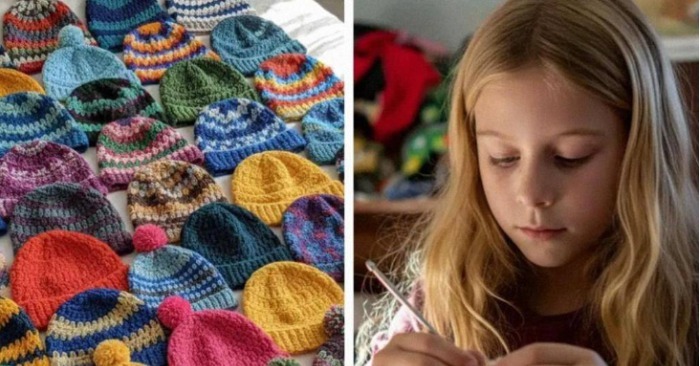
In early December, she decided she wanted to crochet eighty hats for kids spending the holidays in hospice.
Eighty.
She taught herself from YouTube videos, using the tiny allowance she saved to buy her first yarn. Every afternoon became a ritual: homework, a snack, and then the quiet click-click of her hook. Each finished hat got folded carefully into a big bag beside her bed like it was treasure.
I watched her work and thought, How did I raise someone this kind?
She was on hat number seventy-nine when Daniel packed his suitcase and kissed her forehead. “I can’t wait to see the final one when I get back,” he said.
Emma beamed. “I’m gonna hit eighty!”
The second his car disappeared down the street, it was like Carol sensed the vacancy.
Whenever Daniel travels, she suddenly “checks in.” She frames it as concern, but it feels like inspection. Like she’s waiting to see what kind of household we are when her son isn’t there to buffer her.
That afternoon, Emma and I came home from running errands. She ran to her room, excited to pick colors for the last hat.
Five seconds later, she screamed.
“MOM—MOM!”
I dropped the grocery bags and flew down the hall.
Emma was on the floor of her bedroom, sobbing so hard she couldn’t catch her breath. Her bed was stripped of the big bag. The bag that held every single hat—weeks of work, hours of love—was gone.
I scooped her up, trying to calm her, trying to understand.
And then I heard a quiet clink behind me.
Carol stood in the doorway holding tea in one of my nicest cups, looking perfectly composed—like she’d just finished watering plants, not ripping a child’s heart out.
“If you’re looking for that bag,” she said, breezy as weather, “I threw it away.”
My brain didn’t register the sentence at first. Like my mind refused to accept it.
“You… threw away eighty hats?” I managed.
Carol rolled her eyes. “They were ugly. Clashing colors, sloppy stitches. And honestly—why are you encouraging her to waste money on strangers? She isn’t my blood. She doesn’t represent this family.”
Emma made a broken little sound, like a hiccup of disbelief.
I stared at Carol, waiting for the punchline.
There wasn’t one.
She sighed dramatically—dramatically, as if she was the one being inconvenienced—and walked away.
Emma collapsed against me, crying like something inside her had cracked.
Every part of me wanted to chase Carol down and erupt. But Emma needed me more than my anger did. So I held her and whispered every soothing word I could find, even though I felt like I was the one falling apart.
When she finally calmed enough to release me, I went outside.
I dug through our trash. Then the recycling. Then the bins nearby, because I was frantic enough to believe maybe Carol was lying, maybe she’d hidden them, maybe I’d find a corner of yarn like a miracle.
Nothing.
That night, Emma cried herself to sleep.
I sat by her bed until her breathing evened out. Then I went to the living room, stared at the wall, and let my own tears come—hot, angry ones that tasted like helplessness.
I thought about calling Daniel. I almost did.
But I convinced myself to wait because he was traveling, because he had meetings, because I didn’t want him distracted.
That decision—my silence—became the spark that lit everything.
When Daniel got home, he walked through the door like sunshine.
“Where’s my girl?” he called. “I want to see the hats! Did you hit eighty while I was gone?”
Emma was watching TV. The second he said “hats,” she burst into tears.
Daniel froze.
“What happened?” he asked, voice instantly different—tight, protective.
I pulled him into the kitchen, out of Emma’s earshot, and told him everything.
I watched his face change—confusion to horror to a kind of anger so controlled it felt dangerous. Like the only thing keeping it in check was love.
“She did what?” he said softly, like his voice didn’t trust itself louder.
“I don’t even know where she dumped them,” I finished. “I searched everywhere. They’re gone.”
Daniel stared at the counter for half a second. Then he went back to Emma, sat beside her, and wrapped an arm around her shoulders.
“I’m so sorry I wasn’t here,” he said gently. “But I need you to hear me: Carol will never hurt you again. Not once.”
He kissed her forehead, stood up, grabbed his keys, and looked at me.
“I’m going to fix what I can,” he said. “I’ll be back.”
Two hours later, he returned carrying a huge black trash bag.
I met him in the kitchen, heart pounding.
He unknotted the top.
Inside were Emma’s hats—squished, a little rumpled, but there. Pastels, bright stripes, messy-but-perfect stitches made by a child who cared more than most adults ever do.
My knees almost gave out.
“I spent an hour going through the dumpster behind her building,” Daniel said. He lifted a soft yellow hat—one of Emma’s early ones. “These aren’t ‘ugly.’ This is a kid trying to bring warmth to sick children. And my mother stole that from her.”
Half an hour later, Daniel made the call.
“Mom,” he said, steady. “Come over. I’ve got a surprise for you.”
Carol arrived like she was walking into a reward ceremony.
“Daniel! You said surprise,” she chirped, brushing past me like I was a coat rack. “I canceled dinner plans for this.”
Daniel held up the trash bag.
Carol’s face tightened as he pulled a hat out and set it on the table like evidence.
Her mouth curled. “You dug through garbage? You’re being dramatic over a sack of poorly made hats.”
Daniel’s voice dropped. “You didn’t just insult the hats. You insulted my daughter.”
Carol snapped, sharp and pleased: “She’s not your daughter.”
It was like something in Daniel’s expression went still—like a door closing.
“Get out,” he said.
Carol blinked. “Excuse me?”
“You heard me,” Daniel said, louder now. “You are not welcome here. You will not speak to Emma again. You will not visit. We’re done.”
Carol’s face flushed. “Because of yarn? Daniel, I’m your mother!”
“And I’m a father,” he shot back, “and my job is to protect a ten-year-old girl from you.”
Carol turned to me, stunned. “You’re allowing this?”
I didn’t raise my voice. I didn’t need to.
“Absolutely,” I said. “You chose cruelty. You don’t get access to our home after that.”
Carol looked between us like she couldn’t compute a world where she didn’t win. Then she hissed, “You’ll regret this,” and stormed out, slamming the door so hard the frames on the wall rattled.
For a few days after that, the house was quiet.
Not peaceful—quiet like after a storm, when you’re checking what broke.
Emma didn’t crochet. She didn’t mention the hospice kids. She moved carefully, like her kindness had been punished and she wasn’t sure if it was safe to be herself again.
Then one evening Daniel came home carrying a huge box and set it on the table in front of her.
Emma blinked. “What’s that?”
Daniel opened it.
New yarn. Soft, beautiful colors. Fresh hooks. Tissue paper. Little packaging supplies.
“If you want to start over,” he said, “I’m with you. I don’t know what I’m doing, but I’ll learn.”
He picked up a hook like it was a tiny weapon and frowned at it. “Will you teach me?”
Emma stared at him.
And then—for the first time in days—she laughed.
Daniel’s first attempts were honestly terrible. He made something that looked like a sad sea creature. Emma laughed so hard she snorted.
And slowly, stitch by stitch, she started again.
Two weeks later, she reached eighty.
We delivered the hats.
A couple days after that, an email came from the hospice director—thank yous, real gratitude, and a request: could they post photos of the kids wearing the hats?
Emma nodded, shy but proud.
The post went viral.
People flooded the comments, asking about “the sweet girl who made these.” I let Emma reply through my account.
And because Emma is honest in the way only kids are, she wrote:
“I’m happy they got the hats! My grandma threw away the first set, but my dad helped me make them again.”
That same day, Carol called Daniel sobbing like she was the victim of a crime.
“They’re calling me a monster! They’re harassing me! Make them take it down!”
Daniel didn’t shout. He didn’t insult her. He sounded almost calm.
“We didn’t post it,” he said. “The hospice did. And if you don’t like the truth being public, you should’ve behaved differently.”
Carol wailed. “I’m being bullied!”
Daniel’s voice was flat. Final.
“You earned it.”
Emma and Daniel still crochet together on weekends.
Our house has its sound back—the steady click-click of hooks, the soft conversation, the quiet safety of a child who knows her dad will not let anyone make her feel “less than” again.
Carol sends messages on holidays and birthdays. She’s never truly apologized. She always asks if we can “move forward.”
And Daniel answers the same way every time:
“No.”
Because peace isn’t something you beg for.
It’s something you protect.