The scorching July sun in Madrid beat down relentlessly, transforming the city into an oven. The streets of Alcalá were clogged with traffic, the cacophony of honking horns and frustrated drivers filling the air. But inside Fernando Rivas’ sleek black Bentley, the temperature was perfect. He was insulated from the chaotic world outside, a successful CEO at the helm of Rivas Tax Solutions, a premier financial consulting firm in Europe. At 38, Fernando had everything: wealth beyond measure, influence, and a name that was synonymous with power.
But even the world’s wealthiest can run out of patience. The traffic had come to a standstill, and Fernando, his calm usually unshakable, snapped. “Pedro, I’m stepping out,” he told his driver. “I need some air, even if it’s this stifling heat.” His luxury apartment was a short walk away, and he figured a few minutes on foot would help him clear his mind before an important merger meeting with Singaporean investors the following week. Everything in his life was planned with precision—nothing was left to chance.
As he walked briskly, dodging tourists and construction sites, his mind was consumed by numbers and strategies. But then, everything came to a sudden halt. It wasn’t a noise or even a call; it was a voice. A voice he hadn’t heard in six years but that had remained embedded in his memory, hidden in a painful corner.
— “David, don’t run! Leo, help your brother with the bag. Mateo, tie your shoelaces!”
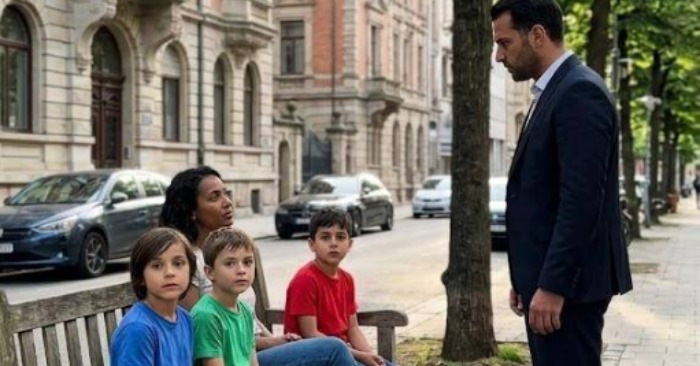
Fernando’s head whipped around, and there she was—Claudia. Her hair was tied back loosely, and she wore simple, casual clothes, a stark contrast to the elegant dresses she used to wear when they were together. But what stunned him wasn’t seeing her—it was the three children around her.
Three boys. Identical to one another. And, terrifyingly, identical to him.
It was like looking at a trio of miniature versions of his childhood photos. The same piercing green eyes, the same sharp jawline, and even the same rebellious curl in his hair—just like the one he used to tame every morning with gel. He stood frozen, unable to breathe, as people moved around him like ghosts.
One of the boys, wearing a rocket shirt, noticed him and tugged at Claudia’s sleeve.
— “Mom, that man is staring at us funny.”
Claudia looked up. Her eyes met Fernando’s, and in that moment, time itself seemed to freeze. Her expression shifted from exhaustion to shock, then to sheer fear. Without thinking, she grabbed the children’s hands as if protecting them from a threat.
Fernando could barely move, his feet dragging as he approached them. His heart hammered in his chest.
— “Claudia…” His voice cracked, barely a whisper. “Are those kids…?”
She didn’t answer. Instead, she pressed her lips together tightly, her eyes filled with a mixture of anger and terror.
— “They’re mine,” Fernando murmured, more to himself than to her. It wasn’t a question, but a painful realization that hit him like a ton of bricks.
Claudia’s eyes flicked between the children and him before she sighed, pulling a pen from her bag. Scribbling something quickly on a receipt, she handed it to him with a push to his chest.
— “Tomorrow. 12:00. Donato Café. Don’t follow me now.”
And just like that, she walked away. Fernando stood there, holding the crumpled paper in his hand, with the unmistakable feeling that everything he had worked for—the money, the empire—had suddenly become meaningless in the face of three innocent faces that stared at him, not knowing who he was.
He thought the shock would be the hardest part. That with enough money, with a few well-chosen words, he could fix the past. But little did Fernando know, this was just the beginning of his awakening, and life was about to teach him the hardest lesson of all: there are things money can’t fix.
That night, sleep eluded him. He tossed and turned in his sprawling penthouse, a place that felt emptier than ever before. The next day, he arrived at the café twenty minutes early. When Claudia walked in, she wasted no time.
— “Their names are David, Leo, and Mateo. They’re six years old,” she said bluntly, not bothering to order anything. “And yes, they’re yours.”
— “Why?” Fernando’s throat closed with emotion. “Why didn’t you tell me? You knew where to find me. I’m a public figure, Claudia.”
She let out a bitter laugh.
— “Do you think I didn’t try? I came to your office in Valencia when I was four months pregnant. They threw me out, said you were in an ‘important’ meeting. I emailed you. Nothing. I figured you chose your career over us. Like always.”
The memory hit him hard. Six years ago, consumed by his ambition to expand into Asia, he had ordered his staff to filter out all personal distractions. He had erased Claudia from his life, prioritizing his career over everything else. Now, that very career was staring at him, embodied in three pairs of reproachful eyes.
— “I want to meet them,” he said, his voice breaking. “I want to be their father.”
— “Being a father isn’t about signing checks, Fernando,” she snapped. “It’s being there when they’re sick, when they fall, when they’re scared. You don’t know how to do that.”
— “Let me try. Please.”
Claudia stared at him for a long moment, her gaze searching for any hint of sincerity. Finally, she nodded.
— “One chance. But on my terms. If you fail them, if I see them hurt because of you, you’re out. Understood?”
Fernando nodded desperately. “I won’t fail.”
The first few meetings with the boys were awkward. David, the outgoing one, warmed up to him quickly, fascinated by his stories. Leo, the intellectual, eyed him warily. But Mateo, the quiet one, remained distant, suspicious of this stranger in a suit who seemed to be just passing through.
Gradually, Fernando began to change. He started canceling business dinners to share pizza at Claudia’s modest home. He swapped his expensive suits for jeans and spent hours building Legos with the boys. He learned that David dreamed of being an astronaut, that Leo was a chess prodigy, and that Mateo played the piano with an emotion that broke his heart.
But Fernando’s old world wasn’t ready to let him go just yet.
The crisis hit on a Friday. The merger with Singapore was on the brink of collapse. The investors demanded an urgent call to finalize the deal, or they would pull out, taking with them 300 million euros. The meeting was scheduled for 6:00 PM.
At the same time, Mateo had his first piano recital—the first time he would play solo. He had been practicing for weeks, and just the night before, he had asked Fernando: “Are you coming? Promise me you’ll be there.” Fernando had promised.
At 5:55 PM, Fernando was in his office, his hands clammy as he stared at the clock. The call with the investors could take just 30 minutes—enough to make it to the recital, he thought. He could manage both, he convinced himself.
But the negotiations dragged on. The minutes felt like hours. 6:15. 6:30. 6:45. Fernando’s phone buzzed incessantly. It was Claudia, but he ignored it, focusing instead on the call, forcing a smile as he discussed tax projections.
By 7:15, the deal was done. He’d saved the company. He rushed to the school, but when he arrived, the auditorium was empty. Only the janitor was left, sweeping the floor.
Panicked, Fernando drove straight to Claudia’s house. She opened the door, arms crossed, eyes swollen.
— “Did you finish your business?” she asked, her voice icy.
— “Claudia, it was 300 million. I couldn’t just walk away…”
— “Mateo waited for you,” she interrupted. “Before playing each note, he looked at the empty chair in the front row. Afterward, he asked me if something had happened to you. I told him you were just busy. He said, ‘Better to leave, Mom. Mr. Rivas has more important things.’”
“Mr. Rivas.” The words cut deeper than any financial loss.
— “I can fix this,” Fernando pleaded. “I’ll buy him that piano, I’ll explain…”
— “Go, Fernando. Not tonight.”
That night, as he sat in his luxurious penthouse, Fernando stared at his reflection in the window. He saw a man—rich, powerful, and utterly empty. It was clear now. His friend Marcos had been right: “It’s not about balance, it’s about priorities. And if family never wins, you’ve already lost.”
The next day, he called a board meeting. Not to discuss Singapore, but to present something much more radical. He proposed a new vision: the Family First Project. Flexible hours, no calls after hours, a corporate campus with daycare, a school, and family spaces. He wanted his employees to have the choice between career and family.
The board was outraged.
— “You’re crazy!” shouted Richard, the president. “The investors will leave! This is financial suicide! We’ll vote to remove you on Monday. If this happens, you’re out.”
But Fernando didn’t back down.
— “Do what you need to do.”
On Monday, the vote came. Fernando’s future was on the line. But that morning, his phone rang. It was Claudia, panic in her voice.
— “It’s Leo. He’s had an accident at the chess tournament. He’s in the ER. He’s asking for you.”
Fernando glanced at the clock. Only twenty minutes before the vote. Victoria, his loyal assistant, urged him to stay and save his career.
— “Fernando, if you don’t go in there and convince them, you’ll lose everything. The company. Your empire.”
He looked at the boardroom, full of gray suits, then glanced at the photo of his children on his phone. For the first time, the choice was easy.
— “Victoria,” he said, handing her his briefcase. “You go in. Tell them my proposal stands. If they fire me, they can send the papers. I have a chess tournament to win.”
He ran out, leaving his assistant speechless.
When he arrived at the hospital, Leo was calm, his arm in a cast. When he saw Fernando, his face lit up.
— “Dad!” Leo cried, and Fernando held him tightly.
He spent the entire day at the hospital, laughing with the boys, playing cards, and telling silly jokes to distract them. His phone kept vibrating. He didn’t answer once.
Later, as Leo slept peacefully, Claudia approached him.
— “You had an important meeting today, right?” she asked, her voice soft. “I saw the news. They said your job was at risk.”
Fernando just shrugged.
— “I had something more important here.”
At that moment, his phone buzzed with a message from Victoria: “The vote was 7 to 6. You barely made it. And Fernando… the Singapore representative said they want a partner who’ll risk everything for his principles. They’ve doubled the investment for the family campus.”
Fernando exhaled in relief and showed Claudia the message. She smiled—a smile that reached her eyes for the first time in years. She took his hand.
— “I think Mateo has forgiven you,” she said softly. “But you’ll have to work hard for the next recital.”
Six months later, the Rivas Family Campus was unveiled, making headlines worldwide. A place where employees could enjoy family time. Fernando stood there, scissors in hand, surrounded by his three children, ready to cut the ribbon.
— “Ready, Dad?” David asked, impatience in his voice.
— “Ready,” Fernando replied, his heart full.
He looked at the crowd, the joyful employees, the satisfied investors. Then his gaze turned to Claudia, watching from the front row, and finally to his children. For the first time, he realized that his definition of success had been all wrong. It wasn’t about skyscrapers or bank accounts. It was about moments like this. A regular Tuesday, tie undone, knowing he’d be home in time for dinner.
Fernando cut the ribbon, but his greatest achievement wasn’t the campus. It was that when Mateo looked at him and smiled, he didn’t see “Mr. Rivas.” He saw his dad. And that was worth more than any fortune in the world.