December settled over Hacienda San Pedro like a spell, wrapping the grand estate in the heart of Jalisco in a beauty so vivid it felt unreal. Golden lights hung from the tall jacaranda trees and cast a soft glow over the central courtyard, where the scent of white tuberoses drifted through the night air, mixing with damp earth and the smoky sweetness of aged tequila. Elegant tables decorated with talavera accents and trembling candlelight framed a vast wooden dance floor. Three hundred and fifty guests had come from across Mexico to witness the day Jimena had imagined for years—her wedding. Since she was a little girl, she had pictured this moment as the doorway to the life she wanted most: a future beside the man she believed was her great love.
Inside the hacienda’s main suite, Jimena stood before the mirror in a silence so still it almost felt holy. Her gown was breathtaking, a white masterpiece with delicate lace stitched across the bodice and shoulders, while tiny handmade blossoms were tucked into her dark, carefully pinned hair. She had waited three long years for this night. Then the door opened and Sofía, her closest friend, rushed in, breathing quickly, her eyes bright. She said the mariachis were ready, the families were already seated, and Mateo was waiting beside the flower-covered altar in the garden, eager for her to appear. Jimena drew in a deep breath and smiled with the kind of joy that feels too big for the body to hold. She never noticed that Sofía’s smile quivered, or that something frightened lingered behind her shining eyes.
The ceremony was so beautiful it hardly seemed real. Beneath a sky scattered with stars, the priest’s voice carried across the garden, the vows were spoken with conviction, and when the rings slid into place, Jimena felt as though her chest might burst from happiness. Mateo looked perfect in his black charro suit, every detail immaculate, every word steady as he promised her forever. She believed every syllable. Why wouldn’t she? The evening unfolded exactly as she had dreamed it would: a feast filled with traditional dishes, heartfelt toasts that made her mother cry three separate times, laughter rolling from table to table. Then came the music and the dancing. Their first song was a slow bolero. Mateo pulled her close, and with her eyes closed against his chest, Jimena felt like the luckiest woman alive.
Then, without warning, everything shattered.
Mateo bent toward her and murmured that he was going to the bar to grab two tequilas and would return in a moment. Jimena stayed behind, laughing with her cousins beneath the lights. Five minutes slipped by. Then ten. Mateo didn’t come back. She glanced toward the tables, then toward the bar, but he was nowhere. A second later, Sofía appeared at her side, her fingers icy against Jimena’s shoulder. When she spoke Jimena’s name, her voice was so thin and strained it barely sounded human. Jimena followed her gaze toward a shadowed corner near the gift table.
Mateo was there.
And he was not alone.
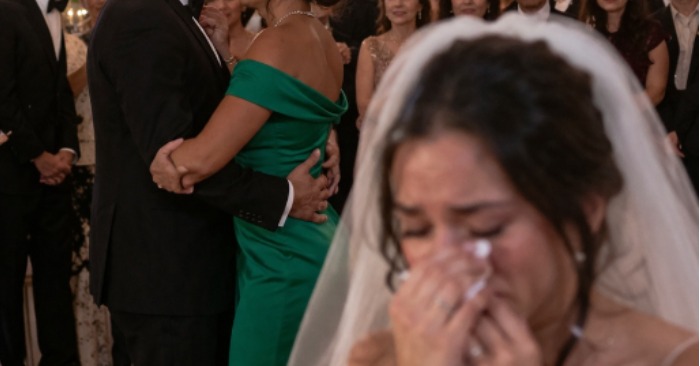
His arms were around Valeria, the senior manager from her family’s distillery. Valeria’s red dress clung to her as she swayed against him, the two of them moving together in a slow, intimate rhythm, fingers laced, faces dangerously close. Mateo’s lips brushed Valeria’s neck while she smiled with her eyes shut, as though the rest of the world had disappeared. Jimena felt the air leave her body. Around her, several relatives and friends had already spotted the scene. Their faces were filled with horror, pity, and helplessness. Nobody stepped in. Nobody knew how. But Jimena did not cry. She did not make a scene. She simply inhaled once, deeply, then turned and walked with chilling calm toward the DJ booth. A storm had entered the courtyard, and no one there understood how devastating it was about to become.
When she reached the DJ, she took the microphone from his hand with a composure so cold it unsettled everyone who saw it. The music died instantly. Silence dropped over the hacienda with such force that even the faint crackle of the garden torches sounded loud. Jimena moved to the center of the dance floor, her white dress glowing under the lights, her expression unreadable. Across the courtyard, Mateo and Valeria jerked apart, startled by the sudden stillness. The moment Mateo saw her standing there with the microphone, every trace of color disappeared from his face.
“I want to thank all 350 of you for being here tonight,” Jimena said, her voice steady, clear, and frighteningly calm. “It means more to me than I can say that you chose to be part of the most important night of my life. But I have just learned something, and I believe all of you deserve to hear it. Some truths should never be hidden in dark corners.”
At once, the crowd turned toward the place she meant. Valeria tried to step behind a pillar, but it was pointless. Murmurs rippled through the courtyard like wildfire. Jimena’s father, Don Arturo, rose from his chair so abruptly it scraped across the stone. His fists were clenched so tightly his knuckles had gone white. Mateo began crossing the dance floor, hands half-raised, desperation written all over him. “Jimena, please,” he said, his voice cracking. “Let’s talk privately.”
But Jimena was beyond stopping.
“When I was eight,” she said, “my grandmother told me there are two kinds of people in this world: the ones who lie to your face, and the ones who tell the truth even when it costs them everything. Tonight I learned which kind of man I married.” She lifted a champagne flute from a nearby table. “So here’s my toast—to every woman who puts on the most beautiful dress of her life only to discover the man beside her is a coward.”
A stunned murmur moved through the guests. And then, just as the night seemed unable to grow more explosive, Mateo’s mother entered the center of the storm.
Doña Carmen strode across the dance floor like an empress under attack. Her face burned with fury, her bracelets clattering as she snatched the microphone from Jimena’s hand. “Enough!” she snapped. “This ridiculous spectacle ends now. You will not destroy our family’s name—or the agreement between our lands—because of some jealous tantrum. Mateo made an error, yes, but the papers for the agave fields have already been signed. Lower your voice and start acting like a proper wife.”
The sheer nerve of it stole the breath from the crowd. But before Jimena could answer, Sofía rushed forward in tears, shaking from head to toe. She grabbed the microphone away so violently that a burst of feedback screeched through the courtyard.
“It is not just an error, señora!” Sofía cried, sobbing openly now. She looked at Jimena like someone begging forgiveness from the bottom of a ruined soul. “Jimena… I’m sorry. I’ve known for three weeks, and I was too afraid to tell you. Valeria isn’t only his lover. She’s four months pregnant. And Doña Carmen paid her 500,000 pesos to keep quiet and let this wedding go on, because they needed your father’s land to keep their distillery from collapsing.”
For one terrible instant, the entire world seemed to freeze.
The revelation struck the party like an explosion. Doña Carmen’s face went ghostly pale. Mateo pressed both hands to his head as if trying to stop reality from crushing him. In the shadows, Valeria broke down completely, sobbing so violently that no one needed any further confirmation. This had not been some drunken mistake or single betrayal. It was planned. Calculated. Funded. A deception built to trap Jimena and rob her family under the cover of marriage.
That was the point when Don Arturo erupted.
He crossed the distance in seconds, seized Mateo by the front of his charro jacket, and slammed him against the main table so hard that glasses shattered and plates flew to the floor. “My daughter is not your salvation,” he thundered, his voice shaking the walls of the hacienda. “And neither is my land. This wedding is finished, and so is that deal!” Mateo’s brothers lurched forward, ready to intervene, but Jimena’s cousins were already moving, forming a solid wall between the families.
Jimena stood still and watched the wreckage of the night with a kind of stunned disgust. The betrayal was too deep, too ugly, too deliberate to forgive. There was nothing left to hold onto. Then, with a calm dignity that silenced even the whispers, she bent down, slipped off her white heels, and left them in the center of the dance floor like the final remains of a life she had just abandoned. Without speaking another word, she turned and walked barefoot toward the main gate of the hacienda. Her feet touched the stone slowly, steadily, each step carrying her further from the lie.
The crowd parted for her in complete silence.
Her father released Mateo as though he were something filthy and followed her immediately. Then came her mother. Then her siblings. Then Sofía, still sobbing. One by one, all 180 guests from Jimena’s side stood up and trailed after her without a word, leaving the celebration behind like mourners abandoning a grave. Mateo remained where he was, stranded in the ruins of his own deception, surrounded by the contemptuous stares of those who had come to celebrate him. Behind him stood the towering five-tier wedding cake, untouched and absurd, like a monument built for a lie.
The cold before dawn hit Jimena’s skin the moment she stepped into the parking area. Her father took off his dark jacket and wrapped it around her shoulders without speaking. They climbed into the family car in silence. Jimena stared out the window as the cobbled roads of Jalisco slid past in darkness. In less than an hour, her world had been turned inside out. She thought of every excuse Mateo had made about late nights at work, every false smile, every arrogant look from the woman who had nearly become her mother-in-law. The pain in her chest felt raw enough to split her apart. But underneath that pain, something stronger had begun to burn.
When they arrived at her parents’ home, it looked exactly as it had when they had all left for the wedding hours earlier. Her mother’s shoes were still by the door. The bouquet of roses still rested in the sitting room. As if nothing had changed, and yet everything had. Her mother went straight to the kitchen and began making coffee the old way, as though the ritual itself could stitch together what had been broken. The four of them sat around the wooden table. Jimena wrapped both trembling hands around the hot cup, and for the first time since the nightmare began, one tear slid down her face.
“What hurts most isn’t losing him,” she said at last, her voice low and ragged. “What hurts is realizing I was about to hand my life to something monstrous. But I didn’t let them destroy me. I stood in front of all those people, and I refused to let them humiliate me.”
Her father leaned forward and kissed her forehead. “You are the bravest woman I know,” he said softly. “That coward never deserved even the dust beneath your feet.”
Sunlight flooded her childhood bedroom the next morning. Jimena opened her eyes and, for three merciful seconds, remembered nothing. Then the memories came crashing back all at once—the affair, the pregnancy, the bribe, the walk across the dance floor with bare feet and a broken future. Her phone vibrated nonstop with messages pouring in from everywhere. A little later, her brother entered carrying machaca with eggs and a glass of orange juice. He told her Mateo had called twenty times during the night. He also told her something else: once word of the land deal and the scandal had spread, the banks had pulled back, and Mateo’s family was already falling apart. Consequences had arrived faster than anyone expected.
That afternoon, Jimena stepped into the small garden behind her parents’ house. The breeze moved gently through her hair as she looked toward the orange-stained horizon. She knew the months ahead would not be easy. There would be legal battles, whispers in town, pitying glances, mornings when getting out of bed would feel impossible. Healing would not happen overnight. The future that had been stolen from her would need to be mourned properly.
And still, standing there in the fading light, she felt something she had not expected: peace.
She had not simply escaped a false marriage. She had reclaimed herself.
That night in the middle of the hacienda, she had learned that dignity could not be bought, that betrayal could wound but not erase her, and that from that moment on, her life belonged to no one else. She breathed in the evening air, wiped away the last trace of grief from her face, and understood with complete certainty that she would survive this.
Because the true tragedy was never that she walked away barefoot.
The true tragedy would have been staying.