The drawing showed something nobody expected.
At first it looked innocent.
Just a child’s sketch made with colored pencils.
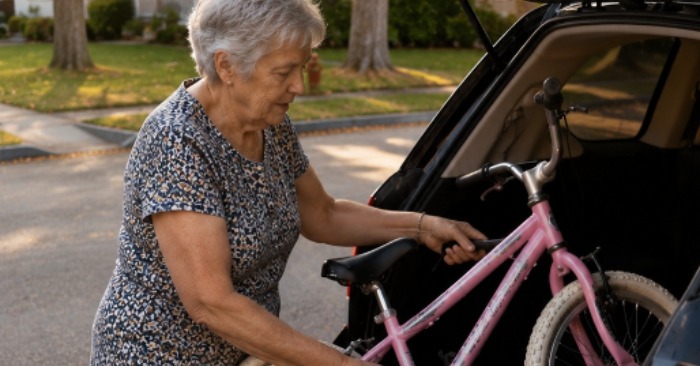
A pink bicycle.
A little girl.
A grandmother.
But then I noticed the words written underneath.
Not by my daughter.
By an adult.
“If you love Grandma most, the bicycle stays yours.”
My heart stopped.
I looked at my daughter.
“Who wrote this?”
She lowered her eyes.
“Grandma.”
The room fell silent.
My husband slowly took the paper from my hands.
His face darkened.
“What else did Grandma say?”
My daughter hesitated.
Then tears filled her eyes again.
“She said I shouldn’t tell you because it would make Mommy sad.”
That sentence hurt more than the missing bicycle.
Not because of the bicycle.
Because someone had turned a gift into a test.
A test of loyalty.
For a five-year-old child.
Over the next hour, more details emerged.
Little comments.
Little secrets.
Little promises.
Grandma had repeatedly asked our daughter who she loved more.
Who bought the best presents.
Who cared about her most.
At first our daughter thought it was a game.
But gradually she became afraid of giving the wrong answer.
Suddenly everything made sense.
The constant reminders.
The guilt.
The criticism.
The control.
The bicycle had never been a gift.
It had been leverage.
My husband sat quietly for several minutes.
Then he picked up his phone.
“I’ll handle this.”
An hour later we drove to his mother’s house.
The bicycle was sitting in her garage.
Spotless.
Untouched.
Like a trophy.
She opened the door and immediately crossed her arms.
“I assume you’re here for the bicycle.”
“No,” my husband replied.
“We’re here because of this.”
He handed her the drawing.
For the first time, she looked nervous.
“That’s just a joke.”
“A joke?” he asked.
“You made our daughter feel like she had to choose between her parents and her grandmother.”
Her face tightened.
“I sacrificed money for that gift.”
“No,” he said quietly.
“You bought influence.”
The words hit harder than any shouting could have.
She tried to defend herself.
Tried to explain.
Tried to blame us.
But every excuse sounded weaker than the last.
Then something unexpected happened.
My daughter stepped forward.
She was still clutching her stuffed rabbit.
Her voice was tiny.
But clear.
“I don’t want the bicycle anymore.”
Everyone froze.
Including Grandma.
My daughter looked directly at her.
“I wanted you to love me even without it.”
The silence that followed felt endless.
For the first time, my mother-in-law had no response.
No argument.
No lecture.
Nothing.
Just tears.
Real tears.
The kind that come when someone finally sees the damage they’ve caused.
Weeks passed.
The bicycle remained in her garage.
Nobody asked for it back.
Nobody mentioned it.
Then one afternoon there was a knock on our door.
My mother-in-law stood outside holding a cardboard box.
Inside was the bicycle.
And something else.
A handwritten letter.
In the letter she apologized.
Not for taking the bicycle.
For everything that came before it.
For using gifts to gain affection.
For turning love into a transaction.
For making a child carry emotions no child should ever have to carry.
Trust wasn’t rebuilt overnight.
Some wounds don’t disappear that quickly.
But it was a beginning.
And months later, when my daughter finally rode that pink bicycle again, nobody talked about money.
Nobody talked about sacrifice.
Nobody talked about ownership.
Because the most important lesson wasn’t about a bicycle.
It was about something far more valuable.
Real love is the one gift that should never come with conditions.