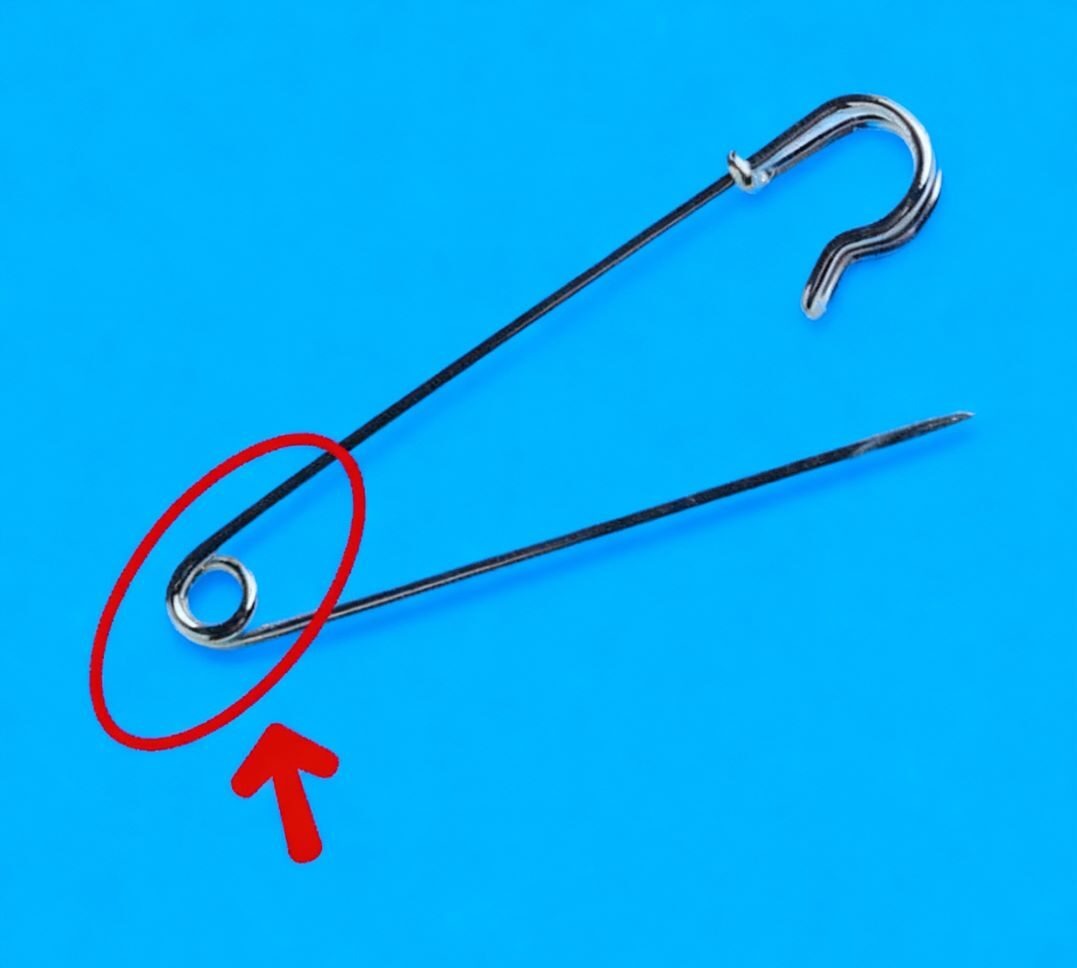
Most people have used a safety pin at some point in their lives, whether for sewing, quick clothing fixes, or small household repairs. But very few notice one small feature that can make certain tasks much easier: the tiny hole at the end of the pin.
At first glance, it may look like a simple design detail. In reality, it can be extremely useful. One of the most practical uses of the small hole is when threading elastic through fabric — such as in waistbands, sleeves, or drawstrings.
By attaching a piece of yarn, thread, or thin cord through that small hole and leaving the end outside the fabric casing, you gain much better control over the safety pin as it moves through the material.

The pin is still fastened normally to the elastic, but the extra thread works like a guide. This simple addition offers several advantages:
It keeps the safety pin aligned as it moves through the fabric.
It prevents the pin from twisting sideways or getting stuck.
If the pin slips inside the casing, the thread allows you to pull it back easily without ripping seams.
Instead of struggling or starting over, the process becomes smoother and faster.
This clever feature reflects a design philosophy focused on practicality. The safety pin doesn’t rely on complicated mechanisms — it simply includes small details that quietly add extra functionality.
For generations, people who sewed regularly knew this trick and passed it along through experience rather than instruction manuals.
The safety pin has remained almost unchanged since its invention in the mid-19th century, and there’s a reason for that. Its balance of simplicity, durability, and usefulness was achieved early on.
Many everyday tools were designed with multiple purposes in mind. Often, their smartest features are the ones we barely notice.
That tiny hole in a safety pin is a perfect example. It may seem insignificant, but it shows how thoughtful design can turn the simplest object into a surprisingly versatile tool.
Sometimes the best innovations aren’t new inventions — they’re small details that have been in our hands all along.