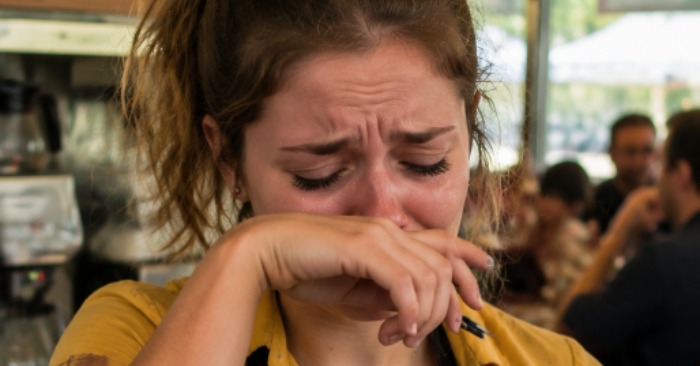
Every Friday, I sat quietly in the back corner of a local café, watching my 17-year-old daughter, Maya, work hard to help pay for my knee surgery. She was a dedicated waitress, taking on extra shifts to make ends meet after I had to take time off due to my health. I admired her determination, especially considering how much she had already sacrificed for me.
Then, one fateful Friday, a woman lost her temper over a missing lemon and called my daughter “trash.” What followed, however, left me in utter disbelief: the woman’s husband stood up and uttered five words that stunned everyone in the café into silence.
I’m 47, and Maya is 17. I adopted her when she was a baby, after her biological mother made the difficult decision to give her up. Maya’s biological father was never a part of her life, and my husband, who was by my side at the time, decided he couldn’t handle raising a child who wasn’t his. He walked out of our lives when Maya was just a few months old
“I can’t raise someone else’s child,” he had said, looking at me with a cold expression. And then, he left, leaving me alone with Maya, a child I was ready to love as my own.
Since then, it’s been just me and Maya. I worked tirelessly—sometimes holding two, even three jobs—to give her the best life I could. Through it all, Maya never once made me feel like I was failing her. She never asked for anything, never complained, and always showed an unshakable sense of gratitude.
But a few months ago, my knee finally gave out. Years of neglecting the pain finally caught up with me, and one morning, while lifting a laundry basket, I twisted my knee, the pain sharp enough to leave me sitting on the floor, waiting for the dizziness to pass. The doctor said I needed surgery and advised me to stay off the knee as much as possible. When I broke the news to Maya, I expected her to worry, but instead, she simply said, “I’ll get a job.”
“No, you won’t,” I replied firmly. “You need to focus on school.”
But Maya insisted. “It won’t interfere with my schoolwork, I promise. I want to help with the surgery cost. I’m not a little kid anymore.”
I couldn’t say no to her, though it broke my heart to see her take on more responsibility. So, every Friday, I would sit in the back corner of the café, watching Maya work.
She was good at it. She had a natural way with people, remembering their orders after hearing them once, laughing softly at their jokes, and making them feel like they mattered. But some customers, no matter how kind you were, would always find fault.
The Sterlings were one of those couples. They’d been coming to the café for a few weeks when Maya started serving them. Mr. Sterling was quiet and polite, but his wife—Mrs. Sterling—was another story. She would complain about everything, from the temperature of the water to the speed of the service. It was subtle at first, but over time, the sharp comments became harder to ignore.
Then came the Friday when everything exploded. The café was packed—one server had called in sick, the espresso machine was malfunctioning, and chaos was in the air. Maya was working quickly, moving between tables with a smile, but I could see the strain on her face.
It was then that Mrs. Sterling raised her voice. “WHERE’S MY LEMON?” she screamed, her tone cutting through the buzz of the café.
Everyone froze.
Maya turned to see Mrs. Sterling glaring at her, her face flushed with anger. “I’m so sorry, ma’am,” Maya said, walking toward their table. “I’ll bring it right away.”
But Mrs. Sterling was already standing. “I asked for one simple thing,” she snapped, waving her finger in the air. “Are you stupid? Lazy? Girls like you are useless!”
My heart sank. I stood up quickly, but before I could reach Maya, Mr. Sterling pushed his chair back, standing up with an icy look in his eyes.
“Enough,” he said coldly, his voice low but firm.
Mrs. Sterling barely looked at him, waving her hand dismissively. “Oh, don’t start,” she muttered.
But Mr. Sterling stepped closer. “I mean it,” he said, his voice calm yet unyielding. “You need to stop. Apologize before it’s too late.”
And that’s when the words came—the five words that would forever change everything.
“Maya is your biological daughter.”
The café went completely silent.
Maya’s face went pale. “What?” she whispered, her voice shaking.
I stood frozen in shock.
Mrs. Sterling’s face drained of color as her husband continued, “You had a child before we met. You gave her up because she didn’t fit the life you wanted. I spent months searching for her. And when I found her, I didn’t know how to approach you.”
Maya stared at him, then back at the woman, her expression unreadable.
“Mom?” Maya asked softly, looking at me.
I rushed over to her, taking her hand. “I’m here,” I whispered.
Mr. Sterling didn’t turn his gaze from his wife. “We came here because of her,” he said.
The woman’s eyes filled with tears, her shoulders shaking as she dropped to her knees. “I’m sorry,” she sobbed, her voice breaking. “I didn’t know. I didn’t know who you were.”
Maya didn’t flinch. She squeezed my hand tighter and stared at the woman. “You don’t get to apologize now,” she said firmly. “I deserved respect before you knew who I was. You don’t get to cry and say sorry like that changes anything.”
The café remained eerily still, as if no one dared to move.
“I deserved respect before you knew who I was,” Maya repeated, her voice steady and unwavering.
The woman trembled, her lips quivering as she tried to form words. But nothing she said could undo what had already been said. Maya’s words hung in the air like a heavy weight, and for the first time, it seemed like everyone in the café could feel it.
“I have a mother,” Maya added, her voice gentle but firm. “And that’s what matters.”
Mr. Sterling looked at me, his face softening. “I know this isn’t easy. I wanted to find you, in case you were looking for her too. And when I did, I didn’t know how to approach you. I just wanted to help.”
He turned back to Maya. “I understand if you want nothing to do with us, but I hope you’ll accept our help. I’d like to cover the cost of your surgery.”
I stood in stunned silence. “What?”
“I know about your knee,” he said quietly. “I just want to help. No conditions, no expectations.”
I stared at him, still trying to process everything. Seventeen years of doing it all on my own had taught me that help always came with strings attached. But there was something in his eyes—sincerity, maybe even regret—that made me hesitate.
“This isn’t payment,” he said quickly. “It’s not an apology for her behavior. I just don’t think the woman who raised Maya should have to carry this burden alone.”
Maya squeezed my hand and nodded. “I’ll think about it,” she said, her voice calm but uncertain.
He nodded, respecting her decision. “That’s all I ask.”
The manager finally arrived, flustered, asking if everything was okay. But no one responded.
The Sterlings left shortly after, and Maya finished her shift, her eyes occasionally meeting mine, searching for something I wasn’t sure I had the answers to.
When her shift ended, we walked outside together. Maya stopped on the sidewalk and pressed her hands to her face. I thought she might break down, but instead, she dropped her hands and looked at me with determination in her eyes.
“Is it true?” she asked, her voice barely a whisper.
I met her gaze. “You are my daughter.”
Her mouth trembled, and tears welled up in her eyes. “I know. But… the other thing?”
“I don’t know,” I replied, gently cupping her face. “But we’ll find out. And whatever happens, none of it changes who you are.”
She smiled through her tears, a shaky laugh escaping her lips. “You really know how to make your point, huh?”
“I’ll make it all night if I have to,” I replied softly.
As we stood there, watching the world move around us, I realized that nothing—no revelation, no unexpected truth—could ever change the love and the bond we shared. Because I had been there for her through every moment, big and small, and that was all that mattered.
For the first time in a long time, I felt like we had truly stepped into the light, together.