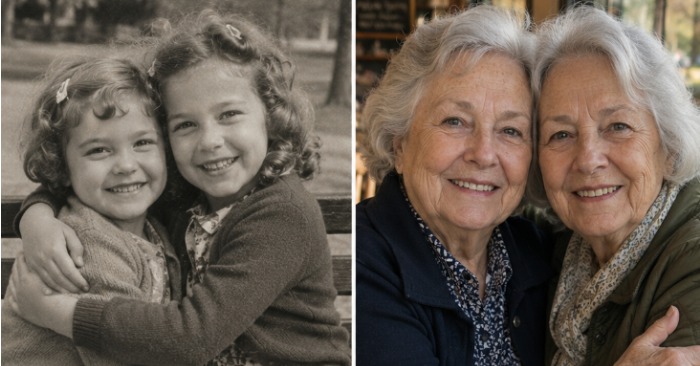
When I was five years old, my twin sister walked into the trees behind our house and never came back. Later, the police told my parents they had found her body, but I never saw a coffin, never stood beside a grave, and never received the truth I needed. All I had was silence — and the feeling that Ella’s story had not really ended.
My name is Dorothy. I am 73 now, and for as long as I can remember, there has been an empty place inside me shaped like my sister.
Her name was Ella.
She was my twin.
We were only five when she vanished.
Ella had been sitting in the corner with her red ball.
We were not just twins because we shared a birthday. We shared everything — a bed, secrets, fears, thoughts only we seemed to understand. If she cried, tears came to my eyes too. If I laughed, she laughed even louder.
Ella was fearless.
I was the one who followed.
On the day she disappeared, our parents were working, and our grandmother was taking care of us.
I was sick that day. Feverish. My throat burned, and my bones ached. Grandma sat on the side of my bed, dabbing my forehead with a cool washcloth.
“Rest, baby,” she said softly. “Ella will play quietly.”
Ella had been sitting in the corner with her red ball.
I remember the soft thudding sound as she bounced it against the wall. I remember the rain beginning outside.
Then I fell asleep.
When I woke up, the house felt wrong.
Too still.
Too empty.
No bouncing ball.
No humming.
“Grandma?” I called.
No one answered.
Then she rushed into my room, hair messy, face tight with fear.
“Where’s Ella?” I asked.
“She’s probably outside,” Grandma said too quickly. “You stay in bed, all right?”
Her voice shook.
Then I heard the back door fly open.
“Ella!” Grandma shouted.
Then the police came.
No one answered.
“Ella, come inside right now!”
Her voice rose higher, sharper, more frightened.
I got out of bed.
The hallway felt cold beneath my feet. By the time I reached the front room, neighbors were already gathering at the door.
Mr. Frank crouched in front of me.
“Have you seen your sister, sweetheart?” he asked.
I shook my head.
“Did she ever talk to strangers?”
Then the police came.
Blue jackets.
Wet boots.
Crackling radios.
Questions I was too young and too sick to answer.
“What was she wearing?”
“Where did she like to play?”
“Did she speak to anyone unfamiliar?”
They found her ball.
Behind our house was a stretch of trees everyone called “the forest,” though it was really just a thick patch of woods and shadows. That night, flashlights moved between the trunks while men called Ella’s name into the rain.
They found her ball.
That was the only certain thing anyone ever told me.
The search continued for days, then weeks. Time became blurry. Adults whispered in corners. Nobody explained anything to me.
I remember Grandma crying at the sink, whispering, “I’m so sorry,” again and again.
One day, I asked my mother, “When is Ella coming home?”
She stopped drying dishes.
“She isn’t,” she said quietly.
“Why?”
My father cut in.
“That’s enough. Dorothy, go to your room.”
My father rubbed his forehead.
Later, they sat me down in the living room. My mother looked at her hands. My father looked at the floor.
“The police found Ella,” my mother whispered.
“Where?”
“In the woods,” she said. “She’s gone.”
“Gone where?”
My father rubbed his forehead again.
“She died,” he said. “Ella died. That is all you need to know.”
One day, I had a twin.
The next day, I was alone.
I never saw her body.
I do not remember a funeral.
There was no tiny coffin in my memory.
No grave anyone took me to visit.
Her toys disappeared. Our matching clothes were packed away. Even her name vanished from the house like it had become dangerous.
At first, I kept asking.
“Where exactly did they find her?”
“What happened to her?”
“Did she suffer?”
My mother’s face would close every time.
“Stop, Dorothy,” she would say. “You’re hurting me.”
I wanted to scream that I was hurting too.
But I learned silence instead. Saying Ella’s name felt like setting a match to the room. So I swallowed every question and carried them alone.
That was how I grew up.
From the outside, I looked fine. I did my schoolwork, made friends, behaved myself, and caused no trouble.
Inside, there was always a hollow buzzing space where my sister should have been.
“I want to see the case file.”
At 16, I finally tried to challenge the silence.
I went to the police station by myself, palms damp with nerves.
The officer at the desk looked up.
“How can I help you?”
“My twin sister disappeared when we were five,” I said. “Her name was Ella. I want to see the file.”
He frowned gently.
“How old are you, sweetheart?”
“Sixteen.”
He sighed.
“I’m sorry. Those records aren’t open to the public. Your parents would have to request them.”
“They won’t even say her name,” I told him. “They only told me she died.”
His face softened.
“Then maybe you should let them handle it,” he said. “Some pain is better left alone.”
I walked out feeling foolish, powerless, and more alone than before.
“Why reopen all that pain?”
In my twenties, I tried once more with my mother.
We were folding laundry on her bed when I said, “Mom, please. I need to know what really happened to Ella.”
She froze.
“What good would that do?” she whispered. “You have a life now. Why reopen all that pain?”
“Because I never left it,” I said. “I don’t even know where she is buried.”
She flinched.
Then she said, “Please don’t ask me again. I cannot talk about this.”
So I stopped asking.
Life carried me forward whether I was ready or not.
I finished school.
I married.
I had children.
I became a mother.
Then I became a grandmother.
From the outside, my life looked full. But inside, there was still that quiet little place reserved for Ella.
Sometimes, without thinking, I would set out two plates.
Sometimes I woke in the dark certain I had heard a little girl calling my name.
Sometimes I looked into the mirror and thought, This is how Ella might have aged.
My parents died without giving me another word of truth. Two funerals. Two graves. All their secrets went into the ground with them.
For years, I told myself the story was finished.
A missing child.
A vague claim that a body had been found.
Silence that lasted decades.
Then my granddaughter was accepted to a college in another state.
“Grandma, you have to visit,” she insisted. “You’ll love it here.”
“I’ll come,” I promised. “Someone has to keep an eye on you.”
A few months later, I flew out. We spent a day arranging her dorm room and arguing over towels, storage bins, and whether she owned enough hangers.
The next morning, she had class.
“Go wander around,” she said, kissing my cheek. “There’s a café around the corner. Good coffee, awful music.”
That sounded exactly like my kind of place.
So I went.
The café was warm, crowded, and loud. There were mismatched chairs, a chalkboard menu, and the smell of coffee and sugar hanging in the air.
I stood in line, pretending to read the menu.
Then I heard a woman ordering at the counter.
A latte.
Her voice struck something inside me.
Calm.
A little raspy.
Strangely familiar.
It sounded like me.
I lifted my eyes.
A woman stood near the register with gray hair pinned loosely at the back of her head. She was my height. She held herself the way I did.
At first, I thought only that it was odd.
Then she turned.
Our eyes met.
For a moment, I was not an old woman in a café anymore. I felt as though I had stepped outside my own body and was looking straight back at myself.
I was staring at my own face.
My fingers went cold.
I walked toward her.
She was older and softer in some ways, but the resemblance was impossible to deny.
She whispered, “Oh my God.”
Before I could think, I said the name that had lived in my throat for 68 years.
“Ella?”
Her eyes filled with tears.
“No,” she said shakily. “My name is Margaret.”
I pulled my hand back.
“I’m so sorry,” I said quickly. “My twin sister disappeared when we were five. I’ve never seen anyone who looked this much like me. I know I must sound ridiculous.”
“No,” she said at once. “You don’t. Because I’m thinking the same thing.”
The barista cleared his throat awkwardly.
“Uh… ladies? Could you maybe move? You’re blocking the sugar.”
We both gave nervous little laughs and sat down at a table.
Up close, it was even more unsettling.
The same eyes.
The same nose.
The same crease between the eyebrows.
Even our hands looked alike.
Margaret wrapped her fingers around her coffee cup.
“I don’t want to make this stranger than it already is,” she said carefully, “but I was adopted.”
My heart tightened.
“Where from?”
“A small town in the Midwest,” she said. “The hospital is gone now. My parents always said I was chosen, but every time I asked about my birth family, they closed the door on it.”
I swallowed.
“What year were you born?”
She told me.
Then she asked mine.
The room seemed to grow warmer.
“My twin vanished from a small Midwestern town,” I said quietly. “We lived near a patch of woods. Months later, my parents said the police found her body. But I never saw anything. No coffin. No grave. No answers.”
We stared at each other without speaking.
Finally, Margaret let out a shaky laugh.
“We’re five years apart,” she said.
“We’re not twins,” I whispered. “But that doesn’t mean we’re not…”
“Connected,” she finished.
She took a deep breath.
“I always felt like there was a locked door in my life,” she said. “A part of my story nobody would let me enter.”
“My whole life has felt like that door,” I replied. “Do you want to open it?”
We exchanged phone numbers.
“I’m scared,” she admitted.
“So am I,” I said. “But I’m more afraid of dying without knowing.”
She nodded.
“Then let’s find out.”
Back at my hotel, I replayed every time my parents had silenced me.
Then I thought of the old box in my closet at home, the one filled with their papers that I had never properly searched.
Maybe they never spoke the truth.
Maybe they left it hidden in paper.
When I got home, I dragged the box onto my kitchen table.
Birth certificates.
Tax records.
Medical forms.
Old letters.
I dug until my hands trembled.
At the bottom was a thin manila folder.
Inside was an adoption document.
Female infant.
No given name.
Year: five years before my birth.
Birth mother: my mother.
My knees nearly buckled.
Behind the papers was a folded note in my mother’s handwriting.
I cried until my chest hurt.
I was young. Unmarried. My parents said I had shamed the family. They told me I had no choice. I was not allowed to hold her. I saw her only once from across the room. Then they told me to forget, marry, have other children, and never speak of her again.
But I never forgot.
I will remember my first daughter for as long as I live, even if no one else knows she was here.
I cried until my whole body ached.
For the girl my mother had been.
For the baby taken from her arms before she could even hold her.
For Ella.
For myself, the daughter raised in silence.
When I finally steadied my hands, I photographed the adoption paper and the note and sent them to Margaret.
She called immediately.
“I saw it,” she whispered. “Is it real?”
“Yes,” I said softly. “It looks like my mother was your mother too.”
Silence stretched between us.
“I always thought I was no one’s,” she whispered. “Or at least no one who wanted me.”
“You were ours,” I said. “You are my sister.”
We took a DNA test to confirm it.
The results said what we already knew.
Full siblings.
People imagine a reunion like that feels purely joyful.
It didn’t.
It felt like standing in the wreckage of three lives and finally seeing how the pieces connected.
We talk now.
We trade photos.
We compare childhood memories.
We notice the small similarities and laugh about them.
And we speak honestly about the painful truth.
Our mother had three daughters.
One she was forced to surrender.
One she lost in the woods.
And one she kept, while wrapping the whole house in silence.
Was it fair?
No.
But pain does not excuse secrets.
Sometimes, it only explains why people spend a lifetime hiding them.