After 32 years of marriage, I was convinced I knew every side of my husband. That included the helpless version of him that appeared whenever he experienced even the slightest discomfort. But after what he claimed was an accident at work, Conor suddenly refused to let me anywhere near him. The more determined he became to keep his injured right lower leg hidden from me, the more certain I was that there was something far more serious behind his story than a simple broken bone.
“Don’t touch my cast!”
Conor’s voice was so sharp that my hand froze just inches away from his right leg.
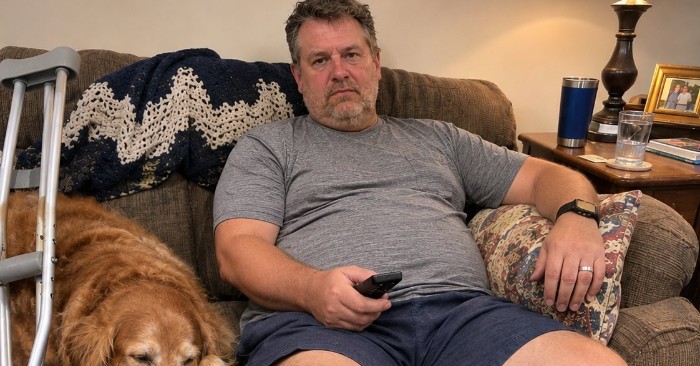
He was sitting on the bathroom floor beside the bathtub. One crutch had ended up beneath the sink, while the other lay across the doorway. During his fall, the upper edge of his cast had cracked, and the padding underneath had shifted out of place.
“You’re sitting in the middle of the bathroom floor,” I said. “I’m only trying to help you.”
“I can manage on my own.”
“Keep your hands off my cast!”
“You just lost a fight with our bathtub.”
“Cynthia.”
Something about the way he said my name made me stop.
He didn’t sound irritated. There was fear in his voice.
Conor quickly grabbed a towel, but he wasn’t fast enough.
The loosened padding had slipped far enough for me to see a long, pink scar running just above the edge of the cast.
Something in his voice immediately silenced me.
The wound was clearly still healing.
And it certainly had nothing to do with the broken ankle he supposedly suffered two weeks earlier.
I stared at my husband.
“Conor… what the hell is that?”
He gripped the towel tightly.
Suddenly, all the strange things that had happened during the previous two weeks began falling into place.
There was absolutely no way that scar had come from his supposed ankle fracture.
At least, that’s what I believed at that moment.
When you’ve been married to someone for 32 years, you eventually become familiar with all their little habits and peculiarities.
For instance, I knew Conor snored especially loudly whenever he slept on his back.
I also knew he would insist he wasn’t hungry right before stealing half the fries from my plate. And, more importantly, I knew my husband lost every ounce of dignity whenever he was even slightly unwell.
A simple cold was enough to make him demand hot soup, tea, extra blankets, and hourly updates about the condition of his sinuses.
So when his coworker Nathan brought him home one afternoon with his right leg in a cast, I was already preparing myself for six weeks of constant requests for help.
I knew perfectly well that Conor’s snoring was at its worst when he slept on his back.
Nathan had worked with my husband for many years. I’d met him often enough to know that he was considerably calmer and probably twice as patient as Conor.
That afternoon, he apparently needed every bit of that patience.
When I opened the front door, Nathan had one arm wrapped around Conor’s waist, supporting him as he struggled to walk.
“What happened?”
“Wet floor,” Nathan explained.
Patience was clearly going to be essential that day.
Conor lowered himself onto the sofa with an agonized groan.
“Broken ankle. The doctor says it’ll take six weeks to heal. This is going to be absolute hell.”
Six weeks.
By Friday, I’d probably deserve a medal for bravery.
I arranged several pillows beneath his injured leg and brought him a glass of water.
“Is there anything else His Majesty requires?”
By Friday, I would surely have earned some kind of award.
“A cup of tea would be lovely, Cyn.”
I stared at him.
“Well, you did ask.”
“I definitely wasn’t being serious.”
He grinned.
That was my Conor.
“A nice little cup of tea would be wonderful, Cyn.”
Naturally, I made him one anyway.
When I returned, I noticed that the padding around the upper edge of his cast had folded over slightly. I reached out to straighten it.
But Conor immediately pulled his leg away.
“I’ll take care of that myself.”
I laughed.
“Since when?”
“I just don’t want you accidentally bumping it.”
Of course, I still made his tea.
“Conor, you once asked me to check your temperature four times in a single evening.”
“I had a genuinely high fever that night.”
Then he moved his leg even farther away from me.
The following morning, I offered to protect his cast with a waterproof covering before he showered.
“No, I can do that myself.”
“So you’re planning to balance on one leg while wrapping the other one all by yourself?”
I wanted to cover the cast before he got into the shower.
“I’ll figure it out, Cynthia. Please stop fussing over me all the time.”
He took the plastic wrap upstairs.
Barely a minute later, I heard the bathroom door lock click into place.
Conor almost never locked that door.
Three days later, I asked when his next medical follow-up was scheduled.
“Next week.”
“I can handle it myself, Cynthia.”
“Which day?”
“I wrote it down somewhere.”
“Where? I’d like to go with you.”
He looked away from the television.
“I’ll take care of it, Cynthia.”
There was that answer again.
He glanced up from the TV.
It didn’t sound like ordinary annoyance.
He seemed determined to keep something hidden.
“You’ve become remarkably independent since breaking your ankle.”
“What’s that supposed to mean?”
“It means you’ve spent the last 32 years asking me where we keep the headache tablets.”
“Now you’re exaggerating.”
“Suddenly, you’re incredibly self-sufficient.”
“For the record, they’re still in the same cabinet they’ve been in since the day we moved into this house.”
For a moment, he looked as though he might smile. But the hint of amusement quickly disappeared.
Over the following week, the little oddities piled up until I could no longer ignore them.
Conor would only shower when I was busy downstairs.
In bed, he always positioned his injured leg on the side farthest away from me.
Whenever I entered a room while he was adjusting something around his cast, he immediately stopped whatever he was doing.
He only took showers when I was downstairs.
Then Nathan called.
Conor’s phone was lying on the kitchen counter while my husband sat in the living room.
I answered the call.
“Hello, Nathan.”
“Oh. Hi, Cynthia.”
“Would you like to speak to Conor?”
“Oh, hello, Cynthia.”
“I actually just wanted to check how he’s doing after everything that happened.”
My fingers tightened around the phone.
“You mean after he broke his ankle, right?”
There was a brief silence on the other end.
“Yes. That’s exactly what I meant.”
I looked through the doorway into the living room.
Conor was pretending to read.
“I just wanted to know how he got through the whole thing.”
“He’s doing fine.”
“Good. Please tell him I called.”
When I ended the call, Conor looked over at me.
“Was that Nathan?”
“Yes.”
“What did he want?”
“He wanted to know how you’re doing after everything that happened.”
“Tell him I got in touch.”
Conor raised his head.
“What?”
“Those were his exact words.”
My husband shrugged.
“He was obviously talking about the accident at work, Cyn.”
I left the kitchen before he could see from my expression that I didn’t believe him.
“Nathan was only referring to the workplace accident, Cyn.”
That evening, I made a decision.
I wasn’t going to secretly search through his phone or start rummaging through drawers.
Instead, after dinner, I would simply ask my husband one question.
What are you hiding from me?
But I never got the chance.
Suddenly, a loud crash came from upstairs.
What exactly are you keeping from me?
Moments later, I found Conor beside the bathtub.
And I saw the scar.
He quickly covered his leg with the towel.
“What happened?” I asked.
“Nothing.”
“People don’t get scars like that from nothing.”
“It’s been taken care of.”
That was when I found him beside the bathtub.
“What has been taken care of?”
He glanced nervously toward the door.
“Conor.”
“I had something removed.”
My stomach tightened.
“What? What did they remove?”
“They cut something out.”
“A skin lesion.”
“What kind of skin lesion, Conor?”
He said nothing.
I sat down on the floor beside him. “Conor, please look at me.”
He lifted his head.
“Tell me the truth. Now.”
His shoulders sagged.
“Conor, look at me.”
“Skin cancer.”
For a moment, the only sound I could hear was the quiet humming of the bathroom exhaust fan.
Then the questions started pouring out of me.
“When did the doctors find it? What exactly did they remove? Are you okay? When do you have to go back for another checkup?”
“Stop. Cynthia, please, just stop.”
I fell silent.
The only sound was the steady buzz of the bathroom fan.
Conor rubbed his forehead wearily.
“This is exactly why I didn’t tell you.”
“Because I ask questions?”
“Because the second you’re frightened, you turn everything into an action plan before the other person has even had a chance to experience their own fear.”
His words hurt. Mostly because they weren’t entirely untrue.
But that didn’t make what he’d done right.
“That’s exactly why I kept quiet.”
“How long have you known?”
He avoided my eyes.
“Conor.”
“A few months.”
I stared at him in disbelief.
“Months?”
“Several months now.”
“I was going to tell you once I knew more.”
“And until then, you simply decided I shouldn’t have anything to do with what was happening to you.”
His face tightened.
Suddenly, I remembered Nathan’s strange reaction on the phone.
“Did Nathan know?”
Conor hesitated a fraction too long before answering.
“I wanted to talk to you when I had more information.”
I didn’t need to hear anything else.
First, we dealt with the damaged cast. I sought medical advice while Conor sat beside me, and we arranged for the cast to be examined and replaced.
Afterward, I took my phone downstairs.
Nathan answered after the second ring.
“Cynthia?”
That alone told me what I needed to know.
“Did you know Conor had skin cancer?”
Silence.
“Yes.”
“Since when?”
“Since the biopsy.”
I sat down.
“You knew about the cancer?”
“Even before he broke his ankle?”
“Yes.”
“Did you drive him to a doctor’s appointment?”
“Once. After they removed the lesion. He couldn’t drive himself.”
So this wasn’t merely an impulsive lie born out of fear. Conor had created an entire arrangement to keep me out of his medical situation.
“Did you at least tell him he needed to talk to me?”
“You actually drove him to an appointment?”
“More than once.”
Nathan let out an audible breath.
“He was terrified, Cynthia.”
“I know. And I believe you. But I’m still his wife.”
“I know that.”
I let his answer hang in the air for a moment.
“Thank you for being honest with me.”
“But I’m his wife.”
After I ended the call, I didn’t pace around the house nervously or immediately start organizing things.
Instead, I called our daughter, Tilly.
She answered cheerfully.
“Hi, Mom!”
“Your father had skin cancer, Tilly.”
The silence on the other end gave me the answer before she even spoke.
I dialed our daughter Tilly’s number.
“You knew.”
“Mom…”
“How long have you known?”
“I drove him to a follow-up appointment a few weeks ago.”
I closed my eyes.
“Why didn’t you tell me?”
“How long have you known about his illness?”
“Dad asked me not to say anything to you.”
“And you just agreed?”
“I thought I was helping him. It was a huge scare, Mom. He’s doing well now, but back then we didn’t know how things would turn out.”
“By helping him lie to me?”
Her voice grew sharper.
“Maybe you should ask yourself why he felt he couldn’t tell you in the first place.”
“Dad didn’t want me to tell you.”
Her answer left me speechless.
Then she said, “Mom, you hardly give people time to be afraid. You always jump straight into fixing everything before anyone gets the chance to explain what they’re frightened of.”
I gripped my phone tightly.
“And that somehow makes what he did okay?”
“No. Of course it doesn’t.”
“You don’t give people a chance to experience their fear.”
Her voice softened again.
“But if you really want to know the whole truth, that’s part of it too.”
For the first time that evening, I didn’t have an immediate answer.
“Is that really how you see me?”
Tilly was quiet for a moment.
“I think taking care of everything is how you show us you love us. But sometimes you move so quickly that nobody gets to tell you how they’re actually feeling first.”
Her voice was much gentler now.
“Still, Dad should have told you,” she added. “I told him that myself.”
“Did he listen to you?”
“Not at the time.”
After we hung up, I could no longer convince myself that Conor was wrong about absolutely everything and I was right about absolutely everything.
That same evening, Conor’s sister Amanda stopped by with a box of brownies.
“I figured the last thing you two needed was another casserole,” she explained.
“I told him he needed to tell you.”
Amanda was two years older than Conor and had such a direct manner that even my husband sometimes felt uncomfortable around her.
“How’s your ankle?”
“Still attached to my leg, at least,” Conor called back.
She sat down across from him.
Then Amanda looked at his leg in its cast.
“At least you’re following the doctor’s instructions this time.”
She settled into the chair opposite him.
Conor’s expression changed instantly.
“What’s that supposed to mean?” I asked.
Amanda glanced toward her brother.
He muttered, “Nothing.”
She frowned. “Conor, you still haven’t told Cynthia?”
“Amanda, what are you talking about?”
Amanda looked at her brother.
She set down her teacup.
“I told him right after the biopsy that shutting you out of everything was a mistake.”
“After the biopsy?”
Conor said, “You didn’t have to bring that up now.”
“Apparently, I did.”
I turned toward him.
She placed her cup on the table.
“So she knew about the biopsy too? You told your sister and our daughter, but you deliberately excluded me?”
“Cynthia…”
“Who was the first person you told?”
“Why does that matter now?”
“Because I want to understand when you stopped seeing me as the person you could trust with anything.”
Amanda started to get up.
“Please stay,” I told her. “You didn’t create this situation.”
“Who did you tell first?”
“Nathan knew. Amanda knew. Tilly drove you to a doctor’s appointment. I’m your wife, and I knew absolutely nothing.”
Conor’s shoulders drooped.
“I told Nathan first.”
“Why him?”
“Because he noticed I kept disappearing during working hours.”
Amanda shook her head.
“Why Nathan, of all people?”
“You called me after the biopsy because you were frightened,” she added. “And you asked me not to tell Cynthia. I told you very clearly back then that you weren’t protecting her by doing that.”
“And you brought Tilly into it later?”
Conor nodded. “I needed somebody to drive me.”
At last, I understood the sequence of events.
The following morning, Conor sat at the kitchen table and sighed.
I knew exactly what that sigh meant: he wanted coffee.
“I needed a ride.”
I simply continued eating my breakfast.
“What do you need?”
“Coffee.”
“Then ask me for it.”
He blinked in confusion. “I thought I just did.”
“You sighed and expected me to make it for you. That’s not the same thing.”
He studied me thoughtfully.
“I thought I’d just asked.”
“Would you please make me a cup of coffee, Cynthia?”
“Yes.”
A few days later, Conor came into the kitchen on his crutches.
“I have another doctor’s appointment on Thursday. Will you come with me?”
Every instinct I had wanted to immediately start planning everything.
Conor entered the kitchen on his crutches.
But instead, I asked, “Do you want your wife to come with you, or do you need someone to take notes for you?”
“My wife.”
So I went with him.
During the appointment, several questions were already racing through my mind before Conor had even finished asking his first one.
But I held back.
He glanced toward me. “You must have something you want to ask too.”
“Are you sure you want your wife here with you?”
“Yes. But you go first.”
He asked the doctor the questions that mattered to him. I listened carefully.
When he finished, he turned toward me.
“Is there anything else?”
“Just one question.”
I asked it and left it at that.
“Do you want to know anything else?”
The doctor explained that the affected area of skin had been treated. However, Conor would still need regular skin examinations and would have to attend all his scheduled follow-up appointments.
Relief came quietly: there was no new devastating news, only the truth I should have been allowed to hear alongside my husband from the very beginning.
In the car, Conor suddenly said, “Thank you.”
“For coming with you?”
“For not immediately taking control of everything.”
I allowed his words to settle, even though they still stung a little.
“Thank you.”
That evening, he finally explained why he’d kept his illness hidden from me.
“When your mother was sick, I once saw you sitting on this kitchen floor.”
I remembered the moment instantly, even before he continued.
Back then, I’d been caring for my mother while still working, barely sleeping, and constantly arranging her medical appointments and medications. Then I’d forgotten to return a borrowed library book on time.
And somehow, that tiny mistake had completely overwhelmed me.
“I saw you sitting on this very kitchen floor.”
“I remember.”
“When the doctors said the word cancer, that moment was the first thing that came into my mind.”
“Me sitting on the kitchen floor?”
He nodded.
“You were completely exhausted. You were drowning in grief. I couldn’t get that image out of my head. I honestly believed I was protecting you.”
“I believe that’s what you wanted to do. But that doesn’t make your decision right.”
“You were exhausted and overwhelmed by grief.”
He lowered his eyes.
“You took one of the worst moments of my life and decided that was the only version of me you could trust to handle anything.”
“Nathan didn’t ask me twenty questions,” he replied. “He just sat down beside me and listened. That’s what I needed, Cyn.”
“You should have talked to me.”
“I just didn’t know how.”
“Then you should have tried, even if you didn’t know what to say.”
“That’s exactly what I needed back then, Cyn.”
He raised his head.
“What should I have tried to do?”
“Be afraid with me. Not always have the perfect words. And allow me to be afraid too.”
A few days later, Tilly came to visit.
I looked at Conor.
“We’re not going to pretend none of this ever happened.”
He looked back at me.
Tilly fell completely silent.
Conor nodded.
“Tilly, I never should have asked you to keep this from your mother.”
“But I thought I was helping you, Dad.”
“You were trying to help. But I put you in the middle of something that was between the two of us.”
She glanced toward me.
“I’m sorry, Mom.”
Tilly went quiet.
“I understand why you did it.”
Then I looked at both of them.
“But neither of you gets to decide for me what I can and cannot handle.”
After Tilly left, Conor asked, “What do you want from me now?”
“I want a husband. Not a self-appointed protector who shuts me out of his life.”
He nodded slowly.
“I understand why you acted the way you did.”
“And if I make it difficult for you to show fear around me, tell me. I’ll work on that.”
I took his hand.
“But don’t lie to me and then call it love.”
A few weeks later, Conor’s cast was finally removed.
He sat beside me.
“I’m worried about my next follow-up examination.”
I held his hand.
The familiar questions immediately began rising inside me.
But I let them remain unspoken.
“Would you like me to help you, or would you rather I just sit here with you?”
“Just stay with me.”
He reached toward my hand but stopped halfway, as though he wasn’t sure he was still allowed to take it. So I reached out and took his hand myself.
I allowed my questions to pass without asking them.
His fingers tightened slightly around mine. Not painfully, but just enough for me to understand how frightened he still was and how hard he was trying despite that fear.
So I simply stayed beside him.
After a while, he looked down at his leg.
“You know, you’re allowed to touch it again now.”
“I know.”
I carefully rested my hand over the place where the scar disappeared beneath his jeans.
So I stayed right there with him.
I was still angry that he’d shut me out for so long.
At the same time, I was endlessly grateful that he was doing well.
Both feelings were allowed to exist together.
This time, Conor didn’t pull his leg away.
And this time, I wasn’t touching him because there was something wrong that I desperately needed to fix.
He had simply asked me to stay by his side.
And at last, I understood just how enormous the difference could be between trying to help someone and simply being there for them.