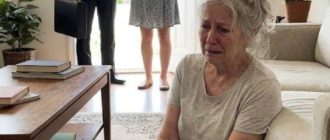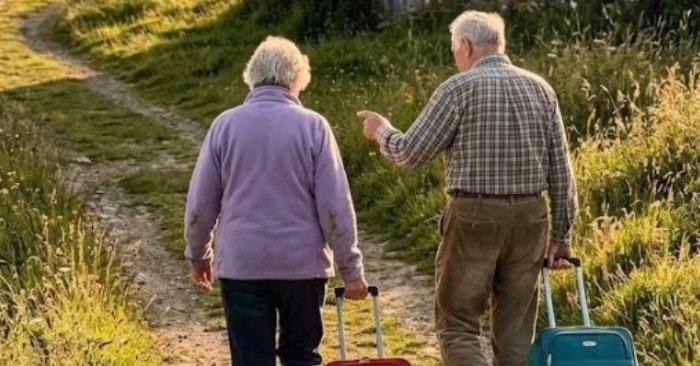
Rosa Ramírez held tightly to the handle of her red suitcase as if everything she had left in this world depended on that single grip. In front of her, the court officer pressed an official seal across the door of the house she had lived in for forty-three years. The strip snapped into place with a hard, unforgiving sound. The word “foreclosure” was never spoken aloud, yet it seemed to hang everywhere—in the suffocating silence, in the distant stares of neighbors pretending not to look, and in the cold autumn sunlight that no longer seemed capable of warming anything at all.
At her side, Armando shifted the blue suitcase higher onto his shoulder and swallowed with difficulty. At seventy-one, his back had carried enough for one lifetime: dismantled engines, greasy toolboxes, endless years bent over cars in the mechanic’s shop… and now this final disgrace—walking away with no key in his pocket, no roof over his head, and no one waiting for him in the back seat of the old Kia.
“Where are we supposed to go now, Armando?” Rosa asked, her voice breaking apart, as if each word stripped away another piece of her dignity.
Armando stared down the cobblestone street of the town—the same old colonial stones Rosa had crossed a thousand times on her way to the market, the same stones that had watched their children grow up. He wanted to give her something: an answer, a plan, a direction, a lie soft enough to sound like hope. But all he could summon was a deep, ancient exhaustion.
—I don’t know, my love… I don’t know anything anymore.
The harshest blow hadn’t come from the bank or the unpaid loan. It came from their own children. Fernando, now the town’s mayor, didn’t even try to hide his indifference.
“You’ll figure something out,” he had said coldly, as if a lifetime of care—sleepless nights, illnesses, school expenses, endless sacrifices—meant nothing. Beatriz had been even more distant. “Your problems aren’t mine,” she replied, without a trace of emotion. And Javier, the youngest… he didn’t answer at all. No calls, no messages—just a silence so deep it hurt more than any cruel words ever could.
With nowhere left to go, Rosa and Armando drifted through the streets aimlessly. They sat on benches, watching life continue around them as if nothing had happened—children laughing, couples carrying groceries, families walking together. Rosa watched it all like it belonged to another world, another version of herself. And yet, it burned inside her, because she remembered who she used to be—the mother who stayed up all night at hospital beds, who stretched every coin for school supplies, who mended clothes long after midnight so her children would never feel ashamed.
“Do you remember when Fernando broke his arm?” she whispered softly, staring ahead. “We didn’t leave his side all night.”
Armando nodded slowly, his eyes filling with tears. He remembered everything—the hospital smell, the fear hidden behind calm words, the small hand gripping his finger. He remembered Beatriz struggling to breathe through illness, Javier waking from nightmares, the table always set no matter how little they had. There had been no cruelty in their home—only patience, effort, and love. And yet now, when they needed support the most, they found only rejection.
As the sun began to dip, painting the town in shades of gold, they reached the outskirts where houses faded into wild land. Rosa’s strength began to fail, her legs trembling beneath her. Armando searched for somewhere—anywhere—they could rest.
“Let’s go a little higher,” he said, pointing toward a hill. “Maybe we’ll find a place to sit.”
The climb was exhausting. Stones shifted under their feet, dry branches scratched at their clothes, and the ground seemed to resist them. Rosa leaned heavily on Armando, while he pushed forward, driven by quiet determination.
Then suddenly, she stopped.
Hidden between rocks and overgrown plants, she saw something strange—a stone arch carved into the hillside, with an old wooden door set deep within it.
“Armando… look… that’s not normal,” she said quietly.
He stepped closer, adjusting his glasses, drawn by both caution and curiosity. The door seemed built into the mountain itself, as if someone had once created a hidden home there. Nature had tried to reclaim it, but not completely. Rosa felt a strange shiver—not from cold, but from something deeper she couldn’t explain.
“Do you think someone lives there?” she whispered.
Armando knocked gently. The sound echoed from within, as though there were space beyond it—real rooms, not just stone. No answer came. He tried the handle. Locked.
Then he noticed a stone near the entrance, placed too deliberately. He lifted it—and found an old key hidden beneath.
Rosa grabbed his arm. “Armando… this doesn’t feel right.”
He looked at her, then at their worn suitcases, the fading light, the emptiness around them.
“What could be worse than sleeping outside?” he said quietly. “Just for tonight.”
She didn’t argue.
When the key turned, the heavy door creaked open slowly, as if revealing something long waiting to be discovered.
Cool air drifted out, carrying a faint scent of wood and earth. They stepped inside cautiously. Armando lit a small flame, and what they saw made them stop in disbelief.
This wasn’t a cave.
It was a home.
Carved into the mountain was a complete living space—chairs, a table, a kitchen, shelves neatly stocked. Everything was clean, organized… cared for. And most unsettling of all—the table was already set, as if someone had just stepped away.
“This… this doesn’t make sense,” Rosa whispered.
Armando lit a lamp, revealing more details—folded blankets, prepared firewood, a full pantry. This wasn’t abandoned. It had been loved.
On the table lay an old letter.
Rosa picked it up, her hands shaking, and began to read.
“To my beloved children…”
Her voice trembled. The letter spoke of a woman named Soledad and her husband Alberto—of a home they had built with their own hands to survive hardship. It spoke of years spent waiting for children who had left… hoping they would return one day.
Rosa lowered the letter, tears filling her eyes. “Another mother… abandoned too…”
One line lingered in the air: Do not feel guilty for staying. This place was built with love.
That night, for the first time since losing everything, they ate a warm meal and slept under a roof. The fear slowly faded, replaced by something unexpected—comfort.
But Rosa couldn’t sleep.
The name “Soledad” echoed in her mind, stirring something buried deep inside her memory.
“I feel like I know this place…” she whispered.
Armando hesitated. “Did your adoptive parents ever tell you anything about your real family?”
The question hit her hard. She had always been told she was adopted—but nothing more.
The next morning, they searched the house more carefully. In a box of photographs, Rosa froze. The woman in one picture looked strikingly like her—older, but undeniably similar.
Then they found a trunk beneath the bed.
Inside were documents, letters, and carefully preserved records. Armando opened one file, then stopped.
“Rosa… look at this name…”
Soledad Vargas.
Another file—birth records.
Rosa picked one up.
Her breath disappeared.
“Rosa María… same date… same name…”
Her voice broke.
“It’s me…”
The truth shattered everything she thought she knew.
Her mother had been real. She had loved her. She had stayed nearby… watching from a distance all those years.
As they read further, the story unfolded—poverty, hunger, a painful decision to give her children away so they could survive. But also a promise—to stay close, to watch over them, to never stop loving them.
Memories began to surface—faces in crowds, quiet gestures, unexplained kindness.
It had never been random.
Days passed as Rosa uncovered pieces of her past. She found a childhood toy she somehow recognized… a diary explaining she had been given up not as a baby, but as a toddler.
That’s why it felt familiar.
That’s why something inside her had always remembered.
Then came another realization—she had siblings.
With trembling hands, she made a call.
“My name is Rosa… and I think we share the same mother.”
Silence.
Then a voice filled with disbelief.
Slowly, carefully, connections formed.
They came.
One by one.
And then, one night, footsteps echoed through the house.
A frail woman appeared in the doorway.
White hair. Tired eyes. A lifetime of waiting.
“Soledad…” Rosa whispered.
The woman dropped her bag.
And in that moment, decades of separation disappeared.
They embraced—mother and children, finally reunited.
The months that followed brought healing. Laughter returned. Family was rebuilt.
Even Rosa’s own children came back, burdened by regret. This time, Rosa didn’t beg. She simply stood with dignity.
Because now she understood something deeper.
Home is not always a place.
Sometimes, it is truth.
Sometimes, it is love that refuses to disappear—no matter how much time has passed.
And when people asked her if she still carried pain for everything she had lost, Rosa would look at the old wooden door—the one that opened when every other door had closed—and quietly say:
“Love doesn’t live in what was taken. It lives in what still finds its way back.”