For months, I kept seeing the same stray dog at the cemetery. Every Sunday, he lay beside my son’s grave as though he were waiting for someone. One day, I decided to follow him. But when the door of a rundown house opened and I recognized the person standing there, I had no idea just how completely that encounter would change my life.
My name is Diane. Three years ago, I lost my son Caleb in a car accident. Even now, there are mornings when I wake up and can barely comprehend that he is truly gone.
Three years sounds like a long time.
Long enough to come to terms with what happened.
But that isn’t how grief works.
Some mornings, I open my eyes and instinctively reach for my phone.
Only then do I remember that another message from Caleb will never arrive.
No question sent in the middle of the night.
No photograph of some terrible meal he’d cooked and was somehow incredibly proud of.
No quick text asking whether I could send him twenty dollars because he’d mysteriously managed to spend every penny he had.
And then the realization hits me all over again.
Caleb is dead.
Some days, I can carry that thought without falling apart.
On others, it feels as though someone has just told me the news for the first time.
My son was only 19 when the accident happened.
He was so young that half his belongings were still scattered around my house.
His old sneakers remained beside the garage door for months because I couldn’t bring myself to put them away.
A hoodie still hung behind his bedroom door, carrying the faintest trace of the detergent he used.
Eventually, I started packing some of his belongings into boxes.
But only some.
Grief changes the value of ordinary things.
A chipped coffee mug can suddenly become priceless.
And throwing away an old grocery list feels impossible when your child’s handwriting is scribbled on the back.
The cemetery became the one place where I didn’t have to pretend that I was doing better.
Every Sunday, I visited Caleb’s grave.
At first, I went because staying at home felt even more unbearable.
Later, those visits became a ritual.
Each Sunday morning, I bought myself a coffee from the same little café in my neighborhood.
Then I drove across town, parked beneath a row of old trees, and followed the path to Caleb’s grave that I had come to know by heart.
Sometimes I brought flowers.
Sometimes I talked to him.
“I ran into your old friend at the supermarket yesterday,” I would tell him.
Or:
“Your aunt still cooks Thanksgiving dinner for twice as many people as actually show up.”
Once, after my car battery had died, I stood in front of his headstone and said:
“You would have laughed yourself silly. It took me twenty minutes just to figure out how to open the hood.”
Talking to a gravestone sounds strange.
Until someone you love is buried beneath it.
Then it somehow feels like the most natural thing in the world.
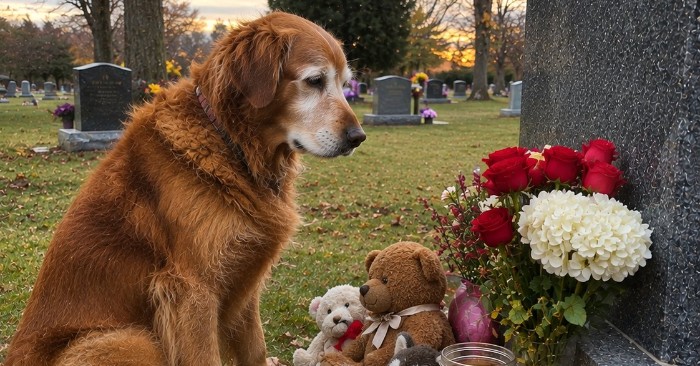
For several months, I had noticed a dog during nearly every visit.
He was a scruffy mixed-breed without a collar, usually resting quietly beside Caleb’s headstone.
Most days, he had already disappeared by the time I left the cemetery.
When I first noticed him, I assumed he belonged to another visitor.
He was a medium-sized dog with patchy brown-and-gray fur that looked as though someone had attempted to trim it with kitchen scissors.
One ear stood upright while the tip of the other folded forward.
His ribs weren’t showing, but he was thin enough to make me wonder whether he was being fed regularly.
When I approached, he didn’t bark.
He simply raised his head.
“Well, hello there,” I said.
His dark eyes followed me as I walked toward Caleb’s grave.
That was when I noticed exactly where he had been lying.
Right beside Caleb’s headstone.
Not somewhere in the general area.
Directly next to it.
When I knelt down, he moved a few steps away.
But he didn’t leave.
I placed fresh flowers beside the stone.
“Did you know him?” I whispered.
The dog tilted his head.
I almost laughed.
It was the first time in months that anything in that cemetery had made me smile.
After that, I started paying more attention to him.
Sunday after Sunday, he was there.
Sometimes he lay curled up in the grass.
Sometimes he sat upright beside the headstone.
And sometimes he slept with his muzzle resting between his front paws.
He never begged for food.
He didn’t demand affection, either.
He simply remained close to Caleb.
Eventually, I began keeping dog treats in my purse.
At first, he accepted them cautiously.
“You’re starting to become a rather expensive little friend,” I told him one morning.
His tail gave the grass a single gentle thump.
That tiny movement stayed with me for the rest of the day.
Still, something about his presence unsettled me in a way I couldn’t explain.
It wasn’t because I disliked the dog.
Quite the opposite.
By then, I was already looking forward to seeing him every Sunday.
What troubled me was how strangely deliberate his behavior seemed.
The cemetery was enormous.
Hundreds of graves stretched across several sections.
Families came and went.
Visitors left flowers, balloons, photographs, and little keepsakes.
Yet this dog always chose Caleb’s grave.
One day, I asked the cemetery groundskeeper about him.
His name was Edwin. He was an older man who had worked there so long that he recognized most of the regular visitors.
I pointed toward the dog.
“Do you know who he belongs to?”
Edwin glanced over.
Then he shrugged.
“He’s been showing up here for quite a while. Nobody seems to know where he comes from, though.”
“Does anyone feed him?”
“Not that I’m aware of.”
“Does he stay here overnight?”
Edwin shook his head.
That only made me more curious.
From then on, I watched the dog more closely whenever I visited.
Most of the time, he seemed perfectly relaxed.
But occasionally, he would turn his head toward the cemetery entrance as though waiting for something.
And at some point, before I was ready to leave, he would suddenly disappear.
I never saw where he went.
One Sunday, I returned to my car and stood beside the driver’s door without opening it.
I glanced back toward the cemetery.
The dog was still there.
For some reason, that image refused to leave my mind throughout the following week.
Last Sunday, I decided to change my routine.
Instead of driving home immediately after my visit, I stopped at a distance and waited.
Eventually, the dog rose, stretched at length, and trotted toward the cemetery gates.
I followed him.
Even now, I couldn’t tell you exactly why.
Something inside me desperately wanted to discover where he went.
I kept enough distance between us that he wouldn’t notice me.
At least, that was what I hoped.
The dog crossed the street outside the cemetery and continued along the sidewalk.
I expected him to wander aimlessly.
But he didn’t.
He moved with surprising determination.
He never hesitated at an intersection.
He turned onto streets I didn’t recognize, passed an abandoned gas station, and eventually disappeared into a narrow alley behind a row of houses.
I had never driven through that neighborhood before.
Several times, I considered turning around.
“This is ridiculous,” I muttered.
I was a grown woman spending her Sunday afternoon following a stray dog through unfamiliar streets.
But whenever I slowed down, he continued moving steadily ahead.
And something about the purpose in his steps made me keep following.
Gradually, the neighborhood began to change.
The front yards became smaller.
Paint was peeling from porch railings.
Several cars sat beneath faded protective covers.
A bicycle missing its front wheel leaned against a fence.
The dog crossed another street without stopping.
I hurried to keep up.
“Where on earth are you going?” I whispered.
Naturally, he didn’t answer.
Almost twenty minutes later, he finally stopped in front of a small, deteriorating house at the end of a dead-end street.
He scratched twice at the front door.
Then he sat down and waited.
I remained on the sidewalk.
My heart began beating faster.
The house was narrow and badly weathered.
One shutter hung crookedly.
Several cracks ran across the porch steps.
But the dog looked completely at ease.
As though he belonged there.
I nearly turned around and walked away.
Suddenly, my curiosity felt terribly intrusive.
Perhaps the dog belonged to an elderly person.
Maybe his owner simply allowed him to wander freely.
Maybe there was nothing unusual about any of this.
Then I heard a sound from inside the house.
A floorboard creaked.
The dog stood up.
For reasons I couldn’t explain, my stomach tightened.
The front door opened a few inches with a quiet squeak.
And when I saw who was standing behind it, I froze.
It was the last person I ever expected to see.
“Mrs. Diane?”
I stared at the young woman.
It took several seconds for me to place her face.
“Sadie?”
Her eyes widened.
Sadie had been Caleb’s girlfriend during his final year of high school.
Back then, she was 17 and Caleb was 18.
For almost an entire year, she had practically been part of our family.
She joined us around the dinner table.
She curled up on our couch during family movie nights.
And sometimes she sat with Caleb on the back steps of our house, whispering about things teenagers believe adults could never possibly understand.
But eventually, they broke up.
Caleb rarely talked about it.
A few months later, Sadie disappeared from our lives completely.
And now she was standing in front of me.
Three years older.
Thinner than I remembered.
Her dark hair was gathered loosely at the nape of her neck.
The dog squeezed past her legs and vanished into the house.
Sadie looked at him, then back at me.
“What are you doing here?”
I swallowed.
“I followed your dog.”
Something changed in her expression.
She glanced briefly into the house.
Then looked at me again.
“You followed Jasper?”
“Is that his name?”
She nodded slowly.
I almost laughed from sheer confusion.
“He’s been sitting beside Caleb’s grave for months.”
All the color drained from Sadie’s face.
For a moment, she said nothing.
Then she opened the door wider.
“You should come inside.”
Every instinct told me that something was wrong.
Nevertheless, I stepped onto the porch and followed her into the house.
The living room was small but tidy.
A worn couch stood against one wall.
Beside the television, children’s books were neatly arranged inside a plastic storage bin.
I noticed them immediately.
Then I spotted a pair of tiny blue sneakers near the hallway.
My chest tightened.
“Do you have a child?”
Sadie went completely still.
Jasper trotted down the hallway and disappeared around the corner.
Before she could answer, a small voice came from another room.
“Mommy?”
I looked at Sadie.
She closed her eyes for a moment.
Then a little boy appeared around the corner.
He looked about three years old.
Although it was already afternoon, he was wearing dinosaur pajamas.
His brown hair stuck up wildly on one side.
When he saw me, he stopped.
I forgot how to breathe.
Something about his face was painfully familiar.
His eyes.
The shape of his mouth.
And the way one eyebrow rose slightly higher than the other.
Caleb used to make that exact expression whenever something confused him.
The little boy pointed at me.
“Who’s that?”
Sadie’s voice trembled.
“That’s Diane.”
The child smiled.
“Hi.”
I couldn’t answer.
Instead, I looked at Sadie.
“No.”
Her eyes filled with tears.
“Diane…”
“No.”
“I wanted to tell you.”
My hands began shaking.
“Tell me what?”
She glanced toward the little boy.
“Beau, sweetheart, why don’t you go play with Jasper for a little while?”
He hesitated.
“Can I have cookies?”
“Yes.”
“Two?”
Sadie managed a faint smile.
“Two.”
The boy disappeared toward the kitchen.
Jasper followed him.
I waited until they were both out of sight.
Then I turned back to Sadie.
“Tell me. Right now.”
She lowered herself slowly into a chair.
I remained standing.
“Beau is Caleb’s son.”
The room seemed to spin around me.
I grabbed the back of a chair for support.
“What?”
Sadie wiped her face.
“I didn’t find out I was pregnant until after Caleb died.”
I stared at her.
Suddenly, every sound around me seemed strangely distant.
The refrigerator hummed.
From the kitchen came the faint jingling of Jasper’s collar.
A child opened a cupboard.
I could hear everything.
Yet I could barely comprehend what the young woman standing before me had just revealed.
“You’ve known for three years?”
“I didn’t know before the accident.”
“But afterward, you did.”
“Yes.”
“And you never told me?”
Her face crumpled.
“I was scared.”
I took a step backward.
“Scared of what?”
“Everything.”
Her voice broke.
“My parents were furious. Caleb and I weren’t together anymore. I was eighteen, pregnant, and then he died.”
She buried her face in her hands.
“I had no idea what I was supposed to do.”
I wanted to be angry.
Part of me was absolutely furious.
Three years.
Three birthdays.
Three Christmases.
Three years of mourning my son while his own child was growing up somewhere across town.
“Why didn’t you come to me?”
Sadie looked up.
“Because I thought you would hate me.”
“Why on earth would I hate you?”
“Because Caleb and I broke up after a terrible argument.”
I shook my head.
“That had nothing to do with me.”
“It felt like it did back then.”
She glanced toward the kitchen.
“My parents wouldn’t let me contact you. They said you’d already suffered enough.”
A bitter laugh escaped me.
“Suffered enough?”
“I know.”
“No, Sadie. You don’t know.”
She flinched.
I hated that I’d hurt her.
But I couldn’t stop myself.
“Do you have any idea how many Sundays I’ve spent sitting beside my son’s grave, wishing I could have just one little piece of him left?”
Tears streamed down her cheeks.
“Yes.”
“While his own son was right here?”
“I came close to calling you a hundred times.”
“Then why didn’t you?”
Once again, she looked toward the hallway.
“Because every month I waited made it harder to finally tell you.”
Her answer hurt because I understood it.
Grief can do that to people.
One impossible day becomes a week.
Then a month.
And before you realize it, years have passed.
I sat down across from her.
My anger hadn’t disappeared.
But something else was beginning to rise alongside it.
Wonder.
“Does Beau know about Caleb?”
Sadie nodded.
“I tell him stories about his daddy.”
She reached for her phone.
“I have pictures.”
My throat tightened.
“Pictures?”
“Of Caleb. Of the two of us. Some are from when we were still in school.”
She opened a photo album and handed me the phone.
The first picture showed Caleb at eighteen.
He was grinning straight into the camera.
In another photograph, Sadie stood beside him.
Then came a picture of Beau.
The same grin.
The same slightly raised eyebrow.
I covered my mouth with my hand.
“Oh, Caleb.”
Sadie began crying again.
“I’m so sorry.”
I handed her phone back.
Then something occurred to me.
“And where does Jasper fit into all this?”
For the first time, something resembling a smile crossed her face.
“Jasper belonged to Caleb.”
I blinked.
“What?”
“Not officially. Caleb found him behind the supermarket during the summer before his last year of high school.”
Suddenly, a memory surfaced.
That summer, Caleb had come home unusually late on several evenings.
And dog food kept mysteriously disappearing from our garage.
I’d assumed he was feeding some neighbor’s dog.
Sadie continued.
“He hid Jasper behind my parents’ shed for weeks. Eventually, my father agreed to let me keep him.”
I looked toward the kitchen.
“That’s why he keeps going to the cemetery.”
“He remembers Caleb.”
I lowered my eyes to my hands.
And suddenly, every single Sunday made sense.
Jasper hadn’t chosen some random grave.
He hadn’t ended up there by coincidence.
He was visiting someone he loved.
Just like me.
At that moment, Beau returned to the living room holding two cookies.
He climbed onto the couch beside his mother.
Then he studied me curiously.
“Mommy says my daddy was funny.”
I laughed through my tears.
“He certainly was.”
Beau smiled.
“Did you know him?”
I looked at Sadie.
She nodded.
So I knelt down in front of the little boy.
“I knew him very well.”
“How?”
My voice cracked.
“Because he was my little boy.”
Beau considered that for a moment.
Then his whole face lit up.
“Does that mean you’re my grandma?”
At first, I couldn’t speak.
I simply nodded.
Then he leaned forward and wrapped his arms around me.
Without hesitation.
A little awkwardly.
As naturally as if he’d known me all his life.
One small arm slipped around my neck.
He was still clutching a cookie in his other hand.
I closed my eyes.
For three years, I’d believed that the accident had taken not only Caleb but also every future he might have lived.
His wedding.
His children.
All the years in which he would have grown older.
I had been wrong.
At least a little.
That evening, Sadie and I talked until twilight slowly settled outside.
Of course, one afternoon couldn’t magically make everything right.
There was still so much anger and pain for us to work through.
There were questions Sadie couldn’t answer.
And three lost years that nobody could ever give back to us.
But before I left, she gave me her phone number.
Then Beau asked whether I would come back.
“Yes,” I promised.
“As soon as you’d like to see me again.”
The following Sunday, I visited Caleb’s grave once more.
But this time, I wasn’t alone.
Sadie stood beside me.
Beau held my hand.
And Jasper lay in his usual spot, right beside the headstone.
I traced Caleb’s name with my fingertips and smiled through my tears.
“You really could have found an easier way to introduce us to each other.”
Jasper lifted his head.
Beau giggled.
And for the first time in three years, I didn’t leave the cemetery carrying only my grief.
I went home holding my grandson’s hand.