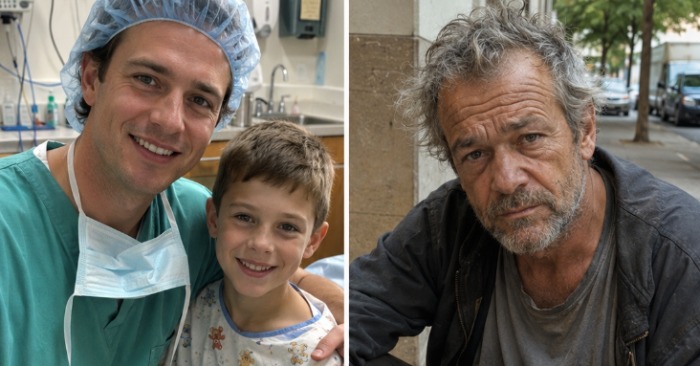
Dr. Bennett’s hand shook as he pushed the envelope toward me.
“If you really mean what you said, find my daughter.”
I stared at him.
Thirty years earlier, this man had stood over my eight-year-old body for eleven hours and refused to let me die.
Now he was asking me for one thing.
Not money.
Not a house.
Not revenge.
His daughter.
I opened the envelope.
Inside were three things.
An old photograph.
A photocopied hospital report.
And a letter that had never been mailed.
The photograph showed Dr. Bennett much younger, standing beside a girl who looked about sixteen.
She had his eyes.
Behind them stood another man in a dark suit.
I recognized him immediately.
Arthur Cole.
The current chairman of the hospital board.
The same man I was scheduled to meet that afternoon.
I looked at Bennett.
“Who is she?”
“My daughter, Lily.”
“Where is she now?”
His jaw tightened.
“I don’t know.”
I looked again at the photograph.
“You haven’t seen her?”
“Seventeen years.”
That stunned me.
“What happened?”
He looked toward the hospital doors.
For a long moment, I thought he wouldn’t answer.
Then he said:
“I made one mistake.”
I sat beside him.
“What mistake?”
“I told the truth.”
Thirty years earlier, Dr. Bennett had been one of the hospital’s most respected cardiac surgeons.
Brilliant.
Demanding.
Difficult.
The kind of doctor other physicians hated working with until someone they loved needed surgery.
Then they wanted Bennett.
He lived inside that hospital.
His wife died when Lily was eleven, and from then on, he raised their daughter alone.
By the time Lily turned sixteen, Bennett was chief of cardiac surgery.
Arthur Cole was an ambitious administrator working his way up through hospital management.
At first, Bennett respected him.
Then patients started arriving in his operating room with problems that made no sense.
Implanted devices failed unusually early.
Certain surgical supplies seemed different from what he had approved.
Bennett began asking questions.
Nobody wanted to answer.
Eventually, he discovered that Cole had quietly approved a cheaper supplier for several critical products.
The hospital was saving millions.
The supplier was making millions.
And some of those products were failing.
My stomach tightened.
“Patients died?”
Bennett looked at the ground.
“Three that I could prove.”
I stared at him.
“What did you do?”
“I reported it.”
“To the board?”
“Yes.”
“And?”
“They told me the evidence was inconclusive.”
“So you went outside the hospital.”
He looked at me.
“How did you know?”
“Because you’re sitting out here.”
A bitter smile crossed his face.
“Yes.”
Bennett contacted a regulator.
Then a journalist.
That was when everything changed.
His access to records disappeared.
Complaints suddenly appeared in his personnel file.
Former colleagues claimed he had become unstable.
One anonymous accusation alleged that he had altered surgical records to hide his own mistakes.
“They blamed the deaths on you.”
He nodded.
I felt sick.
“What about Lily?”
His face changed completely.
That was the wound.
Not the hospital.
Not the career.
Her.
“Cole knew Lily was the only thing I cared about more than medicine.”
I looked at the photograph again.
“What did he do?”
“At first? Nothing obvious.”
Lily had just started applying to universities.
Then a scholarship disappeared.
A recommendation letter was withdrawn.
A summer medical internship she had already been accepted into suddenly rejected her.
Bennett suspected Cole.
He couldn’t prove it.
Then Lily began receiving messages.
Anonymous ones.
They said her father was dangerous.
That he had killed patients.
That he would eventually destroy her future too.
“She believed them?”
“No.”
Bennett’s voice cracked.
“Not at first.”
Then something worse happened.
One evening, Lily came home and found police outside their house.
Bennett had been arrested.
Not for the device scandal.
For prescription fraud.
Controlled medication had been found in his office under falsified patient names.
He swore it had been planted.
The hospital immediately suspended him.
News spread.
His reputation collapsed overnight.
And Lily?
She was seventeen.
Her father’s face was on television.
People whispered at school.
Parents stopped letting their children visit their house.
Then social services became involved.
Because Bennett was under investigation and had no close family nearby, Lily temporarily stayed with one of her mother’s relatives.
Temporary became months.
Then nearly a year.
The criminal case eventually collapsed.
Evidence handling problems.
Missing chain-of-custody records.
No proof Bennett had written the fraudulent prescriptions.
But by then, the damage was done.
His medical license remained under review.
The hospital refused to reinstate him.
Lily left for university.
And something between them broke.
“Why?”
I asked quietly.
“If she knew you might be innocent, why did she disappear?”
Bennett stared at his hands.
“Because I became obsessed.”
That answer surprised me.
“With proving what happened?”
“Yes.”
“I called her constantly. Asked her to remember conversations. Names. Dates. Anything Cole might have said near her.”
He swallowed.
“I stopped being her father.”
I said nothing.
“I became an investigator.”
His voice grew quieter.
“She begged me to stop.”
He didn’t.
Then one night, they had an argument.
Lily told him she couldn’t spend her entire life fighting his war.
Bennett accused her of abandoning him.
She accused him of choosing the hospital over her.
The last thing he said to his seventeen-year-old daughter was:
“If you walk out now, don’t come back.”
Bennett closed his eyes.
“She didn’t.”
For seventeen years.
I looked at the envelope.
“What’s the hospital report?”
“That is why I need you.”
The photocopy was dated only five years earlier.
Much more recent.
It showed a patient named Lily Bennett.
My heart jumped.
“She was here?”
“Yes.”
“How did you get this?”
“Someone mailed it to me anonymously.”
The report indicated Lily had visited the hospital after a car accident.
Minor injuries.
Nothing life-threatening.
But one handwritten note at the bottom caught my attention.
Emergency contact declined.
Bennett pointed to it.
“She was in the same building where I worked most of my life.”
His eyes filled.
“And I was sleeping three streets away.”
That hurt to hear.
“Why didn’t you find her then?”
“I tried.”
“The address on the record was outdated. The phone number was disconnected.”
I looked at the third item.
The unsent letter.
“Did you write this to her?”
He nodded.
“Every year I write one.”
“Why not send them?”
“I don’t know where she is.”
I unfolded it.
I only read the first line.
Lily, I was wrong when I told you not to come back.
I stopped there.
It wasn’t mine to read.
I folded it again.
“You said the hospital took everything from you.”
Bennett looked at me.
“That isn’t completely true.”
“What do you mean?”
“I helped.”
He looked ashamed.
“I spent every dollar fighting them.”
Legal fees.
Private investigators.
Appeals.
He sold his house.
Then his car.
Then his wife’s jewelry.
He refused help from old colleagues because he believed accepting charity meant admitting defeat.
Eventually, the man who had once run an operating department was sleeping in cheap rooms.
Then shelters.
Then outside.
I sat beside him in silence.
There was something deeply unsettling about it.
A man could save hundreds of people and still make choices that destroyed his own life.
Heroism did not make him flawless.
Being wronged did not mean every decision afterward was right.
And Bennett knew that.
That mattered to me.
“I can help you find Lily.”
He looked at me.
“But I’m not promising she’ll want to see you.”
“I know.”
“And if she doesn’t, you have to respect that.”
His face tightened.
Then he nodded.
“I will.”
I stood.
“Come with me.”
“Where?”
“Inside.”
His expression changed.
“No.”
“Yes.”
“I’m not walking into that building.”
“You saved my life in there.”
“That man is gone.”
“No.”
I looked directly at him.
“He’s sitting on a bench feeling sorry for himself.”
His eyes flashed.
Good.
Anger meant there was still something alive inside him.
“You don’t know what they did to me.”
“You’re right.”
I pointed toward the hospital.
“But I know what you did for me.”
He looked away.
“And I know you stink.”
That surprised him.
Then, to my amazement, Dr. Bennett laughed.
It was small.
Rough.
But real.
I took him to a hotel.
Not a luxury suite.
A clean room.
Warm shower.
Fresh clothes.
Food.
Then I made calls.
My company handled medical technology contracts, which was why I had business with the hospital.
That gave me contacts.
Not magical access.
Not secret powers.
Just people who knew people.
It took two days before I found a lead on Lily.
Her surname had changed.
She was Lily Bennett-Hayes.
She lived less than an hour away.
And she was a doctor.
When I told Bennett, he sat down.
“What kind?”
“Pediatric cardiologist.”
His face broke.
Of all things.
His daughter had followed him into medicine.
“No.”
“Yes.”
He covered his mouth.
“She became a cardiologist?”
I nodded.
He cried for several minutes.
Then fear replaced joy.
“Does she know you found her?”
“Not yet.”
He looked relieved and terrified at the same time.
I contacted Lily through her clinic.
I didn’t tell her where Bennett was.
I simply said my name.
Then:
“Your father saved my life when I was eight. I recently found him.”
There was silence.
A long silence.
Then a woman said:
“Is he alive?”
Those three words told me everything.
She cared.
Maybe not enough to reconcile.
But enough to ask.
“Yes.”
“Is he sick?”
“Not critically. But he needs help.”
Another silence.
Then:
“Does he know you called me?”
“No.”
“Good.”
That worried me.
“I need to ask you something,” Lily said.
“What?”
“Did he tell you he was completely innocent?”
I looked toward Bennett, sitting across the hotel room.
“No.”
She seemed surprised.
“He admitted he became obsessed and pushed you away.”
Silence.
Then:
“That’s new.”
We spoke for twenty minutes.
Lily confirmed much of what Bennett had told me.
But she added something he didn’t know.
Arthur Cole had contacted her directly when she was eighteen.
Cole told her that if she publicly supported her father, he would make sure no hospital ever accepted her into a medical program.
“Did you believe him?”
“I was eighteen.”
Her voice hardened.
“And I had already watched him destroy my father.”
“So you stayed away to protect your career?”
“At first.”
“What about later?”
She was quiet.
“Later, I stayed away because I was angry.”
“At your father?”
“At both of us.”
That was painfully honest.
“Would you see him?”
Silence.
“I don’t know.”
I didn’t push.
Then Lily asked:
“Where is he?”
I told her.
She hung up.
I assumed that meant no.
Thirty minutes later, someone knocked on the hotel door.
Bennett looked at me.
“Are you expecting someone?”
I opened it.
Lily stood there.
Forty years old.
Dark coat.
Hair damp from the rain.
And the same eyes as the sixteen-year-old girl in the photograph.
Bennett stood so fast his chair fell backward.
Neither spoke.
Seventeen years.
You imagine reunions as dramatic things.
Running.
Crying.
Embracing.
This wasn’t.
Lily stared at him.
Bennett looked terrified.
Finally, she said:
“You look awful.”
He laughed once through tears.
“So do you.”
She almost smiled.
Then she looked angry again.
“Don’t.”
“I’m sorry.”
“You don’t get to say that once and fix everything.”
“I know.”
That stopped her.
He stepped forward.
Then stopped himself.
“I know.”
He reached into his coat.
Not toward her.
Just the inside pocket.
He took out the stack of unsent letters.
Seventeen of them.
“One for every year.”
Lily stared.
“You wrote?”
“Yes.”
“Why didn’t you send them?”
“I was ashamed.”
Her eyes filled.
“That was always your problem.”
“Yes.”
“You confused shame with punishment.”
Bennett lowered his head.
“And you always made yourself suffer instead of apologizing.”
“Yes.”
Then Lily started crying.
“You stupid old man.”
He laughed and cried at the same time.
“I know.”
She crossed the room.
And hugged him.
Not for long.
Maybe five seconds.
Then she stepped away.
“This doesn’t mean everything is fine.”
“I know.”
“We start slowly.”
“Yes.”
“You don’t call me twelve times a day.”
“I won’t.”
“You go to therapy.”
He hesitated.
Lily raised one eyebrow.
“Therapy.”
“Yes.”
“And you stop sleeping outside hospitals like some tragic Victorian ghost.”
I laughed.
Bennett looked offended.
“I was making a point.”
“You smelled like a point.”
For the first time, all three of us laughed.
That should have been the ending.
It wasn’t.
Because I still had one business meeting.
With Arthur Cole.
Two days later, I walked into the hospital boardroom.
Cole smiled and shook my hand.
He had no idea what I knew.
Our company was considering a major equipment contract with the hospital.
Millions of dollars.
I placed a folder on the table.
Not Bennett’s accusations.
Those required proper investigation.
I wasn’t going to play prosecutor.
Inside were publicly obtainable disciplinary records, archived court documents, supplier records, and inconsistencies my legal team had already confirmed.
Enough to ask serious questions.
Cole’s smile disappeared.
“What is this?”
“A reason my company will not sign anything today.”
He looked at me.
“You’re making a mistake.”
“Maybe.”
I stood.
“But thirty years ago, one of your surgeons made a decision when everyone else thought I was going to die.”
Cole frowned.
I continued.
“He said he’d give me every minute he had.”
Now Cole understood.
“Bennett.”
“Yes.”
His face hardened.
“That man destroyed himself.”
“Parts of that may be true.”
Cole blinked.
I think he expected blind loyalty.
I didn’t give it to him.
“But whether Bennett made mistakes later has nothing to do with whether your hospital buried legitimate safety concerns.”
Cole said nothing.
“The board will receive this too.”
I left.
What happened afterward was not instant justice.
There was no dramatic arrest in the hallway.
No applause.
The hospital launched an independent review after several board members saw the documentation.
Former employees were interviewed.
Old supplier contracts were reopened.
Arthur Cole took leave during the investigation.
Months later, multiple procurement violations and concealed conflicts of interest were confirmed.
Some of Bennett’s oldest allegations were supported.
Others could no longer be proven.
His medical license was never magically restored.
Too much time had passed.
His own conduct during the later years of his fight had created additional problems.
Bennett accepted that.
“I don’t want to operate again,” he told me.
“What do you want?”
He thought for a moment.
“To be useful.”
So we found another way.
My company funded a patient advocacy program independent of the hospital.
Bennett became a volunteer advisor.
Not a surgeon.
Not a hero.
Just an old doctor helping families understand difficult medical decisions and teaching young clinicians what happens when institutions stop listening.
He was very good at it.
Of course he was.
Lily visited once a week at first.
Then twice.
Eventually Bennett met his granddaughter.
A seven-year-old girl named Sophie.
The first time she met him, she stared at him suspiciously.
“So you’re Grandpa?”
Bennett looked like someone had punched him in the heart.
“I suppose I am.”
She handed him a toy stethoscope.
“Then check my heart.”
His hands trembled as he placed it against her sweater.
After a moment, he smiled.
“Sounds strong.”
Sophie nodded seriously.
“Mom says yours is stubborn.”
Lily burst out laughing.
Bennett looked at her.
“She’s right.”
A year after I found him on that bench, Bennett came to my birthday dinner.
My mother had died several years earlier.
But before she passed, she had given me an old photograph.
Eight-year-old me in a hospital bed.
Bennett standing beside me.
I placed it on the table.
He looked at it for a long time.
“You really were that boy.”
“I told you.”
“I remember your mother.”
My throat tightened.
“She remembered you every year.”
He looked down.
Then I raised my glass.
“To thirty-one extra years.”
Bennett’s eyes filled.
“No.”
He lifted his own glass.
“To what you did with them.”
That stayed with me.
For most of my life, I believed gratitude meant remembering the person who saved me.
I was wrong.
Sometimes gratitude is action.
Sometimes the person who once carried you through the worst night of your life eventually becomes the one sitting in the dark.
And when that happens, you may never be able to repay what they gave you.
But you can sit beside them.
You can listen.
You can help them stand.
And sometimes, giving someone their life back doesn’t mean fixing everything they lost.
It simply means reminding them that their story is not finished yet.