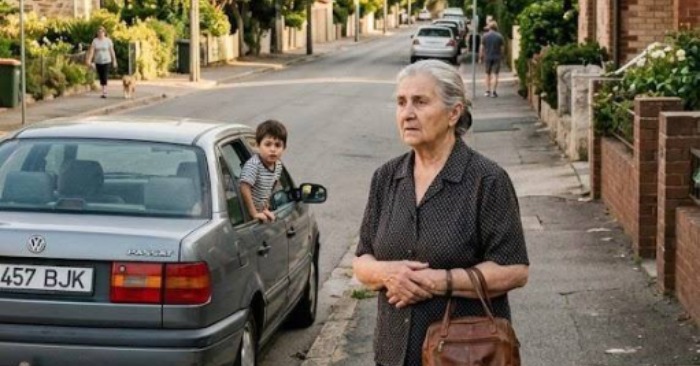
Mateo’s voice rang out from the small living room, rushed and almost mechanical, bouncing off the walls of that modest house in the heart of Mexico City. Doña Rosa gave herself one last look in the worn mirror inside her bedroom. The royal blue dress she was wearing was not new, but she had preserved it with the utmost care for truly special occasions. Her late husband, Don Roberto, had given it to her on their 35th wedding anniversary. She still remembered the way he looked at her that day, under the glow of sunset, as if she were the most beautiful woman in the entire country.
Today, sadly, no one looked at her that way.
Rosa took a deep breath, filling her lungs, and stepped out of the room, adjusting her gray hair with both hands. From the kitchen came the unmistakable smell of red rice with peas and mole poblano she had spent three hours preparing, but no one in that family seemed to have time anymore to sit down and eat at home. Leticia, her daughter-in-law, moved from one side to the other, checking her designer handbag and touching up her lipstick, while little Lupita, only six years old, bounced excitedly near the front door.
“Grandma, we’re going to eat at a really fancy restaurant in Polanco!” the girl shouted, her two eyes glowing with excitement.
Rosa smiled. She always smiled whenever her granddaughter spoke to her. That little girl was the only thing that still made her feel she had a place, a purpose, inside the house she herself had helped build brick by brick.
“Yes, my love, I’m coming,” Rosa answered, her voice far steadier than she actually felt inside.
She carefully picked up her black purse, the one whose four corners had long been worn down by the relentless passing of time. It was not much, but she had learned to cherish it, just as she had learned to cherish many things in her life that no one else seemed to notice or value. When Rosa reached the living room, the three of them were already ready. Mateo held the keys to the sedan, Leticia stared impatiently at her phone screen, and Lupita looked ready to bolt out the door.
For one endless second, no one said a word.
Mateo looked up at his mother. His eyes wavered for a fraction of a second. Rosa noticed immediately. Of course she noticed. A mother always notices everything, even what her children try to bury deep inside themselves.
“Uh… Mom…” Mateo began, scratching the back of his neck nervously.
Rosa felt a strange stab in the center of her chest, like a cruel warning.
“What is it, son?”
He avoided looking her directly in the eyes. He glanced toward the wooden door, then toward Leticia, as if searching for support to justify what he was about to do.
“It’s just… the car is kind of full,” Mateo said at last, forcing a tight-lipped smile that never reached his eyes. “Leticia loaded three big boxes from the shopping she did yesterday, and… maybe another day I’ll take you out by myself for some tacos, okay, Mom?”
Time stopped completely in that room.
It wasn’t only what he said. It was how he said it. In a soft, almost casual tone. As though it were a meaningless detail. As though he were not leaving his own mother outside his life, treating her like an object that simply took up too much space.
Rosa’s ten fingers tightened around the strap of her purse. She could have answered him with a hundred different things. She could have reminded him of the countless nights she stayed awake when he was sick as a child, the twenty years of sacrifice working double shifts, the entire years she devoted to seeing him grow into a man. She could have asked him at exactly what moment she stopped fitting inside his family.
But she did not. Because a Mexican mother, sadly, often learns to swallow her pain in silence.
“Of course, son,” Rosa said, nodding slowly. “If the car is full, then there’s no problem. I’ll stay here and watch the house.”
Lupita looked at her in confusion for a moment, but Leticia was already pulling her by the arm.
“Come on, Lupita, the reservation is for two o’clock and traffic is terrible,” her daughter-in-law said coldly.
Mateo said nothing else. He opened the door, and the three of them disappeared.
Rosa remained standing in the middle of the room. The sound of the engine starting and driving off down the street echoed in her mind. She walked to her bedroom, took out an old suitcase—the same one she had arrived with in that city back in 1985—and packed four blouses and two pairs of pants. She was just about to cross the door and step out into the street when she heard a car brake abruptly and the sound of the key turning in the lock.
Quickly, Rosa stepped back and hid in the hallway. The door opened, and then she heard Leticia’s voice, dripping with venom.
“What a relief that I forgot my wallet and we got to leave her behind. I would have been so embarrassed to show up at a place that fancy with your mother dressed like that. She smells like old cooking. You need to convince her to sell this house so we can buy ourselves an apartment in a better area, and we’ll send her off to some cheap nursing home. I can’t stand one more day with her.”
Rosa held her breath. Then came the voice of her own son, her own flesh and blood.
“You’re right, my love. Tomorrow I’ll bring her the papers so she can sign over the property. She’s too old already, and around here she just gets in the way.”
No one could have imagined the chilling decision that mother would make in the very next second…
PART 2
The silence that followed those cruel words was the heaviest Rosa had ever felt in her sixty-eight years of life. Her heart did not break—it froze completely. For two endless minutes, she stood motionless in the darkness of the hallway, gripping the handle of her 1985 suitcase so tightly that her knuckles turned white. She was not going to cry. She had shed enough tears for a son who had just put a price on her dignity and her home.
Mateo and Leticia grabbed the wallet from the dining table and rushed out once again, slamming the door behind them, laughing as they imagined a future built on the ashes of the woman who had given them everything.
The moment the sound of the car disappeared for the second time, Rosa stepped out of hiding. Her expression had changed. The pain had turned into absolute clarity. She walked to the small wooden drawer where she kept her important documents. From it, she took a yellow envelope containing the deed to the house. Mateo believed he would be able to manipulate her into signing it over, but he did not know one small yet powerful detail: Rosa had never placed the house in his name. The property belonged solely to her, purchased with Don Roberto’s life insurance money.
She took out a sheet of paper and wrote a short, direct note without a single drop of sentimentality. She left it on the coffee table beside a copy of the keys, picked up her suitcase, and stepped out into the street. The air of Mexico City hit her face, but this time it felt fresh. She took a taxi to the bus terminal and bought a one-way ticket to Monterrey, a city where she had an old childhood friend and where nobody would judge her for her blue dress or for smelling like homemade food.
The first three weeks in Monterrey were brutal. Rosa rented a tiny, stifling room. Even so, that little space was hers. There were no contemptuous looks there, no sighs of irritation. After fifteen days, she found work at a modest diner near downtown. She started out washing dishes for eight hours a day, but her hands still remembered the art Leticia had despised so much.
One morning, the main cook failed to show up. Rosa took over the griddle and prepared her famous northern-style chilaquiles and a fire-roasted salsa in a molcajete that filled the place with a heavenly aroma. When customers tasted the food, the diner filled up like never before. In less than four months, the owner, amazed by the success and worn down by her own age, offered Rosa a fifty-percent partnership. Rosa accepted. Her cooking carried magic, and for the first time in decades, she was earning her own money and the respect of an entire community.
Meanwhile, more than nine hundred kilometers away, karma was doing its relentless work in Mateo’s life.
The note Rosa had left behind said only this: “The house will be sold in 30 days through a lawyer. You have that time to find somewhere else to live. I am no longer in the way.” When Mateo and Leticia read it, their world of appearances collapsed. Without Rosa there to cook, clean, and watch Lupita for free, reality crushed them. Leticia refused to lift a single finger in the house. The cost of babysitters and takeout emptied Mateo’s credit cards in just three months. The arguments became daily. The moment Leticia realized Mateo would no longer inherit the house and that they were drowning in debt, she packed her things and abandoned him, leaving him alone with the little girl and a mountain of problems.
Mateo hit rock bottom. Desperate, ruined, and haunted by the unconditional love he had thrown away just to please a shallow woman, he hired a private investigator with the last savings he had left. It took five weeks to find Rosa.
On a hot Tuesday afternoon, Mateo arrived at the address in Monterrey. He expected to find his mother worn down, suffering, begging to see her family again. But when he reached the diner, he froze in the doorway.
The place was packed with people laughing and eating. And there, behind the cash register, giving orders with a steady voice and wearing a radiant smile, was Doña Rosa. She wore an immaculate chef’s jacket and a silver necklace. She looked ten years younger. She radiated peace and power.
Mateo swallowed hard, his legs trembling beneath him. He stumbled between the tables.
“Mom…” he whispered.
Rosa looked up. Their eyes met. There was no shock, no startlement in her face.
“Good afternoon, Mateo. What can I get for you?” she replied in such a professional tone that it pierced Mateo’s soul.
“Mom, please… I’ve been looking for you everywhere,” he begged, tears filling his eyes as he lowered his head under the curious gaze of two waiters. “Leticia left me. I lost my job from all the stress. Lupita cries for you every night. I need you. The house is hell without you. Please forgive me for everything I said. Come back with me to Mexico City. I swear things will be different.”
The son expected an embrace. He expected the submissive mother he had always known to run to comfort him and solve his life again, just as she always had.
The emotional twist was devastating.
Rosa stepped out from behind the counter and approached him, but kept a careful distance. Her face was a mask of perfect calm.
“I’m very sorry to hear what happened to your marriage, Mateo. I truly am. And I feel deeply for my little Lupita,” Rosa said, keeping her voice low but unbelievably firm. “But I think you are confused.”
“Confused? Mom, I’m asking for your forgiveness. I need you at home,” he insisted, clinging to a selfish hope.
“You do not need me as a mother, Mateo,” Rosa interrupted, and every word landed like a precise blow to the man’s conscience. “You need an unpaid servant. You need someone to clean up your messes and make herself smaller so that you and your problems can fit. But I no longer know how to make myself small.”
Mateo went speechless. Tears rolled down his cheeks.
“That day you left me behind because there was no room, you did me the greatest favor of my life,” Rosa continued, gesturing toward the restaurant around them. “You forced me to realize that I was worth far more than a dark little corner in a house where nobody respected me. I built this place. I own half of this business. Here, I decide who comes in and who leaves.”
“Mom, I’m your son…” Mateo sobbed.
“And I am your mother. And because I love you, I forgive you,” Rosa said, and for one brief second, her voice cracked slightly with held-back emotion. “But forgiveness does not mean submission. I will never again live under the same roof as you. If you want to bring Lupita to visit me, the doors of my business and of my new home are open to both of you. But my life, my time, and my space belong only to me now.”
In that exact moment, Mateo understood that he had lost forever the woman who gave him life—not because of an accident, but because of his own arrogance. The truth had revealed itself before his eyes with crushing force.
Rosa asked a waiter to pack two meals for Mateo for the trip back. Then, without another word, she turned around and went back into the kitchen, where the fire still burned and life moved forward.
Mateo left the restaurant dragging his feet, carrying a pain he would have to live with for the rest of his days. He had gone looking for an old woman to fix his life, but instead he found a queen who had reclaimed her crown.
Sometimes family believes they can treat parents like old furniture to be pushed into a corner. But they never imagine the unbreakable strength a mother possesses when she finally decides it is time to love herself.
And you—what do you think of Rosa’s decision? Leave your opinion in the comments and share this story to remind everyone that respect for our parents should never disappear because of some supposed “lack of space.”