“Ma’am, I don’t think that…”
Before the police officer could finish his sentence, I took off running.
The sheriff’s deputy hurried after me. Two search-and-rescue volunteers followed us, carrying flashlights.
Ahead of us, Edgar, the black crow, flew from one post to another.
Whenever we got closer, he fluttered farther ahead.
But each time, he turned his head back, as though checking to make sure we were still following him.
And every time, he let out a loud caw.
He guided us along the canal, well beyond the area the search teams had already covered.
Then he abruptly changed direction.
We had to climb down a steep embankment covered in thick bushes and tangled undergrowth.
At the bottom was a narrow ravine that nobody had searched before.
It was completely removed from the walking trails.
At the foot of the slope, we discovered an enormous concrete drainage pipe.
It was taller than a small child and ran beneath the road.
Edgar landed directly on top of the pipe.
He began cawing relentlessly.
Over and over again.
As though he were desperately trying to tell us something.
I dropped to my knees beside the opening, switched on my phone’s flashlight, and aimed it into the darkness.
“Birdie? BIRDIE!”
For a moment, all I could hear was the trickling water.
Then a faint, trembling voice emerged from somewhere deep inside the pipe.
“Mommy?”
What Edgar Had Carried Out of the Pipe
Rainwater was flowing along the bottom of the concrete tunnel.
With the rain continuing to fall, the water level was steadily rising.
One of the rescue volunteers, a young man named Arlen, lowered himself flat onto his stomach.
Holding his flashlight between his teeth, he carefully crawled into the dark opening.
I stood outside, completely paralyzed.
Every passing second felt like an eternity.
Approximately two minutes later, Arlen reappeared.
He was carrying my daughter in his arms.
Birdie was soaking wet.
Her entire body was trembling, and mud covered her face and clothing.
One of her shoes was missing.
Her lips had already turned slightly blue from the cold.
But she was alive.
I could hardly believe how fortunate we were.
Later, Birdie explained what had happened.
She had spotted a tiny kitten and followed it through the back garden gate.
The animal had scampered down the embankment before disappearing into the enormous concrete pipe.
Birdie had desperately wanted to rescue it.
So she crawled inside after it.
Once inside the tunnel, however, she had suddenly become frightened.
Surrounded by darkness, she could no longer figure out where the exit was.
For three hours, she had sat crying on a dry concrete ledge.
“I could hear everyone calling my name,” she told us afterward.
Her voice was still barely above a whisper.
“But I was so scared that I couldn’t make myself answer.”
Then she looked at me.
“Edgar kept flying back to the end of the pipe.”
She managed a faint smile.
“He was talking to me.”
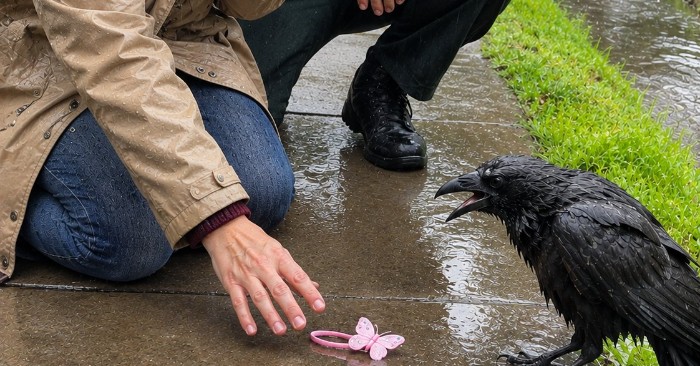
Suddenly, I remembered the tiny hair clip the crow had brought back to us.
“He took your butterfly hair clip,” I said.
Birdie nodded.
“It fell out of my hair while I was crawling through the pipe.”
Then she explained:
“Edgar picked it up. I thought he wanted to steal it.”
But Edgar hadn’t stolen the hair clip.
He had carried it all the way back to my house.
The paramedics determined that Birdie was suffering from mild hypothermia.
After spending one night in the hospital, she was allowed to return home.
Clutched in her arms was a stuffed crow she had received from the hospital gift shop.
The following day, the sheriff’s deputy appeared on our doorstep.
It was the same man who had previously seemed convinced that I was losing my mind from worry.
He shook his head in disbelief.
“I’ve been doing this job for twenty-two years,” he said.
“But I’ve never witnessed anything like this.”
Then he added:
“That bird managed to locate your daughter when even our search dogs couldn’t find her.”
Before long, local news outlets were reporting on the extraordinary rescue.
Eventually, even a national news network picked up the story.
Shortly afterward, I received a phone call from a university wildlife researcher.
She explained that crows are capable of recognizing individual human faces.
They can also remember people who have treated them kindly for many years.
“Your crow recognized your daughter,” the scientist told me.
Then she added:
“And he recognized you, too.”
Later that same week, Mr. Dennison appeared at my front door.
He was awkwardly holding his cap between his hands.
“I owe you an apology,” he began.
Then he looked at me seriously.
“And I’m going to withdraw the fine.”
I was speechless.
Finally, he held out a small paper bag.
Inside were some unsalted peanuts.
“For the bird,” he explained.
After a brief pause, he added:
“From me.”
At the next meeting of our homeowners’ association, the members voted on new safety measures.
They decided to install a lockable protective grate over the enormous drainage pipe.
The purpose was to ensure that no child could ever crawl inside it again.
But they also revised another rule.
From that moment onward, feeding wild birds was officially permitted.
Epilogue: The Missing Butterfly Wing
Edgar still visits us every morning.
These days, Birdie is the one who puts peanuts outside for him.
While he eats, she tells him about her day as though he were an old friend.
And Edgar appears to listen attentively to everything she says.
Last week, he brought us another little gift.
A tiny pink plastic butterfly wing suddenly appeared on our porch railing.
It was the exact piece that had broken off Birdie’s hair clip inside the concrete drainage pipe that day.
My daughter carefully picked it up.
Then she walked over to the little glass jar where she kept all the gifts Edgar had brought her over time.
Inside were already a bottle cap, a button, and an earring.
She gently placed the pink butterfly wing among them.
Then she admired her collection and smiled.
“Now everything is whole again,” she said.