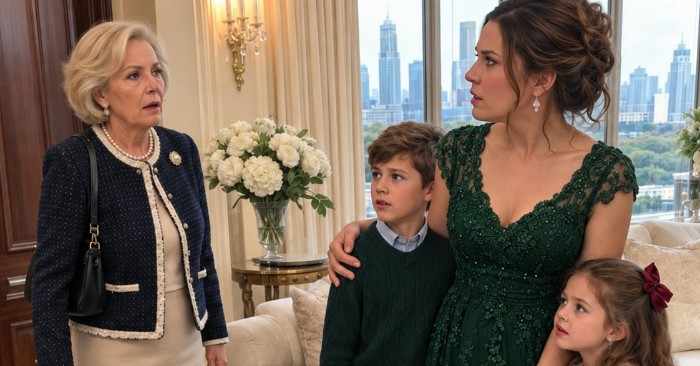
One Saturday morning, my mother-in-law appeared on our doorstep carrying a large bag filled with presents for her grandchildren. She was smiling, but the moment she stepped inside our house, that smile vanished. For six months, I had kept the truth from her: her son, Trevor, had abandoned us for another woman. Our two children still asked every evening when their daddy would finally come home. But the worst part wasn’t that Dorothy discovered my lie. It was the confession she made shortly afterward.
That morning, I was preparing breakfast when the doorbell rang.
I opened the door and found my mother-in-law, Dorothy, standing outside.
She was clutching an enormous gift bag.
“Where are my two little darlings?” she asked without even greeting me first.
“In the living room. They’re having breakfast.”
Dorothy walked into the house with her usual confidence.
But suddenly, she stopped.
Her eyes wandered around the entrance hall.
First, she examined the coat rack where Trevor’s jacket used to hang.
Then she glanced at the small shoe rack beside the door.
There were only three pairs of shoes.
Mine and the children’s.
“Where’s Trevor?” she asked.
My heart tightened.
“He’s at work.”
“On a Saturday?”
“He’s been incredibly busy lately.”
Dorothy didn’t respond.
Just then, my eight-year-old daughter, Piper, and my five-year-old son, Gavin, came running into the room.
“Grandma!”
Dorothy hugged them so tightly that, for a moment, I hoped she would forget her questions.
But I knew this woman far too well.
Dorothy had always possessed an exceptionally sharp eye.
Sometimes, simply hearing someone take a breath before answering was enough for her to recognize a lie.
Throughout breakfast, she barely spoke.
She studied her son’s empty chair.
The calendar attached to the refrigerator.
And the family photographs I still had hanging on the wall.
I tried desperately to behave as though everything was normal.
But my hands were trembling so badly that I accidentally spilled coffee across the table.
Eventually, Dorothy looked straight at me.
“Joanna, how long has Trevor been away from home?”
I froze.
“I already told you. He’s working out of town.”
Dorothy’s voice became firmer.
“I asked you how long.”
Before I could answer, Piper lifted her head from her plate.
“Grandma, Daddy doesn’t sleep here anymore.”
The room fell completely silent in an instant.
Dorothy slowly turned toward my daughter.
“What do you mean, sweetheart?”
Piper lowered her eyes.
“Mommy says he’s busy. But I think Daddy doesn’t want to live with us anymore.”
Tears immediately filled my eyes.
Dorothy looked at Piper first.
Then at me.
But she didn’t say another word.
The truth was that Trevor had walked out on us six months earlier.
There hadn’t been a dramatic argument.
No screaming.
No shattered dishes.
One evening, he had come home, placed his keys on the table, and announced:
“Joanna, I’m tired of this life.”
Initially, I thought he was referring to his job.
Our bills.
Our endless responsibilities.
But the following morning, while the children were at school, he began packing his clothes.
I caught him just as he was closing his suitcase.
“There’s someone else,” he confessed.
Three words.
That was all it took to destroy eleven years of marriage.
The woman’s name was Tiffany.
She worked alongside Trevor.
According to him, they had been in love for several months already.
I asked what would happen to our children.
“Of course I’ll keep seeing them,” he promised.
But he never fulfilled that promise.
During the first few weeks, he still responded to some of my messages.
Then his phone calls became less frequent.
His promised visits turned into excuses.
Eventually, he stopped contacting us altogether.
I continued going to work.
Paid the bills.
And forced myself to smile whenever Piper and Gavin asked about their father.
But there was one person I couldn’t bring myself to tell the truth.
Dorothy.
Since her husband’s death, Trevor had been her only son and her greatest source of pride.
I was terrified that discovering what he had done would completely break her heart.
So I invented business trips.
Endless meetings.
Projects in distant cities.
One lie followed another.
Until that Saturday.
After lunch, the children went upstairs to rest.
Dorothy asked me to sit with her in the kitchen.
“I want to hear the truth now.”
I couldn’t look her in the eye.
“Trevor left us,” I whispered.
“When?”
“Six months ago.”
Her fingers tightened around her teacup.
“And the children?”
“They’ve stayed with me.”
“Does he visit them?”
I shook my head.
I watched Dorothy’s expression gradually transform.
First came disbelief.
Then profound sadness.
And finally, something that looked almost like horror.
“Is there another woman?” she asked.
I nodded.
Without saying anything, Dorothy stood up.
She walked upstairs and entered the bedroom Trevor and I had once shared.
When she returned, she was holding our wedding photograph.
“I can’t believe my son would do something like this,” she murmured.
Then she took her phone out of her handbag.
“Joanna, there’s something you need to know.”
Her voice trembled.
“Trevor has been calling me regularly over the past few months.”
An icy chill ran down my spine.
“What?”
Dorothy looked at me with tears in her eyes.
“He told me that you threw him out.”
I stared at her.
“He claimed you were preventing him from seeing his children. And that you were trying to turn Piper and Gavin against him.”
I covered my mouth with my hand.
Dorothy continued.
“And three days ago, he asked me for a favor.”
She opened a message thread and held her phone toward me.
I read the message once.
Then a second time.
It was from Trevor.
“Mom, I need you to testify for me. If you confirm that Joanna is mentally unstable as a mother, I can get custody of the children. Please don’t let me down.”
I could barely breathe.
My husband hadn’t merely abandoned us.
Now he wanted to take my children away from me as well.
But what Dorothy said next left me completely frozen.
“Joanna… I’ve already spoken with his attorney.”
She paused.
“And there’s something else you don’t know yet.”
For several seconds, I couldn’t move.
The kitchen looked exactly as it always had.
Sunlight streamed diagonally through the window.
The clock on the wall showed 4:20 p.m.
My children were asleep upstairs.
Outside, a neighbor was mowing his lawn.
Everything seemed frighteningly ordinary.
And yet I had just discovered that the man with whom I had shared eleven years of my life was preparing a legal attack designed to separate me from my children.
And that his own mother could potentially become his most important witness.
Eventually, I found my voice again.
“What do you mean you’ve spoken to his attorney?”
Dorothy placed her phone on the table.
She looked as though she had aged ten years in the space of a single hour.
“I called him on Thursday,” she explained.
“I told him I wanted to help my son and was willing to provide whatever testimony was necessary.”
My stomach twisted into a knot.
“Dorothy…”
She raised her trembling hand.
“Please let me finish.”
I remained silent.
“I wanted to understand exactly what Trevor was planning. So I simply allowed the attorney to keep talking.”
Then she slid her phone toward me.
“And I recorded the entire conversation.”
She touched the screen.
A man’s voice filled the kitchen.
“What we need, Mrs. Hale, is an established pattern of behavior,” the man explained in the recording.
“Mr. Hale is prepared to testify that his wife has experienced emotional outbursts and consumed alcohol.”
He continued speaking.
“If you can confirm that you’ve personally witnessed such behavior, even on a single occasion, the court will take your testimony seriously.”
I stared at the phone.
“But I don’t even drink,” I whispered.
“Over the past two years, I’ve probably had nothing more than a glass of wine at Christmas.”
Dorothy nodded sadly.
“I know, Joanna. I’ve known you for fourteen years.”
The recording continued.
“You should also understand that the custody petition has a practical financial component.”
The attorney’s voice remained entirely businesslike.
“If my client is awarded primary custody of the children, his existing child support obligation would no longer apply in its current form.”
Then came the sentence that completely shattered whatever stability I had left.
“Since his new partner is expecting a child, my client is currently experiencing considerable financial pressure.”
I stared at the phone.
“She’s pregnant?”
Dorothy closed her eyes.
“Tiffany is expecting a baby. She’s almost five months along.”
I couldn’t make a sound.
“That’s why he left,” Dorothy said quietly.
“It wasn’t because he was tired of this life, Joanna. He simply didn’t want to be responsible for it anymore.”
I pressed my fingers against my lips.
Suddenly, I thought about all the missed visits.
The unanswered messages.
The countless nights Gavin had cried himself to sleep because his father hadn’t even bothered to call.
And now Trevor wanted to use his own children to save money.
“Why didn’t he simply ask for a divorce and leave us alone afterward?” I asked.
My voice broke.
“Why does he have to take my children away from me too?”
Dorothy’s response was disturbingly straightforward.
“Because it’s cheaper than paying child support.”
She pointed toward her phone.
“That’s exactly what his attorney said.”
For a long time, neither of us spoke.
Then Dorothy reached across the table and took my hand.
Her skin felt cool and delicate.
Yet her grip was surprisingly strong.
“Now I need to tell you the thing I’m most ashamed of.”
I waited.
Dorothy lowered her gaze.
“Last spring, I saw Trevor with that woman.”
My breath caught in my throat.
“I was in Columbus for a doctor’s appointment,” she began.
“Afterward, I went to that little Italian restaurant near the courthouse to get something to eat.”
She swallowed.
“Trevor was sitting at a table in the corner. There was a young woman with him.”
Dorothy’s voice became quieter.
“He was holding her hand.”
“Dorothy…”
She shook her head.
“He noticed me. He immediately came over. His face had gone completely white.”
She wiped her eyes.
“He told me she was a colleague and that they were celebrating a successful business deal.”
Then she looked at me.
“I knew he was lying.”
Tears streamed down her cheeks.
“A mother can sense those things.”
She breathed heavily.
“But I wanted so desperately to believe him.”
I said nothing.
“I convinced myself that perhaps it wouldn’t be true as long as I never said it out loud.”
Her voice cracked.
“So I kept quiet.”
She looked at me pleadingly.
“I didn’t tell you. And I didn’t tell anyone else.”
Then she pressed my hand against her cheek.
“If I’d spoken up back then, perhaps he would have stopped.”
She sobbed.
“Perhaps you wouldn’t have had to spend six months pretending everything was all right.”
I felt my heart contract painfully.
“I’ve been carrying that guilt ever since, Joanna.”
Dorothy was now crying openly.
“I’m so terribly sorry. I failed you. I failed all of you.”
I should have been furious.
And part of me was.
But as I watched this proud, perceptive woman break down at my kitchen table, I realized something.
She hadn’t simply been trying to protect Trevor.
She had been trying to deny the loss of the son she thought she knew.
“I lied to you too,” I said quietly.
“For six months.”
Dorothy managed a sorrowful smile.
“You lied because you wanted to protect me.”
She shook her head.
“I lied because I wanted to hold on to a comforting illusion. There’s a difference.”
We were still sitting there holding hands when the clock struck shortly after five.
Eventually, I asked:
“What are we going to do now?”
Dorothy wiped away her tears.
Then she straightened her shoulders.
For the first time that day, she looked like the woman I had known for years.
“Now we fight.”
I looked at her in surprise.
“I’ve already contacted my late husband’s former attorney,” she explained.
“Gerald Whitcomb.”
She gave a quiet snort.
“He’s eighty-one years old and nastier than a snapping turtle.”
Then she added:
“And he’s absolutely furious.”
Despite everything, I almost smiled.
“He wants to see you on Monday morning.”
I shook my head.
“Dorothy, I can’t afford an attorney like that.”
She lifted her chin determinedly.
“You won’t be paying him.”
I stared at her.
“I’ll take care of it.”
“But…”
“Joanna, I have my pension and the proceeds from my husband Frank’s life insurance policy.”
She squeezed my hand.
“And I honestly can’t think of anything better to spend that money on than my grandchildren.”
I started laughing.
But my laughter nearly turned into a sob.
On Monday morning, Dorothy and I sat inside a wood-paneled law office in downtown Cleveland.
Gerald Whitcomb listened to the recording twice.
Throughout the entire playback, his expression never changed.
When the conversation ended, he removed his glasses.
“Mrs. Hale,” he said to Dorothy, “do you understand that if you confirm this information in court, you’ll be testifying against your own son?”
Dorothy looked at him calmly.
“I understand that I’ll be telling the truth.”
She paused.
“Whether my son can ever forgive me for that is something he’ll have to decide for himself.”
The next four months became the most difficult period of my life.
Trevor’s attorney proceeded with the threatened custody petition.
The documents accused me of being mentally unstable.
Of neglecting my children.
And of abusing alcohol.
Reading those allegations, I felt as though I was looking at legal documents describing a complete stranger.
A woman who had committed terrible acts and deserved to lose everything.
But Gerald Whitcomb refused to be intimidated.
He arranged for Piper’s teachers to testify.
They described a mother who attended every parent-teacher conference.
Who volunteered at every bake sale.
And who reliably took care of her children’s educational needs.
He spoke with our pediatrician.
With our neighbors.
With people who had repeatedly seen me over the preceding six months.
Carrying grocery bags up the driveway.
Gathering soccer cleats.
And bringing two exhausted children home after long days.
Whitcomb also obtained the telephone records.
Since March, Trevor had called his children exactly four times.
Four times.
Throughout all those months.
The court hearing took place on a gloomy Tuesday in February.
Trevor sat on the opposite side of the courtroom.
He was wearing a dark blue suit I had never seen before.
Tiffany sat behind him in the spectators’ section, her pregnancy visibly apparent.
Trevor didn’t look at me.
He stared down at the table.
Exactly as he used to do whenever he suddenly remembered that he had forgotten our wedding anniversary.
Then Dorothy was called to the witness stand.
The entire courtroom fell silent.
Trevor’s attorney stepped forward.
He smiled confidently, as though he already knew what answer he was going to receive.
“Mrs. Hale, you’ve had opportunities to observe your daughter-in-law interacting with her children.”
He paused briefly.
“Would you describe Joanna as a mentally stable mother?”
Dorothy folded her hands.
Then she responded calmly:
“I would describe her as the strongest woman I’ve ever known.”
The smile disappeared from Trevor’s attorney’s face.
But Dorothy continued.
“And I would describe my son as a man who abandoned his family.”
She looked toward Trevor.
“Who lied to me about what happened.”
Then she turned her attention back to the court.
“And who subsequently asked me to help him take his wife’s children away from her.”
She paused briefly.
“I have a recording of my conversation with his attorney, should the court wish to hear it.”
Trevor’s head jerked upward.
For the first time, I saw genuine fear in his eyes.
The judge listened to the recording in silence.
When it ended, she removed her glasses.
Then she studied Trevor for a very long time.
“Mr. Hale,” she finally said, “in my twenty-two years on the bench, I’ve rarely heard anything that has disappointed me this deeply.”
I was awarded sole authority over the children’s primary residence and primary physical custody of both children.
Trevor was permitted to see Piper and Gavin every other weekend.
However, those visits would be supervised for the first six months.
Child support was also established at the full amount required under the applicable guidelines.
Trevor’s attorney attempted to raise objections.
But the judge didn’t even allow him to finish speaking.
I sat there, barely able to comprehend that it was finally over.
My children would remain with me.
After the hearing, Trevor caught up with us in the hallway near the elevators.
“Mom,” he said.
His voice suddenly sounded incredibly small.
“How could you do this to me?”
Dorothy turned toward him.
She was seventy-three years old.
Yet at that moment, she stood taller than anyone else in that hallway.
She looked directly into her son’s eyes.
“I did it because I love you.”
Trevor stared at her.
Dorothy continued.
“And because somebody should have told you a long time ago that you can’t simply do whatever you please.”
Her voice remained steady.
“Visit your children, Trevor.”
She gestured toward me.
“Start being there for them.”
Then she added:
“When you do that, I’ll be the first person to welcome you back into my arms.”
Her eyes glistened.
“But I will never lie for you again.”
She shook her head.
“Never again.”
Trevor stood before us with his mouth slightly open.
At that moment, the elevator doors opened.
Dorothy and I stepped inside.
And the doors closed between us.
The following spring, Dorothy sold her house in Cleveland.
She purchased a small yellow bungalow just six blocks away from our home.
From then on, she visited us almost every afternoon after school.
She sat with Piper at the kitchen table, helping her practice fractions.
She taught Gavin how to bake her famous butterscotch chip cookies.
Our house was filled with life once more.
During the first few months, Trevor regularly attended his scheduled visits.
Initially, the encounters were awkward and uncomfortable.
Gradually, things became a little easier.
But as time passed, his visits became increasingly infrequent again.
Eventually, only a thin, fragile connection remained between him and the children.
Piper continued to approach her father cautiously.
Gavin forgave him more quickly.
As five-year-old children sometimes do.
As for me, I eventually stopped constantly wondering whether I would ever be able to forgive Trevor.
Some wounds need their own time to heal.
Exactly one year after that Saturday morning, Dorothy appeared on our doorstep once again.
Just like before, she was carrying a large bag filled with presents.
Piper and Gavin eagerly descended upon it.
When they discovered two matching baseball gloves, they squealed with delight.
Gavin looked up at his grandmother.
“Grandma, are you staying for dinner tonight?”
Dorothy smiled.
“I wouldn’t miss it for the world.”
Then her gaze wandered toward the coat rack beside our front door.
My jacket was hanging there now.
Alongside the children’s school backpacks.
And a bright yellow raincoat Dorothy had purchased and now kept at our house.
She studied the coat rack for a while.
Then she turned toward me.
“It finally looks like a real home again,” she said softly.
I slipped an arm around her shoulders.
“It always was,” I replied.
Then I smiled.
“It just needed someone to walk through that door who could finally recognize it.”