My name is Laura. I’m forty years old, and I work as a cashier in a small neighborhood grocery store. Covering six dollars for an exhausted mother’s baby formula felt like nothing at the time — until the following morning, when my manager summoned me over the loudspeaker and placed an envelope in my hands.
I’ve been working a register for years. It’s not the life I imagined when I was a kid, but it keeps the lights on. Most of the time.
When you stand behind a checkout counter long enough, you learn how to read people.
The rushed ones.
The lonely ones.
Parents who smile at their kids while panic quietly flickers behind their eyes.
It was nearly eleven at night, ten minutes before closing. Half the store lights were already dimmed, the aisles silent, the hum of the refrigerators louder than the background music. My feet ached, my patience was gone, and I was already deciding which sad snack would keep me company before bed.
That’s when she stepped up to my register.
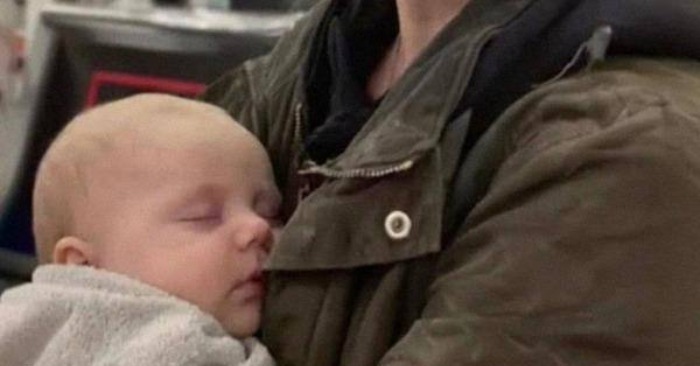
Early thirties, maybe. Hair pulled into a messy bun, a hoodie that had clearly seen better days, cheap leggings, worn-out sneakers. A baby was strapped to her chest in a carrier, his cheek pressed against her collarbone.
She offered a weary smile, the kind people give when they’re holding themselves together by habit.
“Hey,” I said. “You made it just in time — we’re about to close.”
She let out a breath that sounded more like surrender than relief. “I wouldn’t call it lucky, but at least I got here.”
She unloaded her groceries. Simple things. A loaf of bread. A carton of eggs. Milk. One oversized container of infant formula. Nothing indulgent. Nothing unnecessary.
I rang everything up and read the number on the screen.
“Your total comes to thirty-two forty-seven.”
She opened her wallet. Inside was a small, uneven pile of cash. She counted once. Then again. Her lips moved as she whispered the numbers to herself. A crease formed between her eyebrows. She dug through another pocket, then a tiny coin pouch. Finally, she checked the back sleeve of her wallet, as if hoping something had been hiding there all along.
Her posture collapsed.
“Oh… no.”
“How much are you missing?” I asked gently.
“Six dollars,” she said. “I’m sorry. Could you remove the formula? I’ll take the rest.”
She couldn’t bring herself to look up. Her gaze stayed fixed on the can. The baby shifted, let out a faint noise, then went still again.
I’d watched people abandon items before — expensive cuts of meat, snacks, prescriptions. But this wasn’t optional. This wasn’t a luxury.
I reached into my apron pocket and pulled out my tips from the shift — wrinkled singles, warm from being carried all day. I counted out six dollars and placed them beside the register.
“I’ll cover it.”
She looked up sharply. “No— you don’t need to—”
“I know I don’t. I want to. Please take the formula.”
“I’ll pay you back,” she said quickly. “Next time—”
“You don’t need to. Really. Just take your things. Go home. Try to get some rest.”
Her eyes filled with tears so fast it startled me.
“Thank you,” she said. “You have no idea what this means to me.”
She hugged the baby closer, wiped her face, took the bag, and walked toward the exit. The automatic doors opened, cold air rushed in — and then she was gone.
I put the six dollars into the till, shut down my register, clocked out, and drove home. By the time I reheated leftovers and crawled into bed, it already felt like a tiny, forgettable moment in a long shift.
Six dollars. No big deal.
The next morning, the store was packed.
People grabbing coffee, cereal, and far too many energy drinks.
I clocked in, tied my apron, and took my place at register three.
Scan. Beep. Bag. Smile.
“Good morning.”
“Do you have a rewards card?”
“Paper or plastic?”
I was finishing up with a guy whose cart was overflowing with junk food when the intercom crackled.
“Laura to the manager’s office. Laura, please come to the manager’s office immediately.”
The customer smirked. “Uh-oh. Trouble?”
“Story of my life,” I said with a weak smile.
I completed the transaction, asked a coworker to cover my lane, and headed to the back.
With every step toward the office, my mind replayed the night before.
Her face.
The money on the counter.
The camera above us.
I knocked.
“Come in,” my manager said.
He sat at his desk, glasses on, eyes on his computer. He looked up as I entered.
“You wanted to see me?”
“Yes. Close the door and have a seat.”
Never a comforting sentence at work.
I sat. He clicked something and turned the monitor toward me.
Grainy security footage filled the screen.
My register.
The woman.
The baby.
Me pulling money from my pocket.
We watched silently as I slid the bills across the counter.
He paused the video.
“Did you pay for part of a customer’s purchase last night?”
My face burned. “Yes. She didn’t have enough, and it was formula. It was my own money, not the store’s. I know that’s probably against policy, and I’m sorry, I just—”
He raised a hand. “I’m not upset. Technically, we’re not supposed to do that. But that’s not why I called you in.”
“Oh.”
He opened a drawer and pulled out a plain white envelope, placing it between us.
“This was dropped off for you this morning. The woman came back and asked me to give it to you.”
My name was written on the front in neat handwriting. Laura.
“You didn’t open it?”
“Not my place. You can read it now or later. I just wanted to make sure it reached you.”
“Am I in trouble?”
“Just don’t make a habit of it. But… it was a kind thing.”
I nodded, slipped the envelope into my apron, and returned to my register.
The rest of the shift, I felt it with every movement at my hip.
When I clocked out, my hands were shaking. I went straight to my car, shut the door, and pulled out the envelope.
Inside were several folded pages.
The letter began:
“Dear Laura. I’m the woman you helped with baby formula last night. I wanted to thank you — not just for the six dollars, but for the way you treated me. You didn’t embarrass me. You just helped.”
She wrote about skipping dinner. About calculating numbers in her head. About realizing she didn’t have enough money and wanting to disappear. Then the tone shifted.
“There’s something else I need to tell you. I was adopted as a baby. I always knew there was a woman somewhere who gave birth to me and let me go. My adoptive parents are good people, but they had very few answers. I’ve spent my whole life wondering who she was.”
I thought of my mother.
Of a night when she’d had too much wine and cried at the kitchen table.
She told me she’d had a baby before me.
Too young. Too scared. Too alone.
She gave the baby up for adoption.
She called me her second chance.
We never spoke of it again.
She died five years ago. The truth stayed buried, like a bruise I never touched.
I kept reading.
“After my son was born, I started searching. I needed to know where I came from. I wasn’t trying to disrupt anyone’s life. I just needed answers.”
“Eventually, I found documents. And one name kept appearing.
Yours. Laura. And the name of our biological mother: Mary.”
My hands trembled. Mary. My mother.
“Our biological mother passed away a few years ago. I’m sorry if this is how you’re learning that.”
I already knew — but the words “our biological mother” landed differently.
“I didn’t know how to approach you,” she continued. “I learned where you worked, but I was afraid to walk in and say, ‘Hi, I think we’re related.’ I kept putting it off.”
“Last night, I came into the store to buy baby formula. I was beyond tired — running on instinct more than thought. Then I noticed your name tag. Laura. And it hit me that the woman behind the register was the same person mentioned in the records.”
“My sister.”
I stared at that word until the letters smeared together.
“I really didn’t have enough money,” the letter continued. “That part wasn’t an act. When I asked you to take the formula off, I felt ashamed — like I’d failed before I even started. And then you reached into your pocket and paid the difference yourself.”
“You had no idea who I was. No idea that we might share a mother. And you helped me anyway. In that moment, I learned more about you than any file or document could ever tell me.”
The closing was quiet and honest.
“I’m not asking for anything. You don’t owe me a connection. I just wanted you to know that I’m here — that we’re linked by more than paperwork. My phone number is below. If you ever want to talk, meet, or even just exchange a few messages, I’d truly like that.”
She signed her name.
Hannah.
Then one final line beneath it:
“Thank you, my sister.”
I sat in my car with the letter trembling in my hands, the sounds of the parking lot slowly dissolving into nothing.
All I could see was that word.
Sister.
I’d been an only child my entire life — or so I thought.
Before I could overthink it, I typed in the number.
I called.
Once. Twice. Three times.
“Hello?” a cautious female voice answered.
“Hannah?”
“Yes.”
“It’s Laura. From the store.”
Silence.
“You got my letter.”
“Yes. I’m sitting in the parking lot.”
“I’m sorry if it was too much. I didn’t know if I should leave it or if—”
“I’m glad you did,” I said. “I’m still processing, but… I’m glad.”
“Would you want to meet?” she asked.
“Yes,” I said immediately, surprised by how true it felt. “There’s a café a few blocks away. Tomorrow?”
She confirmed the meeting quickly. I could hear an infant crying nearby before the line went dead.
I showed up the next morning long before the café opened, nerves buzzing, hands wrapped around a cup I let go cold. Every customer who walked in made my pulse jump.
And then she appeared.
Oversized sweatshirt. Exhaustion written all over her face. Hair pulled up without effort.
A baby strapped to her chest, wide-eyed and alert.
We locked eyes.
“Hey,” she said quietly.
“Hey,” I answered.
Neither of us moved at first. Then she shifted the carrier and stepped closer. We hugged — unsure, brief, a little stiff — but it felt oddly natural.
We took a table.
“His name’s Eli,” she said, gently rocking him. “That would make you his aunt… I think.”
I smiled as he wrapped his fingers around mine. “Nice to meet you, Eli. I’m Laura.”
Calling myself his aunt felt unfamiliar.
And somehow comforting.
We talked about Mary.
I told her how our mom always overcooked breakfast, cried at animal movies, and sang terribly but confidently on road trips. How she was imperfect, stubborn, and warm in her own complicated way.
Hannah listened as if every memory mattered.
“I used to wonder if she ever thought about me,” she admitted. “I didn’t want to accept that she’d forgotten.”
“She didn’t forget,” I said. “She just didn’t know how to reach back.”
Nothing was magically fixed that day. The past stayed messy. But we decided not to disappear from each other’s lives again. Messages turned into photos. Photos turned into visits.
Weeks later, we took a DNA test — just to silence the doubt neither of us wanted to admit was there.
The results were clear: sisters.
Not just a stranger with a baby.
Not just a name on paper.
Family.
Now Hannah comes by the store sometimes. Eli recognizes me — reaches out when he sees my uniform. I keep his picture taped inside my locker, tucked above my work schedule and an expired coupon.
We’re still learning how to be sisters. It’s clumsy, emotional, and far from perfect — but it’s real.
All of it started with six dollars.
I clocked in that day thinking I was just doing my job.
I clocked out with a sister and a nephew I never knew existed.