After losing her husband, Melissa discovers how delicate compassion can be. A single, quiet choice made on the sidewalk below her apartment sets off a chain of events she never anticipated, forcing her to confront grief, motherhood, and the echoes of a love that hasn’t truly left. When the aftermath surfaces in an unexpected way, she must reckon with what kindness sometimes costs.
The message sat unread in my inbox for nearly an hour.
Not because I missed it.
Because I saw it immediately.
“Concerning the matter outside the grocery store.”
It stayed there, unmoving, like it knew I was afraid to touch it.
I scanned the subject line twice, not opening it, letting a familiar tightness settle behind my ribs.
Micah’s worn sneakers were still by the entryway, toes scraped raw, laces undone like he’d kicked them off without thinking. Nova’s backpack rested against the wall, one strap twisted the way it always was when she dropped it in a rush.
A matter?
What kind of matter?
I reread the subject again, still not clicking, letting the unease spread.
I’d lived in that apartment above the grocery store for six years. Long enough to memorize the hum of its refrigerators, the early-morning deliveries, the faint smell of bread that drifted up through the floorboards. Nothing serious ever happened there—just the occasional shoplifting scare or a knocked-over display.
I finally opened the email… then shut it almost immediately.
A week earlier, I’d made a choice that felt insignificant at the time. Now it seemed anything but.
After Nathan passed away, the meaning of “practical” changed entirely.
I lived above that supermarket.
I went through each day with intention—not because I felt brave or resilient, but because two small people watched me constantly, searching my face for reassurance.
Micah was ten, old enough to notice the questions I avoided and the half-second hesitation before certain replies.
Nova was eight, sensitive in a way that didn’t need words. She could read a room like a temperature change.
The apartment above the grocery store wasn’t charming, but it kept the kids close to their school and kept me close to my job. Convenience mattered more than comfort now.
I lived deliberately.
My mother called it a short-term solution. I called it getting by.
“You deserve peace, Melissa,” she told me more than once. “You’re raising kids alone. You’ve lost enough.”
“Peace doesn’t look the way it used to,” I’d answer, even though I wasn’t fully convinced myself.
Nathan’s coat had stayed on the hook since the day he never came home to wear it again. Thick wool. Charcoal gray. Heavy enough that winter couldn’t creep into your bones when it was on.
Sometimes Micah slipped into it when he thought I wasn’t looking.
“Does it still smell like Dad?” he asked one evening, careful, like he was testing fragile glass.
“A little,” I said gently. “Why?”
He shrugged. “Just wanted to know.”
Nova pressed her cheek into the sleeve whenever she could, breathing deeply as if scent alone could rewind time.
I never told them to stop.
The day everything changed began like any ordinary morning.
“Mom, I can’t find my blue folder,” Micah complained, already irritated with life.
“It’s probably under the couch,” I said, rinsing plates at the sink.
Nova lingered near the door, her jacket half zipped, shoes already on.
“Grandma’s picking me up today, right?”
“Yes, sweetheart. She’ll be here in ten minutes. You know how she is—never late.”
And she wasn’t. My mother arrived exactly when she said she would. She kissed my cheek, bent down to hug Nova, and reminded Micah—again—to eat something other than cereal occasionally.
“You’re growing,” she told him. “You need real food too.”
“Yes, Gran,” he said, smiling.
Once they were gone and the apartment fell silent, I grabbed my canvas tote and headed downstairs for groceries.
That’s when I noticed him.
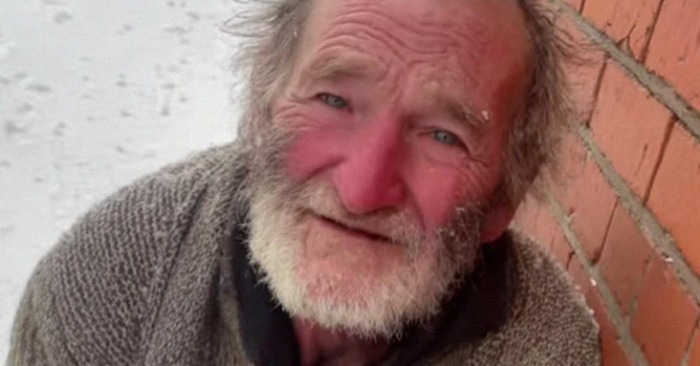
He was seated against the brick wall near the entrance, careful not to block anyone’s way. His shoulders were drawn inward, hands tucked tight against his body. A piece of cardboard rested beside him.
Veteran. Anything helps.
The cold was sharp, but he had no hat, no gloves—no coat at all. Just a thin sweater that offered no defense against the wind that cut straight through him.
That’s when I saw him.
I slowed down without meaning to.
The man looked up—alert but tired, like he’d learned to read faces carefully.
“Ma’am,” he said softly. “Sorry to bother you, but it’s colder than I thought today. Do you have any spare change?”
I nodded, uncertain. I’m not someone who handles moments like that gracefully. I usually overthink them afterward.
“Do you have any spare change?”
“I’m a veteran,” he added, gesturing to the sign. “I’m just trying to make it through the week.”
I told myself to keep walking. Dinner had to happen. Homework would need checking when the kids got home. Life didn’t pause just because someone else was struggling.
Then I saw his hands—red and bare, trembling slightly as he pulled them back under his arms.
Life didn’t pause just because someone else was struggling.
I thought of Nathan and the way he used to say the cold on deployment sometimes bit all the way down to your skin.
“You should have a jacket,” I said before I could stop myself.
“I know,” the man replied, letting out a small, embarrassed laugh.
“Wait here,” I said, already turning around.
“You should have a jacket.”
Upstairs, the silence in the apartment felt unusual—silence that pressed instead of soothed. The supermarket’s hum through the floorboards sounded farther away than usual, like I’d stepped into a different version of the same place.
I paused in the hallway, my eyes fixed on the rack by the door. Nathan’s coat was still there, exactly where it had always been. The sleeves curved inward, almost as if they remembered the shape of his arms. For a brief second, I imagined him standing behind me. I could hear his voice in my head, telling me I was overthinking everything.
That was his favorite line whenever I spiraled.
So I just stood there.
I pictured Micah quietly slipping into the jacket on days he missed his father but didn’t know how to say it out loud, the heavy fabric swallowing his small frame. I thought of Nova on restless nights, pressing her face against the sleeve, breathing it in like it could bring comfort no words could.
“It smells like Dad,” she would whisper, as if nothing more needed to be explained.
I thought about the kind of cold that sinks deep, the kind that lingers in your bones, and how Nathan used to grumble that winter always made his old aches speak up louder than the rest of the year.
I took the jacket off the hook.
“It smells like Dad,” she’d say then.
When I came back downstairs, he looked at me like he couldn’t believe what he was seeing—his gaze flicking from my face to what I carried and back again.
“It’s been washed,” I told him, extending it toward him. “And it’ll keep you warm.”
He shook his head. “I can’t accept that. It looks like it belongs to someone.”
“What’s your name?” I asked gently.
“I’m Paul,” he said.
“It did belong to someone,” I replied. “But it’s doing no good sitting unused in my apartment.”
“I don’t want to get you in trouble,” he said, hesitant.
“You won’t,” I assured him. “I want you to take it.”
After a pause, he slipped it on. It fit him better than I expected—slightly loose, but close enough to matter.
“Thank you,” he said quietly. “I’ll remember this.”
Inside the store, I bought a container of hot soup, a loaf of bread, and a cup of tea. When I handed them to Paul, he simply nodded, clearly overwhelmed.
I went upstairs without turning around.
That evening, Micah noticed the empty hook by the door.
“Where’s Dad’s coat?” he asked.
“I let someone borrow it who really needed it,” I said softly.
He thought for a second, then nodded.
“Dad would’ve done that.”
Nova didn’t comment, but she held on to me longer than usual that night, wrapping her arms around me as if she sensed something she couldn’t yet put into words.
Ignoring the email didn’t make it disappear. It stayed in my inbox—silent, persistent.
When I finally read it all the way through, the tone was stiff and official, the kind that knots your stomach.
Dear Ms. Melissa C.,
This message concerns a reported interaction outside the grocery store located beneath your residence.
Building regulations restrict unauthorized contact that may affect tenant safety or business operations.
During a routine inquiry, an individual stated that a resident provided him with personal property.
Please contact Property Management promptly to address this matter.
I read it several times before closing my laptop. Nathan used to tease me for doing that.
“You always assume bad news first,” he’d say, smiling.
“Address this,” I muttered. “That never sounds reassuring.”
I called my mom.
“Did you break some rule?” she asked after I explained, alert but calm.
“I don’t think so. I just helped someone who was cold.”
“And now you’re worried kindness has consequences.”
“That’s one way to put it.”
When I called the number listed, a woman answered professionally.
“We simply need to log the interaction,” she said. “The man was questioned briefly. No complaints were filed. Everything was fine.”
“Is he alright?” I asked, surprised by how much I needed to know.
“Yes,” she said. “He asked us to thank you.”
“For what?” I asked, though I already knew.
“For the coat.”
She hesitated, then added, “He also mentioned your husband by name.”
“My husband?” I repeated, my grip tightening.
“Yes—Nathan. He was in the service, correct?”
I closed my eyes. Nathan always left pieces of himself behind quietly, without ever announcing it.
“How would he know that?” I asked.
“He said they served together,” she replied. “He recognized the coat.”
After the call ended, I sat there for a long time, thinking about all the parts of Nathan’s life I’d never fully known—and how one of them had just circled back to me.
Paul showed up the next day.
He stood near the building entrance, the coat folded carefully over his arm.
“I wanted to return this,” he said.
“You didn’t need to,” I replied, surprised by the ache in my chest.
“I know,” he said. “I just wanted to.”
We stood awkwardly, neither of us sure what to say next.
“I’m not sleeping outside anymore,” he added, reading my expression. “The VA shelter took me in. They got me a coat, meals, a place to stay. They’re helping me figure out what comes next.”
And in that moment, I realized the coat had done exactly what it was meant to do—carry warmth forward.
“That’s good, Paul. I’m glad you’re safe and taken care of.”
We stood there for a moment, both of us unsure what to do with our hands or where to put our eyes.
“Your husband once showed up for me,” he said quietly. “Did you know his name is sewn inside the sleeve? On the right side. That’s how I recognized the jacket. That’s how I knew it was Nathan. When I came home… I was struggling. He didn’t lecture me or draw attention to it. He just checked in. Made sure I ate. Made sure I didn’t disappear.”
That sounded exactly like Nathan. He would’ve waved it off, said it was nothing worth mentioning.
“The shelter staff didn’t really hear me at first,” Paul went on. “But when they saw the coat—when they realized whose it was—everything changed. Suddenly, I wasn’t invisible anymore.”
I swallowed. “I’m glad you told me that.”
“He would’ve been proud of you,” Paul said. “He always believed people are supposed to take care of each other.”
I stood there and watched him leave, his steps steadier, his shoulders no longer weighed down the same way.
Later, upstairs, Micah noticed what I was holding.
“The jacket came back,” he said simply.
“Yes,” I replied.
Nova didn’t ask any questions. She just wrapped her arms around it, holding it close.
That night, when I placed it back on the hook where it had always hung, something finally settled inside me. I no longer questioned whether doing the right thing required permission.
I understood now—kindness isn’t something we own.
It’s something we’re meant to keep moving forward.
If you were in this situation, what would you have done? Share your thoughts with us in the Facebook comments.