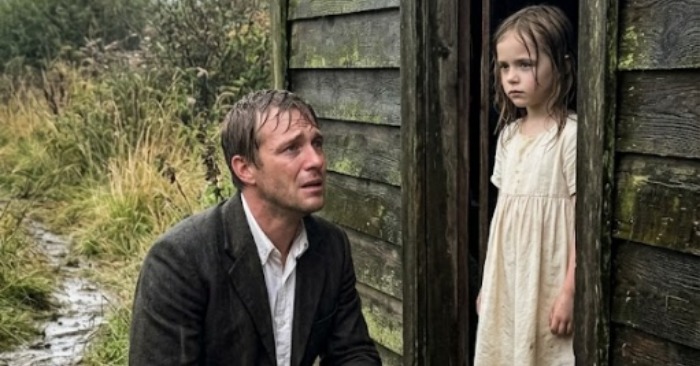
A sudden downpour struck Tiradentes, as if the sky had decided to pour an entire bucket of water onto the cobblestone streets. It was just after three in the afternoon, and the damp air carried the scent of wet earth mixed with the faint aroma of freshly baked bread drifting from a nearby café. Demetrio Valverde, a fifty-two-year-old man in a dark suit and an Italian tie that clashed with the chaos of the storm, quickened his pace in search of shelter.
He wasn’t used to feeling vulnerable. As the owner of a construction company that turned empty lots into towering buildings, Demetrio was accustomed to doors opening before him, chairs being offered, and people looking at him with a mix of respect and quiet fear. But today, the colonial town showed him no mercy: rain soaked his shoulders, and thunder rolled through his chest like a reminder of mortality.
He noticed a two-story house with faded yellow and blue shutters that seemed to have endured centuries. The door was slightly ajar. Without hesitation, he knocked.
“Is anyone there?” he asked, his voice sounding unfamiliar — softer, almost fragile.
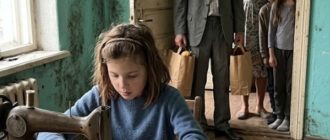
A small face appeared in the doorway. A tiny girl with wide eyes, messy hair, and a T-shirt far too large for her. She looked at him as if measuring the world with invisible tools no one else could see.
“I live here alone,” she said quietly, almost in a whisper, as though she had said it many times before.
A chill ran down Demetrio’s spine. He wanted to smile, to joke, to say that couldn’t be true — but the seriousness in her eyes stopped him.
“Alone?” he repeated, but at that very moment, a scream cut through the house. It wasn’t just noise — it was pain, sharp enough to slice through the air.
The girl flinched, and Demetrio understood: this doorway was not shelter — it was a boundary.
He didn’t knock again. He didn’t step inside. Instead, he backed away, feeling rain trickle down his neck while his throat tightened with a strange sensation, as if he had swallowed ash. He crossed the street back to his modern apartment — the one he had built himself — and from behind heavy curtains, he watched the colonial house like an open wound.
The next day, the sun returned with harsh clarity. The town woke as if nothing had happened: tourists snapped photos, spoons clinked in cafés, conversations filled the square. But Demetrio couldn’t erase what he had seen and heard: the words “I live here alone,” the scream, the fear in the eyes of a girl too young to carry such weight. And then he noticed something even more disturbing: the screams repeated every day at exactly three o’clock — a relentless, ominous rhythm, always the same.
He tried to convince himself it wasn’t his concern. He paid his taxes, the authorities were nearby, and in this town everyone knew each other. He told himself that other people’s suffering was not his burden, that he had already lost enough to interfere in something he didn’t understand.
Five years earlier, on a rainy night, he had lost Mariana — his wife and the only place he had ever truly felt at home. Since then, Demetrio had lived as if his heart were locked in a dark room: work, contracts, meetings. Nothing hurt him. Nothing asked for love.
But the colonial house refused to let him rest.
After the screams, there would sometimes be a suffocating silence, as if the street itself was holding its breath. At other times, when the mountain wind carried a cool whisper through the air, he heard a melody — soft and trembling, like a small voice clinging to a tune just to stay whole. Demetrio recognized the song instantly, with a pain that could not be ignored.
Mariana used to hum it on weekends in the kitchen, when the smell of coffee filled their apartment. It was a song from Minas about free birds flying over mountains. Hearing it in the voice of a stranger felt like finding an old photograph and realizing someone from the past was still looking at you.
Across the street lived Maristela Santos, a sixty-year-old retired teacher with steady hands and eyes that had seen too much truth behind school desks. She heard the song too. She heard the screams as well. And unlike Demetrio, who hid behind his curtains, Maristela didn’t know how to pretend.
“For forty years I taught children,” she thought. “I learned to read silence, to recognize sadness behind laughter, to understand when a small body is quietly asking for help. And that house… even from the outside it smells of neglect.”
Maristela put on her floral dress, combed her gray hair with almost ceremonial care, and crossed the street.
Creuza Santos opened the door with a swollen face, irritated eyes, and a sour smell that made the air heavy. Her smile was a weak mask.
“Good morning, Creuza. I came to say hello… it’s been a while,” Maristela said gently, the tone one uses with someone who might be dangerous.
“This isn’t a good time. The house is a mess,” Creuza replied, trying to close the door as if shutting a window against a storm.
“And your niece… how is the girl? I never see her playing, never see her outside,” Maristela continued.
Creuza frowned.
“She’s sick. Fibrosis. Contagious. Better to stay away.”
At that moment, a faint sound came from deeper inside the house — something small being dragged. It wasn’t a cat. It wasn’t an adult. It was a child learning how to be invisible.
Maristela held Creuza’s gaze and said quietly, “If you need help, I’m here. I’m watching.”
That night, Demetrio didn’t sleep. He paced his apartment like a trapped animal, Mariana’s song mixing with a name that suddenly surfaced in his mind: Joaquina.
Joaquina Santos, a former employee of his company — precise, kind, always efficient, always humming that same melody while organizing files. He remembered how quietly proud she was of her daughter. “My Livian,” she had once said, a light shining in her eyes.
Joaquina had left years ago. Demetrio never asked why. He had been too busy, too broken, too blind to the world.
“Livian… Joaquina’s daughter…” he murmured, feeling a sharp ache in his chest.
From that moment on, every scream from the house weighed on him like an unpaid debt. The girl was no longer just “the child across the street.” She was the daughter of someone he had failed to help.
Demetrio began recording the sounds. At first, he felt ashamed, but gradually he realized those recordings might save someone — if he could find the courage to act.
Three days passed, and the courage didn’t come. Fear clung to him. Fear of facing pain again. Fear of opening his heart only to have it torn apart once more.
Until one morning, Maristela saw something that could no longer be ignored.
In the yard of the colonial house stood Livian: alone, fragile, far too still for a child her age. She was drawing birds on the ground with charcoal, as if each stroke gave her wings.
“Hello, my dear,” Maristela said softly.
Livian smiled shyly.
“Hello, grandma,” she replied, using that word for any kind woman.
Maristela wanted to take the girl away with her own hands, but she knew that without support, the consequences could be severe.
At that moment, Creuza’s sharp voice cut through the air from inside the house. Livian froze as if struck by lightning and ran toward the door without looking back — but she glanced once at Maristela, a silent cry for help.
That same day, Maristela went to the police. She had known Officer Antonio Cardoso for decades.
“There’s a little girl in danger. If we wait, we’ll lose her,” she said calmly but firmly.
At the same time, Demetrio called his lawyer and childhood friend, Roberto Mendes. When Roberto saw the recordings and heard the sounds, he was horrified.
“We act today. Not tomorrow,” Roberto said.
The operation unfolded quickly: social services, a court order, police involvement. On Friday at exactly three o’clock, they knocked on the door of the colonial house. Creuza opened it with a thin, nervous smile. She tried to talk about illness and misunderstandings, but her lies crumbled like rotten glass.
Inside, the house was in ruins — clutter, dirt, the smell of abandonment. On the walls, charcoal drawings of birds stood like silent cries. And in the back room, Livian sat frozen with fear — not simple shyness, but something learned.
The damage caused by neglect.
Ana Paula knelt down to Livian’s level.
“You’re not alone. We’re here to help,” she said, her voice gentle yet entirely new to the child.
Livian didn’t understand every word, but she felt something unfamiliar: a hand reaching toward her without threat.
From his window, Demetrio watched as she was carefully carried out, wrapped in a clean blanket. He cried — the way he hadn’t since losing Mariana. For the first time, life was showing him a way forward — not away from pain, but away from indifference.
Maristela stood at the doorway with her arms open.
“Grandma!” Livian cried from the car, her voice now carrying a fragile thread of hope, even though fear still lingered.
Creuza was arrested. Neighbors gathered to watch. Some murmured, “I suspected something,” as if suspicion alone had ever been enough. A wave of shame washed over Demetrio — for everyone. For how many times he had told himself, “It’s not my problem,” while a small girl learned that the world didn’t see her.
The following weeks passed in a whirlwind of doctors, psychologists, reports, and endless paperwork. Livian recovered slowly — like a wounded heart that had been broken too many times. And she wasn’t just healing physically, but learning to trust the world again.
At the hospital, Nurse Clara became a familiar and kind presence. Maristela visited every day, bringing stories and drawings. And Demetrio… he wandered the corridors like a man learning how to breathe again.
Then Roberto brought news no one wanted to hear: there were no suitable relatives for Livian. The only option was an orphanage in Belo Horizonte.
The thought struck Demetrio like a curse.
“No,” he said before fear could stop him. “She won’t grow up feeling like life has let go of her hand.”
Roberto looked at him in surprise.
“What do you mean?”
Demetrio swallowed hard. The words burned, but they were clear.
“I want to take her in.”
The decision wasn’t simple. Guilt mixed with something far stronger — a sense of certainty, a purpose he had never felt before. Everything he had built out of steel and concrete suddenly felt like a rehearsal for a real home.
Maristela looked at him sternly, like a teacher assessing a student.
“She’s not a project to ease your conscience,” she said in her living room. “That girl will test you. She will make you doubt yourself. You’ll need patience when you’re exhausted. If you walk away, she will break with you forever.”
Demetrio listened, his face wet with emotion.
“I don’t want to save her to feel better,” he said. “I want to stay. I want to learn. And I need your help… because you’ve already become her grandmother.”
The next day, they went to the hospital together. Livian looked at Demetrio like a tiny judge.
“Do you know me?” she asked.
“I knew your mother,” he said. “She loved you very much.”
Livian stayed still, as if listening to a melody no one else could hear.
“Adults promise things and then leave,” she said with a quiet sadness no four-year-old should carry.
Demetrio knelt in front of her.
“I won’t disappear while you’re still deciding,” he said gently. “I won’t pressure you. I just want you to know that there are homes where no one gets hurt. Where singing isn’t scary. Where you can watch birds at the window — and they don’t fly away.”
Livian showed him her notebook: a large bird carrying a small one over mountains.
“Big birds take care,” she explained. “Without hurting.”
Demetrio felt something open inside his chest.
“Then I want to be a big bird for you,” he whispered. “If you let me.”
Livian was silent for a moment, serious like a little queen.
“I’ll think about it,” she finally said. “But… can I still see Grandma Maristela?”
“Every day,” Demetrio replied without hesitation. “And you can draw whatever you want. And sing your mother’s song whenever you feel like it.”
Six months later, Demetrio’s house no longer felt like a museum. The walls were covered in drawings, toys lay scattered in corners, and laughter echoed through open windows. Livian, now five, ran down the hallway calling him “Dad” with such natural ease that his hands still trembled.
One Saturday, Maristela arrived carrying a cardboard box with holes. Inside was an injured bird that needed care. Livian held her breath.
“He’s real,” she whispered, as if the world had finally become kind.
Together, they cared for the bird. They named him Joaquim, honoring the root of her mother’s name, so that memory would bring light instead of pain.
When the bird was ready to fly, Livian stood by the door and said something Demetrio would never forget:
“Stay if you want. Fly if you want.”
As the bird soared into the tree in the yard, Livian clapped with joy, unafraid of letting go. She understood now: real love isn’t about holding someone in a cage — it’s about creating a place so safe that they choose to return.
That night, Demetrio sat on the terrace, looking up at the stars. Maristela sat beside him.
“They’re saving each other,” she said softly, with gratitude.
Demetrio leaned forward, and for the first time in years, rain no longer reminded him of loss. He understood that sometimes rain is the beginning of something new.
In her room, Livian hummed her mother’s song — not to soothe pain anymore, but because she was happy. On the wall hung a new drawing: a man smiling beside a little girl, with birds flying above a house with open windows. Below it, written in a child’s careful handwriting, was a simple sentence worth more than any contract:
“My family will never leave.”