The cold that morning was merciless, but something else made me stop in my tracks: a soft sob coming from the back of the school bus. What I found there changed far more than just that one day.
My name is Gerald, I’m forty-five years old, and I’ve been driving a school bus in a small town you’ve probably never heard of for more than fifteen years. I truly thought I’d seen it all—every type of kid, every type of parent, every kind of weather, every mood, every little disaster between dawn and the first school bell. But what I didn’t expect was that one small gesture from me would set off a chain of events that ended up being much bigger than that single morning.
It was last Tuesday. The day started like any other—except the cold was different. Not the usual “Oh, it’s chilly today” kind of cold, but the kind that creeps up your spine and settles into your bones like it plans to live there. Even when I unlocked the depot gate, my fingers stung just from turning the key.
I blew warm air into my hands, climbed the steps, and stomped the frost off my boots as I slid into my seat. The old yellow beast creaks with every movement like an offended dinosaur, but I know every quirk, every sound it makes. I started the engine so the heater had a fighting chance before the kids got on. Not glamorous, not big, but honest work. And those kids? They’re the reason I show up every morning—even when it’s dark and the world is still asleep.
When the first kids appeared at the stop, I called out as sternly as I could while still letting them know I wasn’t being mean: “Come on, get in! Fast, fast! The air’s got teeth today—this weather is trying to eat me alive!”
A few giggled, others marched up the steps like tiny soldiers, scarves fluttering, jackets pulled up to their chins, and the usual chaos rolled into the bus like a wave of voices, backpacks, and snow crystals.
“You’re so silly, Gerald!” a voice squealed.
I looked down and saw Marcy—five years old, bright pink pigtails, and the kind of confidence only little kids have. She stood at the bottom of the door with her mittened hands planted on her hips like she owned the bus.
“Tell your mom to buy you a new scarf!” she teased, squinting at my frayed blue scarf.
I bent down and whispered conspiratorially, “Oh, sweetheart… if my mom were still alive, she’d buy me a scarf so pretty yours would look like a dish rag next to it. I’m jealous!”
I made an exaggerated pout, and Marcy giggled, proud as a queen, then hopped past me and marched to her seat humming some made-up melody. That tiny moment warmed me more than the heater or my jacket ever could.
I gave a quick wave to the parents, exchanged a nod with the crossing guard, pulled the handle, and the doors folded shut as the bus eased forward. I’ll admit it—I’m more attached to this daily routine than I let on. The noise, the bickering that turns into laughter in seconds, the whispered confidences that feel monumentally important to them. There’s a cadence to it all, and somehow it makes me feel like I still matter.
It’s not a job that fills a savings account. Linda, my wife, makes sure I don’t forget that.
“You earn next to nothing, Gerald. Practically scraps,” she’d snapped just the other night, arms folded tight as she stared down the power bill, as if glaring at it might make the numbers retreat. “How do you expect us to keep up with this?”
“Peanuts have protein,” I’d muttered.
She did not find that funny.
Still—I love this job. There’s a kind of joy in getting kids safely from point A to point B. Even if it doesn’t mean big numbers in the bank.
After I dropped the kids off, I did my usual walk-through. After every run, I go down the aisles once—I’ve found everything: forgotten homework, single gloves, half-eaten granola bars, broken pencils, even a stuffed animal once that looked like it survived a war. It’s part of the job, collecting the small stuff before it disappears under the seats and starts to smell like “wet winter” after a week.
I was about halfway down the aisle when I heard it.
A soft sob. Way in the back corner.
I stopped like someone had hit pause on time.
“Hello?” I called, walking farther back. “Is somebody still here?”
And there he was.
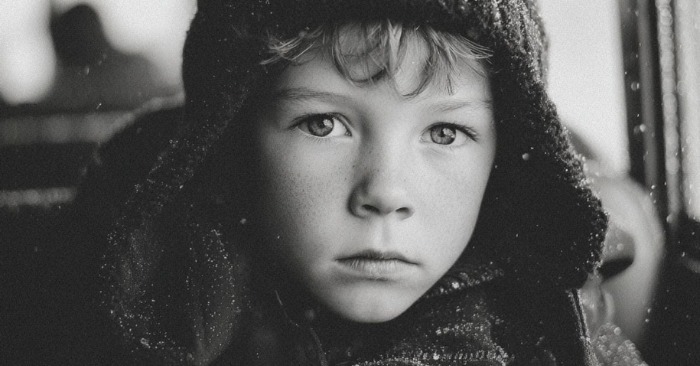
A little boy, maybe seven or eight, crouched by the window with his shoulders hunched like he could make himself invisible. He wore a jacket that was far too thin, pulled tight around his body. His backpack sat on the floor beside his feet, untouched, like he hadn’t fully arrived anywhere.
“Hey, buddy…” I said, squatting down so I wasn’t towering over him. “Everything okay? Why aren’t you going inside the school?”
He didn’t look at me. He hid his hands behind his back and only shook his head.
“I… I’m just cold,” he mumbled.
That “just” snapped me fully awake. Kids don’t talk like that when they’re really just cold. They say that when they’re ashamed to need something at all.
“Can I see your hands, champ?” I asked gently.
He hesitated. Then, very slowly, he brought them forward.
And the ground dropped out from under me.
His fingers were blue. Not “a little chilly” blue—blue like he’d been outside far too long. His knuckles were stiff and slightly swollen, like he’d been clenching his fists to fight the cold.
“Oh no…” I whispered, more to myself than to him.
Without thinking, I pulled off my own gloves and slid them over his hands. They were way too big, hanging past his fingertips like flippers, but too big was better than nothing.
“They’re not perfect,” I said, forcing a smile. “But they’ll keep you warm for now.”
He looked up, eyes red and watery.
“Did you lose yours?” I asked.
He shook his head again, slower this time. “Mom and Dad said they’ll buy new ones next month. The old ones are broken. But it’s okay… Dad is trying.”
That sentence lodged in my throat like a stone. I didn’t really know his family, but I knew that tone. That quiet, brave “It’s okay” that really means, It’s not okay, but I don’t want to be a burden.
I blinked hard, cleared my throat, and then said as casually as I could, “You know what? I know a place. They sell the warmest gloves and scarves you’ve ever seen. After school, I’ll get you something. But for now, you take these, alright? Deal?”
His face brightened just a little, like someone flipped on a tiny light inside him. “Really?”
“Really,” I said, giving his shoulder a quick squeeze and ruffling his hair.
He stood up, the oversized gloves dangling off him, and then—without warning—he threw his arms around me. One of those kid hugs that doesn’t just say thank you, it says please don’t forget me. Then he grabbed his backpack and ran toward the school entrance.
I stayed there for a moment, breathing out like I’d been holding my breath the entire time.
That day, I didn’t stop for coffee. I didn’t go to the diner. I didn’t go home to warm up by the heater. Instead, on my break, I walked down the street to a small shop. Nothing fancy, but reliable—things that last.
I explained the situation to the owner, a kind older woman named Janice. No big details, just: a kid, too cold, no gloves. She looked at me like she already understood everything I didn’t say.
I picked out a thick pair of children’s gloves and a dark blue scarf with yellow stripes—something about it made it look like it belonged to a superhero. I paid without hesitating with the last bit of money I had to spare.
Back on the bus, I found a small shoebox, put the gloves and scarf inside, and placed it right behind my driver’s seat. Then I wrote on the front with a marker:
“If you’re cold, take something. — Gerald, your bus driver.”
I didn’t tell anyone. I didn’t want it to become a big thing. For me, it was a quiet way of saying: You are not alone.
That afternoon, nobody said anything—but in my rearview mirror, I saw a few kids pause, read the words, giggle, whisper. I pretended I didn’t notice.
Then I saw a small hand reach for the scarf.
It was the boy.
He didn’t look up, didn’t say a word. He just took it and slid it under his jacket like it was something you had to carry in secret. I didn’t say anything either. But when he got off the bus, he wasn’t shaking. And he smiled—so small you could almost miss it.
That would have been enough for me.
But it wasn’t the end.
Later that week, I was dropping off the last group of kids in the afternoon when my radio crackled.
“Gerald, the principal wants to see you,” the dispatcher’s voice said.
My stomach jumped. My mind immediately raced through the usual worries: Did a parent complain? Did someone see me give the boy gloves and now they’re twisting it into something? In this world, it doesn’t take much—a wrong impression, and suddenly you’re the villain.
“Copy,” I said, trying to sound steady.
When I walked into Mr. Thompson’s office, he was waiting—but not with the face I feared. He was smiling. And he had a folder in his hand.
“You wanted to see me, Mr. Thompson?” I asked, lingering near the door.
“Come in, Gerald. Sit down,” he said warmly.
I sat, my fingers tapping unconsciously on my thigh. “Did something happen?”
“Oh yes,” he said. “But nothing bad. Quite the opposite.”
He opened the folder, glanced down, then looked back up at me.
“You didn’t do anything wrong,” he said, his eyes bright. “You did something wonderful. The boy you helped—Aiden. His family is going through a hard time right now. His father, Evan, is a firefighter. He got injured on a call a few months ago. He hasn’t been able to work and he’s in physical therapy. What you did for Aiden… it meant more to that family than you can imagine.”
I blinked, almost overwhelmed. “I just didn’t want him to freeze.”
“You didn’t just help Aiden,” Mr. Thompson said. “You reminded all of us what community looks like. That box on your bus started something. Teachers and parents heard about it. And now we’re turning it into something bigger.”
He slid a sheet of paper across the desk.
“We’re launching a school-wide initiative,” he explained. “A fund for families who are struggling—for winter clothing. Coats, boots, gloves, scarves. No questions. If you need it, you take it. And all of it is happening because you paid attention.”
My face went hot. I didn’t know what to say. I hadn’t done it to start anything.
“That’s exactly why it matters,” he said, like he could read my thoughts. “Because you didn’t do it for applause.”
And then everything moved fast.
A local baker dropped off boxes of hats and mittens the next day. Parents donated gently used winter coats. A retired teacher offered to knit wool hats. Janice from the shop called and said she wanted to donate ten pairs of gloves every week.
And the wild part was: nobody made a show of me. They just joined in. Like that quiet kindness had finally given everyone permission to admit they had it in them too.
By mid-December, my little shoebox had turned into a real box. Then into an entire bin.
Some kids left little notes whenever they took something. One wrote, “Thank you, Mr. Gerald. Now I won’t get laughed at for not having gloves.” Another: “I took the red scarf. I hope that’s okay. It’s so warm.”
Every time I read one, it felt like my heart grew too big for my chest.
And then came the day I will never forget.
The afternoon bell had just rung, and the kids poured out like a swarm of sparrows when I saw Aiden sprinting across the sidewalk, waving something in his hand like a flag.
“Mr. Gerald!” he shouted, charging up the bus steps two at a time.
“Hey, buddy! What’ve you got there?” I asked.
He pressed a folded piece of construction paper into my hand. Inside was a crayon drawing: me in front of the school bus, surrounded by lots of children. Some held up gloves, some held scarves, and all of them were grinning wide.
At the bottom, in big uneven letters, it said: “Thank you for keeping us warm. You are my hero.”
I had to swallow hard. Tears burned in my eyes, and I didn’t want anyone to see how much it hit me.
“Thank you, Aiden,” I said hoarsely. “That is… that is beautiful. That’s the best thing I’ve gotten all year.”
He grinned even wider. “I want to be like you when I grow up!”
Later, I taped the drawing next to my steering wheel, right where I can see it every day.
That night I couldn’t sleep. I kept thinking about all the kids who might be cold, who might be hungry, who might be quietly hurting because they’ve learned you don’t say those things out loud. And I understood something I’d heard as a cliché before: small actions can make huge waves.
And then there was one more twist.
Two weeks later, just before winter break, a woman approached me while I was checking tire pressure after my morning route. Mid-thirties, neat and professional, gray coat, shoulder bag.
“Excuse me,” she said. “Are you Gerald?”
“Yes, ma’am. Can I help you?”
She smiled and held out her hand. “Claire Sutton. I’m Aiden’s aunt. I’m his emergency contact because his parents have been running back and forth between the hospital and appointments. I’ve heard a lot about you. Aiden talks about nothing else.”
I stammered, “I… I didn’t do much.”
“Yes, you did,” she said firmly. “You did something that matters. You saw him. Not many people do.”
She pulled an envelope from her bag. Inside was a thank-you card and a generous department store gift card.
“This is from the whole family,” Claire said. “You can use it for yourself or keep doing what you’re doing. We trust you.”
I thanked her, still completely stunned.
And even that wasn’t the end.
In the spring, there was a school assembly. They asked me to come—unusual, since I’m not officially faculty. But I put on my cleanest coat and sat in the back of the gym while the kids sang “You’ve Got a Friend in Me.” I sat there feeling like a stranger and, at the same time, suddenly… like I belonged.
Mr. Thompson walked up to the podium next.
“Today,” he began, “we’re here to recognize someone extraordinary.”
My pulse slammed in my ears.
“Someone whose simple kindness made a real difference for countless kids. Someone whose small gesture sparked something much bigger.”
It took a second for the realization to land.
“Please give a warm welcome to Gerald—our school bus driver and a true hero in this community!”
I rose to my feet, awkward and stunned, unsure where to put my hands as I made my way forward. The gym erupted. Children jumped up on the bleachers, waving and cheering. Teachers applauded. A few parents wiped at their eyes.
I couldn’t remember the last time I’d felt so visible.
Mr. Thompson placed a certificate in my hands, then raised his palm again for silence.
“But that’s not all,” he said with a smile. “What started on one bus didn’t stay there. The idea has spread—to other routes, other schools. We’re calling it the Warm Ride Initiative.”
He described how families now volunteered to gather winter clothing, organize it, and discreetly pass it along. Collection bins had popped up throughout the buildings—by the entrance, near the lunchroom. No student, he promised, would have to sit through class with frozen fingers again.
“And there’s one last thing,” he added. “The person most affected by this kindness wanted to meet you.”
I turned just as a small boy stepped onto the stage, gripping an adult’s hand tightly.
Behind him stood a tall man in a firefighter’s uniform. He moved carefully, each step measured, like his body still remembered pain. His eyes reflected pride—and something deeper.
“Mr. Gerald,” the boy said softly, “this is my dad.”
The man approached and extended his hand.
“My name’s Evan,” he said. “I needed to thank you. What you did didn’t just help my son—it carried our entire family through the hardest winter we’ve ever known. We wouldn’t have gotten through it without people like you.”
I shook his hand and didn’t know whether to smile or cry.
Then he leaned in just slightly and whispered so only I could hear:
“Your kindness… it saved me too.”
I stood there rooted to the floor as the gym erupted in applause again. I didn’t have any clever words—only gratitude spreading through me like warmth.
Since that day, I see my job differently. I used to think it was just about being on time, driving carefully, and getting kids safely where they needed to go.
Now I know: it’s about noticing.
It’s about being there in the small moments that add up to something big later. It’s about a pair of gloves, a scarf, a shoebox—and a kid who doesn’t have to hide his hands anymore.
And for the first time in a long time, I felt proud. Not just of what I do—but of the person it’s made me become.