I make my son’s lunch every morning.
Even on the mornings when the fridge looks like it’s holding its breath and the pantry sounds hollow when I open it.
Sometimes it’s nothing more than a peanut butter sandwich, a bruised apple, and a granola bar I found in the clearance bin because “reduced” is what our life has felt like lately.
But it’s something. It fills a ten-year-old stomach. And in our house, something is sacred.
Andrew doesn’t talk about bills. Kids his age aren’t supposed to notice when adults skip meals or count coins at the register.
But my son notices.
He never asks for seconds. He never complains when dinner is the same thing three nights in a row. And not once—not one single time—has he brought leftovers home in his lunchbox.
“Empty again?” I’d joke most afternoons, shaking the container like it was a funny magic trick.
“Yep, Mom,” he’d say, setting it neatly by the door, like being careful with objects could somehow keep life from falling apart. Then he’d feed the cat or sit down with his math homework like the world wasn’t sitting on our shoulders.
But lately, he started asking for more.
“Can I have two granola bars today?”
“Do we have any crackers left? The black pepper ones?”
“Could you… maybe make two sandwiches? Just in case.”
At first I told myself it was normal. He’s growing. Growth spurts happen. Boys suddenly turn into bottomless pits overnight.
Except it wasn’t just hunger in his eyes.
It was hesitation—like he was asking for something he didn’t feel entitled to.
That night, while I rinsed out his lunchbox and set it on the counter to dry, I asked as casually as I could:
“Sweetheart… is someone taking your food at school?”
He shook his head without looking up. “No, Mom.”
“Then why do you need extra?” I kept my voice gentle. “Just tell me what’s going on.”
He chewed the inside of his cheek—the way he does when he’s thinking too hard.
“I’m just hungry sometimes,” he said. “That’s all.”
It was an answer. But it wasn’t the whole truth. It was the kind of answer kids give when they’re protecting someone. Or when they’re trying not to add weight to a person who’s already carrying too much.
So I let it go.
I told myself the truth would show up eventually, the way it always does.
“Okay,” I said, brushing his hair back. “We’ll figure it out.”
After he went to bed, I sat on the edge of my mattress with a grocery list scribbled on the back of an envelope:
Bread. Apples. Granola bars. Peanut butter. Lunch meat—if it’s on sale.
The cupboard held two cans of soup, half a loaf of bread that was already going stiff, and not a single piece of fruit.
My bank account had $23.
Payday was still three shifts away.
I opened the top drawer of my dresser and stared at a gold locket I hadn’t worn since my mother died. I held it in my palm and wondered if the pawn shop would take jewelry without a box.
It would probably get us through the week.
The next morning, I didn’t eat breakfast.
I poured the last of the chicken soup into Andrew’s thermos and slid a chocolate bar into his jacket pocket—an old Halloween candy I’d hidden away like it was a tiny emergency fund.
He grinned, hugged me tight, and ran down the steps.
He didn’t know I hadn’t eaten.
He didn’t know I was already panicking about tomorrow.
And he didn’t need to know.
I had barely turned back toward the kitchen when there was a knock at the door.
Not loud.
Not angry.
Just… firm. Too early. Too official.
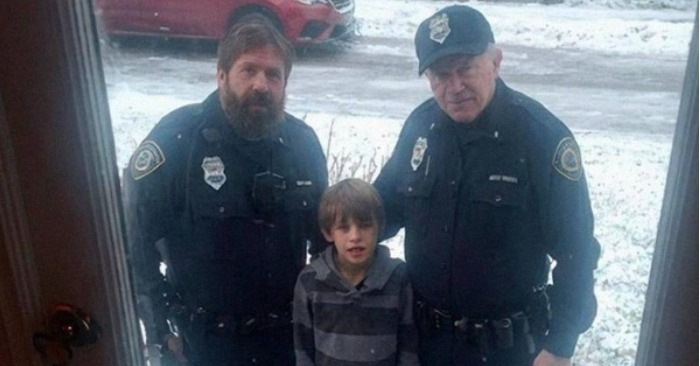
When I opened it, two police officers stood on my porch.
My blood turned to ice so fast it felt like my bones cracked.
“Are you Andrew’s mother?” one of them asked calmly.
“Yes,” I said, and the word came out strangled. “Why? What happened? He left ten minutes ago.”
The other officer glanced down at something in his hand, then back up at me.
“Ma’am, we need you to come with us.”
They didn’t handcuff me. They didn’t treat me like a criminal. But they also didn’t explain much.
Only one sentence repeated like a loop in my head:
It’s about Andrew. He’s safe.
That word—safe—should’ve soothed me.
Instead, it made my imagination sprint in all directions at once.
Was he hurt? Was there an accident? Did someone take him? Was he in trouble? Did I miss a sign?
The drive felt like it lasted an hour, even though we were at the school in minutes.
“This makes no sense,” I whispered as we pulled into the parking lot. “Why didn’t the school call me?”
“You’re not in trouble,” one officer said, softer than I expected. “Someone inside asked to speak with you.”
Inside the building, I saw Andrew’s teacher, Mr. Gellar, and a woman I recognized from parent night—Ms. Whitman, the school counselor. Her smile was meant to be reassuring, but it didn’t quite reach her eyes.
“Meredith,” she said, “thank you for coming. Andrew is fine. He’s in class right now.”
My legs nearly gave out. I gripped the back of a chair to steady myself.
“Then why are the police here?” I managed. “You terrified me.”
“I’m so sorry,” she said quickly. “That wasn’t our intention. We truly didn’t mean to frighten you.”
“It’s actually… it’s about something kind your son has been doing,” Mr. Gellar added gently, gesturing toward an empty classroom. “Can we sit?”
The door shut behind us. The room felt suddenly too small.
Ms. Whitman folded her hands. “Do you know a girl named Haley?”
I blinked. “No. Should I?”
“She’s in Andrew’s class,” Mr. Gellar said. “Quiet. Smart. Her dad is raising her alone. Things have been… hard lately.”
A heaviness settled in my chest.
“She hasn’t always had lunch,” Ms. Whitman said carefully. “Not consistently.”
I swallowed. “Okay…”
“But for the last few weeks,” Mr. Gellar continued, “that changed. Haley has been eating every day. She’s smiling again. She’s participating.”
My mouth went dry. “And… what does that have to do with Andrew?”
Mr. Gellar’s expression softened.
“Haley told us Andrew has been giving her his food.”
The room tilted.
“All of it?” I whispered.
Ms. Whitman nodded. “He started bringing extra. He’s been giving her the snacks he thought she’d like. And sometimes… he skipped his own lunch so she wouldn’t be hungry.”
My hands went numb in my lap.
“I thought he was just… growing,” I said, voice breaking. “I thought he was asking for more because he needed more.”
“He didn’t want you to worry,” Ms. Whitman said. “Yesterday he told us something that… stayed with me.” She paused, eyes shining. “He said you taught him you don’t need a lot to be kind—you just need enough to share.”
I pressed my fingertips to my mouth to keep myself from making a sound.
That’s when a man stepped into the room.
He wasn’t in uniform, but something about him—his posture, the tired steadiness in his face—made it clear he was law enforcement.
“I’m Ben,” he said quietly. “Haley’s dad.”
My heart jumped. “Is she okay?”
He nodded, swallowing hard. “Because of your son—yes. I didn’t even realize how bad it had gotten.” His voice cracked. “Haley thought if she ate less at home, there would be more for me.”
That sentence split something open inside me.
“She told me about Andrew,” Ben continued. “How he made sure she had something. How he always gave her the granola bar with the ‘happier wrapper.’”
The word happier nearly destroyed me.
“He learned that at home,” I whispered.
Ben nodded once. “That’s why I wanted to meet you. And I owe you an apology. I didn’t have a car today—I work nights. I asked two buddies to bring you in because I didn’t want to show up alone and make it awkward.” He exhaled. “I didn’t realize how it would feel from your side.”
“It felt like my world ended,” I admitted, and my laugh came out shaking. “I thought… I thought something happened to him.”
“I’m sorry,” he said again, sincere. “Truly.”
For a moment, we just stood there—two adults who didn’t know each other, tied together by children who had done what so many grown-ups forget how to do: share without keeping score.
“I used to think people in uniforms had it all figured out,” I said quietly. “That you didn’t know what it felt like to be… one bad week away from falling apart.”
Ben’s smile was tired but real. “I used to think that about moms like you.”
That evening, I waited until Andrew was home and settled with his science project before I sat across from him at the table.
“You could’ve told me,” I said softly.
He glanced up. “About Haley?”
I nodded.
He fiddled with the edge of his notebook. “I didn’t want you to feel bad, Mom. You already do a lot.”
My chest ached so sharply I had to blink hard.
“What you did was brave,” I told him. “And quiet. And good.”
He shrugged like it wasn’t a big deal. “She was just… really hungry. And it didn’t feel fair that I had food and she didn’t.”
I reached across the table and touched his cheek.
“You are everything I ever hoped you’d be,” I whispered.
He squinted at me. “That’s what you say right before you cry.”
“I’m not crying.”
He smiled. “Sure, Mom.”
Two days later, a box appeared on our doorstep.
No return address. Just careful tape and a card tucked under it.
For the mother who packs two lunches and still finds a way to smile.
Help belongs to people who give it, too.
Inside were grocery gift cards, snacks, coffee, and a note from Ms. Whitman saying we’d been added to a school support program.
No paperwork. No waiting list. No humiliation.
Just help.
Andrew stood over the box after school, eyebrows raised.
“Is that… for us?”
I nodded.
He looked up at me, understanding flickering in his eyes.
“Because of Haley?”
“No,” I said gently. “Because of you. Because of who you are.”
He picked up a granola bar—the same brand we always bought.
“I’ll bring her one tomorrow,” he said simply.
And the next morning, when I packed his lunch, I added one more sandwich.
Not because I had to.
Because now I knew kindness doesn’t disappear into the air.
Sometimes it circles back.
What do you think happens next for Andrew, Haley, and their families? Share your thoughts in the Facebook comments.