That Tuesday, Guadalajara was suffocating under a wave of relentless heat. At the auto factory where Mateo served as a floor supervisor, an electrical transformer suddenly exploded and shut down power across the entire plant. By around eleven in the morning, the managers dismissed the workers and canceled the rest of the shift. For Mateo, thirty-two and already drained by nonstop labor, it felt like rare good fortune. He could go home early and surprise Sofía, his wife, who had delivered their first child, baby Leo, just four weeks before.
In a cheerful mood, Mateo decided to make a quick stop before heading back. He parked a few blocks away from the house and went into a supermarket near the crowded San Juan de Dios area. First, he headed to the infant aisle and bought a box of high-end imported formula. Then he filled his basket with fresh vegetables and several kilos of good meat. The doctor had been firm: Sofía’s delivery had been difficult, and her body needed strong, nourishing food so she could regain her health and continue breastfeeding properly. As he paid at the register, Mateo felt satisfied. Every month he deposited fifteen thousand pesos into his mother Doña Carmen’s account so she could handle food, household needs, and the care Sofía required during recovery. In his mind, everything at home was under control.
Carrying several shopping bags, Mateo arrived at the house and immediately sensed something was wrong. The gate was open, and the front door had been left partly ajar. The moment he stepped inside, the silence unsettled him. There was no television, no sound from the kitchen, no crying from Leo. He assumed the baby must be asleep and figured his mother had gone out to chat with the neighbors, something she often did. He left the groceries on the small table in the sitting room and walked quietly down the hallway, thinking he might prepare some tea for Sofía.
But the instant he reached the kitchen entrance, he froze.
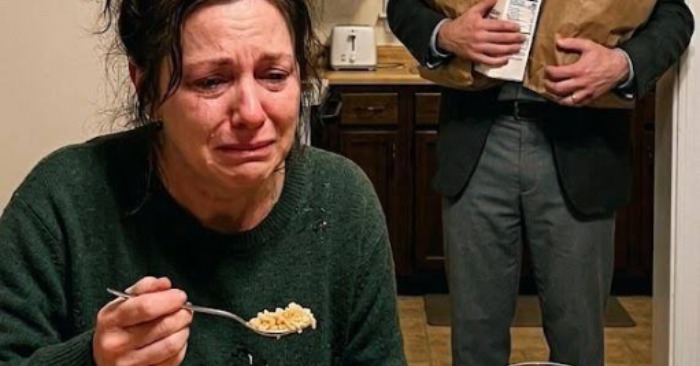
Sofía was crouched in the corner beside the counter. The way she sat looked painfully wrong, her body folded in on itself like someone trying not to be seen. In her hands she held a cheap plastic bowl and was eating in frantic mouthfuls, barely swallowing before scooping more in. Her shoulders shook. She was crying. Tears slid down her face and fell into the bowl while her terrified eyes kept flicking toward the front entrance.
Mateo stared, confused and disturbed. For a split second, he wondered whether she was sneaking some forbidden greasy food behind his mother’s back, breaking the diet everyone had agreed she should follow. He stepped into the room.
“What are you doing hiding in here?” he asked sharply, not yet shouting but already alarmed. “Are you eating something you know you shouldn’t?”
Sofía flinched so violently that the spoon slipped from her hand and clattered onto the floor. As soon as she recognized him, the color drained from her face. She tried to shield the bowl with trembling hands.
“Mateo… why are you home so early?” she stammered. “I was just eating a little lunch…”
A terrible instinct rose in him at once. Without answering, he moved closer, pulled the bowl from her hands, and looked down inside.
His blood ran cold.
What he saw was not a proper meal. It was a disgusting pile of old yellow rice, rotten fish heads, and sharp bones sticking out at odd angles. It looked like refuse—something scavenged, not served.
A hot wave of rage slammed into him. The idea forming in his mind was so awful that he almost rejected it on sight.
The stillness in the kitchen turned unbearable. Mateo’s breathing grew rough as he stared at the bowl. The sour stench of spoiled fish hit him fully now, making his stomach twist. The empty sockets of the fish heads seemed grotesque, almost mocking.
Slowly, he looked up at Sofía. She stood there weak and drained, the woman who had endured hours of labor to bring their son into the world. Her face was pale, her hair lifeless, and her eyes stayed lowered as though she expected to be scolded.
“What is this, Sofía?” Mateo asked, his voice so low and harsh it barely sounded like his own.
She said nothing. Her hands trembled against the edge of the counter.
“I asked you a question!” he exploded. “I send my mother fifteen thousand pesos every month for this house. I buy groceries. I keep food here. There should be meat, vegetables, everything! I just brought expensive milk home! So why are you eating this filth?”
His voice shook the house. From the back room, baby Leo stirred and began to cry faintly. Sofía squeezed her eyes shut, and whatever strength she had been clinging to finally broke. She covered her face and began sobbing.
“Because… because that’s all she lets me have,” she whispered.
Mateo went still.
“What did you say?”
Sofía lifted her tear-streaked face.
“Your mother hides my food,” she said. “She says the old ways are best. She tells me that if a woman who just gave birth eats meat, milk, or anything rich, her breast milk becomes too heavy and the baby will suffer. She says I have to purify my body by going hungry.”
A violent heat rushed through Mateo.
“And the groceries? The money I give her?”
“She takes all the good food,” Sofía said, swallowing hard between words. “The meat, the chicken, everything fresh. She says that belongs to you because you’re the one who works, and the rest belongs to her because she’s older and needs strength. She leaves me scraps. Sometimes stale tortillas. Sometimes the bones from meals already eaten. She told me if I ever said anything, you would think I was ungrateful… or losing my mind.”
A chill ran along Mateo’s spine.
“How long?” he asked, his throat tightening. “How long has this been happening?”
Sofía looked away.
“Since the day we came home from the clinic. A whole month. I was so hungry today… I barely have any milk left, so I searched through the trash and found those fish remains from yesterday.”
The pain that hit Mateo was almost worse than the anger. All this time he had believed he was doing the right thing. He thought he was providing, protecting, being a good husband. Meanwhile the woman he loved had been starving in his own home—because of his own mother.
“Why didn’t you tell me?” he asked, his voice breaking. “I’m your husband.”
Sofía looked at him with fear still written across her face.
“Because she’s your mother. In our world, a mother-in-law is almost untouchable. She threatened me. She said a son will always choose the woman who gave him life over the wife he married.”
Those words struck him like a punch. Sofía had chosen hunger rather than risk coming between him and his mother.
Mateo set the bowl down on the counter. Something shifted in his expression. The raw shock hardened into something colder, steadier. He crossed to the main cupboard and yanked it open.
It was empty.
“Where is everything?” he asked, almost whispering.
“I don’t know,” Sofía said, hugging herself tightly. “Every morning she leaves with two big cloth bags. She says she’s going to the market, but she never comes back with them.”
Mateo slammed the refrigerator door so hard a few magnets fell to the floor. Then he turned back to her.
“Go to the bedroom. Lock the door. Stay there with Leo until I come for you.”
“What are you going to do?” Sofía pleaded, panic rising. “Please, don’t make this worse!”
“It ends today,” Mateo said. “Right now.”
He marched across the burning patio. He already knew where to look. Three houses away lived Doña Leticia, the biggest gossip on the street. Before he even reached the gate, he could hear laughter and ranchera music drifting through the air.
And there was Doña Carmen.
She sat beneath a tarp at a plastic table with three other older women, drinking coffee, eating sweet bread, and playing lotería. She looked perfectly comfortable—new blouse, freshly colored hair, and on her wrist, to Mateo’s astonishment, a gold bracelet he had never seen before. Beside the table sat one of the packages of fresh meat and two bottles of expensive oil he himself had purchased, tucked inside a neighbor’s shopping bag.
The truth hit him with nauseating force.
His mother was not starving Sofía out of tradition. She was stealing. She was taking the best groceries, selling them off cheaply to neighbors, and using the money to indulge herself—hair dye, jewelry, little luxuries—while feeding the mother of his child leftovers from the garbage.
The laughter around the table stopped the moment the women noticed Mateo standing in the courtyard, breathing hard, fists clenched so tightly his knuckles had turned white.
Doña Carmen’s smile vanished.
“Oh, son!” she said too brightly. “What are you doing here at this hour? Shouldn’t you be at the plant?”
Mateo ignored everyone else. He didn’t greet them. He didn’t even nod. He fixed his eyes on his mother and spoke in a voice so cold it emptied the air around them.
“Come home. Now.”
Doña Carmen gave a strained laugh and glanced at her friends.
“Ladies, excuse him. He must be tense from work. Son, don’t speak to me like that in front of company. Show a little respect. We’re only having a harmless game…”
“I said come home. Right now!” Mateo roared.
Dogs up and down the block started barking.
Doña Leticia and the others lowered their eyes, embarrassed. Face burning with anger and humiliation, Doña Carmen grabbed her purse and followed him without another word. They walked back to the house in silence.
The second they entered the kitchen, she turned on him.
“What kind of disrespect is this?” she shouted, pointing a finger at him. “I am your mother. I gave birth to you, I raised you, and this is how you repay me?”
Mateo did not answer. He picked up the filthy bowl from the counter and held it in front of her face.
“What is this?”
She glanced at the rotten rice and fish bones. For an instant, fear flickered in her eyes. Then her pride returned and she lifted her chin.
“That? Your wife is spoiled and stubborn. She’s always craving trash. I told her that rice was for the alley cats, but if she was greedy enough to eat it, that’s her problem.”
The lie was so shameless Mateo felt sick.
“For the cats?” he said. He pointed to the empty cupboard. “And what about the groceries I bought two days ago? What about the fifteen thousand pesos I gave you last week? Did the cats take that too? Or did you spend it on that bracelet and on selling my food at Doña Leticia’s house?”
Doña Carmen went quiet. Her mouth opened, but no answer came. Cornered, she fell back on the last shield she had left—self-pity.
“Look how you treat me because of that woman!” she cried dramatically, striking her chest. “She only gave birth once, but I brought you into this world! Women these days are weak and useless. In my day, we survived on beans and water after childbirth and kept going. I handled the money because the two of you would waste it. And if I keep her from eating too much, it’s for her own good—so she doesn’t get fat and make you stop wanting her!”
The ugliness of her words shattered whatever loyalty Mateo had still been holding onto. In that instant, he saw clearly that she felt no shame, no remorse. She truly believed she had the right to control his home, his money, and his wife’s body.
Drawn by the shouting, Sofía appeared in the doorway with Leo in her arms, tears silently running down her face.
Mateo looked at her, then back at his mother. He inhaled once, slowly, and his expression turned final. He reached into his pocket, took out two thousand pesos, and placed the bills in Doña Carmen’s hand.
She stared at the money. “What is this?”
“It’s enough for a taxi and one night in a hotel,” Mateo said as he opened the front door. “Or for you to get to my brother’s place. You have fifteen minutes to pack.”
She looked at him in disbelief.
“You’re throwing me out? Your own mother? For her? God will punish you for this, Mateo! You’ll regret it!”
“I will always honor the fact that you gave me life,” Mateo replied, steady and firm. “But the day I married Sofía, she became my responsibility. And when Leo was born, protecting them became my duty—even from you. I will not allow the woman I love to be treated worse than an animal in her own house. Pack your things. Now.”
The next quarter of an hour was chaos—shouting, curses, fake tears, accusations, threats. But Mateo did not bend. He stood by the door like a wall until Doña Carmen finally dragged her suitcase outside, hissing that he would never see his grandson again.
The moment the gate shut behind her, the oppressive weight that had been hanging over the house seemed to lift.
That evening, the home felt calm for the first time in weeks.
Mateo tied on an apron and went to the stove. He chopped onions, tomatoes, and garlic, then made a rich broth with the fresh vegetables and meat he had bought that morning. He warmed tortillas and poured a generous glass of imported milk.
When the tray was ready, he carried it to the living room, where Sofía sat gently rocking Leo.
“Eat, my love,” he said softly.
Sofía stared at the plate—real food, hot and nourishing, more than scraps, more than survival. Her hands shook as she lifted the spoon. The first bite undid her completely. The warmth of the broth, the tenderness of the meat, the comfort she had been denied for so long all hit her at once. Tears streamed down her cheeks, but these were not tears of fear.
“It’s so good, Mateo,” she cried.
He sat down beside her, wrapped an arm around her shoulders, and kissed her forehead.
“Forgive me for not seeing it sooner,” he whispered, his own eyes wet. “I swear to you, on our son, you will never be hungry again. No one will ever hurt you again. Anyone who tries will have to face me first.”
Leo sighed softly in his sleep. Sofía leaned her head against Mateo’s shoulder and, for the first time since returning home from the hospital, felt what true safety was.
She looked around the house without fear. Then she closed her eyes, smiled faintly, and spoke the words that marked the start of a different life:
“Today, for the first time, this house feels like a safe home.”
Because money, comfort, and old customs mean nothing without kindness, respect, and the kind of protection that comes only from genuine love.