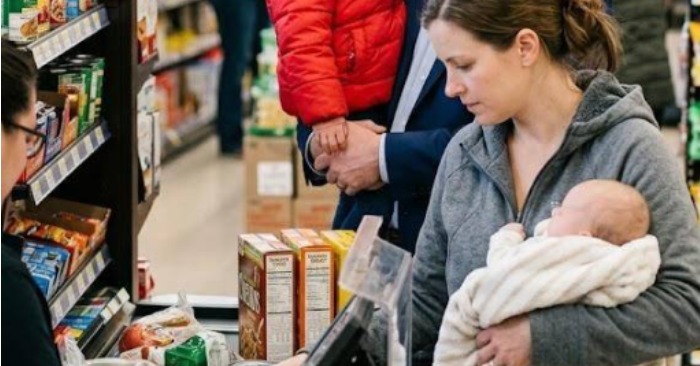
Under the cold lights of Megamart, everything seemed the same as any other afternoon: shopping carts clashing, babies crying, deals hanging like promises, and the constant hum of the fluorescent lights filling the air like soulless music. No one looked at anyone. No one wanted to look.
Elenor Bans, however, was watching. She watched the clock, the balance in her wallet, the short list she carried on a folded piece of paper, and above all, she watched the nervous beat of her hands. She was twenty-seven years old, but that week had aged her by ten more. In the cart seat was a bag with a couple of jars of baby food, cheap bread, a pack of oats, frozen vegetables… the bare minimum to get by, the things you buy that don’t hurt because life already does.
And at the end, as if it were the center of the universe, a blue can: hypoallergenic formula, the only one the pediatrician had strongly recommended. “If you switch brands, Daisy will suffer,” he had said. Daisy, her nearly one-year-old daughter, was the reason Elenor woke up with swollen eyes and kept going. She had that little nose and light, summer sky-colored eyes, a look that seemed to know nothing of the world… and that’s why Elenor felt bound to protect her from everything.
The problem was that the world wouldn’t let her.
At the checkout, the cashier—a young man with a face of eternal exhaustion named Kevin—scanned the products one by one with a “beep” that sounded to Elenor like a hammer. Each sound marked a small defeat. Bread, beep. Oats, beep. Vegetables, beep. The number on the screen climbed relentlessly.
When Kevin took the blue can, Elenor stopped breathing. She knew that price. She had calculated it down to the last cent in her head while walking through the aisles, as if thinking hard could change the number. But knowing it wasn’t the same as facing it.
The “beep” sounded louder, or maybe it was her heart. The total appeared on the screen. Kevin looked up just for a second, his voice flat:
—Is that everything?
Elenor nodded, swallowing hard. She opened her wallet. Counted crumpled bills, loose coins, a couple of old receipts. Her fingers trembled, not from the cold, but from shame. She was short. Just short of what separated a mother from her promise.
—I’m sorry… —she whispered, and her voice cracked like a fragile glass—. I have to leave… this item.
She slid the formula back across the counter. A small gesture, but for her, it felt like surrendering with her whole body.
Behind her, the line grew impatient: sighs, a throat clearing, someone glancing at their phone as if Elenor was stealing minutes of their life. Elenor wanted to disappear. She wanted to sink into her coat, as if the fabric could protect her from judgment.
She paid for what she could afford. Kevin packed the purchase into a thin plastic bag and pushed it toward her without looking at her. Elenor took the bag carefully, as if it weighed much more than bread and oats. She walked toward the exit with her head down, feeling like a ghost in a place full of bodies.
She didn’t know that, just a few meters away, a tall man was pretending to pick organic juices with exaggerated concentration. He wore a simple gray coat, without any flashy brands, and a five-year-old girl squeezed his hand with confidence. No one recognized him, and that, tonight, felt like a gift.
The little girl leaned slightly, looking at Elenor with clear eyes.
—Daddy… —she whispered—. Why does that lady look so sad?
The man, James Caldwell, felt the question hit his chest like a stone. How could he explain to a child that sometimes the world forces a mother to choose between eating and feeding her child? How could he put into words the cruelty disguised as normalcy?
—She’s just… having a tough day, sweetheart —he replied, stroking her hair.
But he couldn’t take his eyes off Elenor’s slumped shoulders. He had seen many things in his life: boardrooms, absurd figures, applause for huge donations. He had learned to move among people who smiled with their teeth but not with their souls. Yet, that silent defeat, that can returned due to lack of money, struck him with a truth that no amount of wealth could buy.
Elenor stepped into the cold of the night, clutching her bag to her chest, and walked to the bus stop. She sat on a metal bench, staring at the street as if the street had answers. Her tears burned, but she swallowed them down, because she didn’t want to cry in public. Because even crying seemed like a luxury.
And in that very moment, unknowingly, someone made a decision that would break the routine of her life like lightning breaking through the darkness… and that would also unearth an ancient bond, hidden in the history of two families.
—
James asked Sofia to wait for a moment with the security guard at the supermarket, a trusted man who knew him well. He returned to the checkout with firm steps. He took the blue can Elenor had left behind and placed it on the counter as if it were the most natural thing in the world. He added a roasted chicken, artisan bread, fresh apples, and some small cookies, thinking of little hands and genuine smiles. He paid in cash. Kevin didn’t say anything; he just passed the items. Beep, beep, beep.
James walked out to the parking lot with the bags in hand. He scanned the area until he found Elenor’s silhouette at the bus stop. She was hunched over, as if the exhaustion had settled in her back forever. James took a deep breath and approached slowly, not intruding.
—Excuse me.
Elenor jumped. She looked up with distrust. A well-dressed man, at night, approaching… her body reacted before her mind.
—I think you forgot this —James said, extending the bag with the formula.
She looked down, and her face flushed with a hot, red embarrassment.
—I didn’t forget it —she murmured—. I couldn’t pay for it.
—I know —he replied, with a calmness that didn’t sound like pity—. That’s why I bought it for you.
Elenor immediately shook her head, as if that “yes” were dangerous.
—I can’t accept it.
James didn’t raise his voice. He didn’t try to convince her with speeches. He just held the bag a little closer, as if offering a coat to someone who was cold.
—Please. It’s not charity. It’s… a gift from a father to a mother. Your daughter needs it.
The words “your daughter” made Elenor’s throat tighten.
—Her name is Daisy —she whispered, almost like a confession.
James smiled, and for the first time, his face showed something warm, human.
—Beautiful name. I have a daughter too: Sofia. She’s five years old.
Elenor felt her eyes blur. She looked at the bag as if it were a door opening. In the end, she extended her hands and took it carefully.
—Thank you… really.
James nodded, as if the gratitude made him more uncomfortable than the money.
—It’s cold, and the bus might take a while —he said—. Let me take you home.
Elenor hesitated. Prudence pushed her to say no. But need… need had a stronger voice. Also, when her fingers brushed his while adjusting the other bag, she felt a brief warmth, a minimal sign that there was no threat. Just an offer.
She got into the car. The ride was short and almost silent, but not uncomfortable. Elenor gave the address with a soft embarrassment, imagining how a man like him would react to seeing her old building. James didn’t ask any more questions. Sofia, sitting in the back, was entertained with a game James proposed: guessing shapes in the dark clouds and animal names.
When they arrived at the complex, James insisted on walking her to the door. He carried the bags without accepting a “no” as an answer. They climbed narrow stairs under flickering light, revealing cracked walls. Elenor felt the urge to apologize for everything: for the place, for her life, for not being someone else. But James walked calmly, as if the only thing that mattered was arriving.
When she opened the door to the apartment, a sweet sound filled the air.
—Mom! —Daisy babbled from a small crib in the living room, raising her arms as if Elenor were the sun.
Elenor let the tension drop to the floor. She lifted her up and held her close, and the tears she had held in finally found their way out. It wasn’t just sadness: it was relief, love, accumulated exhaustion.
—James… —she said, turning toward him with Daisy in her arms—. This is Daisy.
James looked at the baby with unexpected tenderness. His eyes softened.
—She’s perfect.
The apartment was small, with old furniture and worn paint, but it was clean with a dignity that was felt. There were children’s books stacked up, framed photos, an order made through love’s force. James, who had lived surrounded by enormous empty spaces since his wife’s death, felt something he had almost forgotten: real connection. Not the applause of a gala, but the warm silence of a family that struggles.
Elenor thanked him over and over again. He left the bags on the table, and in an instant, their gazes met. There were no promises, no speeches. Just a deep recognition: two different worlds united by a gesture.
James said goodbye and left.
That night, when the cold hit his face outside, he understood that something inside him had moved. It wasn’t pride. It was hope.
For Elenor, the hours that followed were different. Not just because of the formula on her table. But for something more intimate: someone had seen her. In a world that made her feel invisible, a stranger treated her like a worthy person.
The next morning, Elenor sat with paper and pencil. She wrote down her skills as if she needed to remind herself: responsible, organized, good with people. She remembered her old job as a receptionist before life had torn it apart. She searched ads, sent applications, and found a vacancy at a community center for veterans. The salary was better than at the restaurant… and the job had purpose. That lit something inside her.
Meanwhile, across town, James couldn’t stop thinking about what he had witnessed. His wife’s death had turned him into a man who functioned on inertia: meetings, silent mansions, accounts growing as if money could fill a void. What he experienced in ten minutes inside Elenor’s apartment hit him harder than any charity event.
He asked his security chief, a former federal agent he trusted, to investigate discreetly. Not to invade, he told himself. Just to make sure Elenor and Daisy were okay. When he received the report, one detail left him breathless: Elenor was the great-granddaughter of Sergeant Michael Bans.
That name he knew. His grandfather, Sergeant Thomas Caldwell, spoke of Michael Bans as a hero. “He saved my life,” he used to say. “If it weren’t for him, you wouldn’t exist.” James had heard that story so many times it had become part of his blood… and now that name was here, in the supermarket, returning a can of formula.
He didn’t want it to remain an isolated gesture. He designed something bigger. A real, transparent program, with clear rules, to honor forgotten local heroes and open opportunities for their descendants: the Bans Legacy, a fund with monthly stipends and educational support.
Days later, Elenor received a call from the community center. They invited her for an interview. She arrived nervous, in simple clothes, but spoke from the heart. She talked about Daisy, her desire to move forward, about her great-grandfather, who she only had photos and family stories of… and about her wish to help those who carried wars no one applauds.
In the end, the director smiled warmly.
—The position has already been filled —she said—, but… there’s something else.
She showed her a brochure. In big letters, it said: Bans Legacy. “Support for descendants of local heroes. Education, stability, and the future.”
Elenor felt the world stop.
—Is this… real?
—Completely. And you qualify.
She signed with trembling hands, just like that night at the checkout… except this time it wasn’t shame: it was disbelief. She didn’t know that behind the program was the same man who bought her the formula.
With the grant, Elenor moved with Daisy to a safer neighborhood. She bought a new crib, a winter coat, enough food without counting coins like they were air. She enrolled in online business administration courses. During the day, she played with her daughter. At night, with coffee in hand, she studied. Her life was no longer just surviving. She was building.
But progress sometimes bothers those who live off control.
At a reception to officially present the scholarship, Elenor walked in with a racing heart. There were elegant people, trained smiles, glasses sparkling under warm lights. And then she saw him: James, in the back, talking to council members. For a second, Elenor froze. He looked at her, recognized her instantly, and his face lit up with genuine surprise.
Before they could talk privately, an influential woman approached with firm steps. Penélope Covington: sharp gaze, voice sweet like a knife.
—What a… convenient story —she said, looking at the brochure—. A beneficiary with the “perfect” last name, right? It almost seems like someone handpicked her.
The comment fell like poison in the air. Some people turned their heads. Elenor felt the old tremble return, that feeling of being judged.
But this time, she didn’t lower her gaze.
—My great-grandfather isn’t “convenient” —she said firmly—. He’s part of my family and part of this community’s history. And this isn’t charity. It’s a legacy.
Penélope smiled with false kindness.
—Sure… legacy. Or elegant favoritism.
The tension exploded days later in a council meeting. Explanations were demanded. Doubts were insinuated. Elenor, sitting in front of people with expensive suits, spoke without trembling. She told her story without dramatizing it, with the dignity of someone who has carried too much. She spoke of her family’s sacrifice and the purpose of the program: opportunities, not handouts.
James listened silently. Then he stood up. Not to impose himself, but to clarify with truth.
—My grandfather wrote this —he said, pulling out an old notebook—. It’s his diary. Here, he recounts the day Sergeant Michael Bans saved his life. This program didn’t start in a marketing room. It started from a debt of honor that my family has remembered for generations.
He showed the pages. Read short fragments. Names, dates, facts. Truth.
The murmuring stopped. Doubt fell away like a mask that no longer serves.
The council voted not only to keep the scholarship but to expand it. Penélope, exposed, resigned shortly after.
Two years passed.
Elenor graduated with honors and began working at the foundation, helping other families rise from the edge of the abyss. She became the hand she had once needed: someone who listens without judgment, who opens doors without humiliating. Daisy grew strong, healthy, with an easy laugh. Sofia and Daisy became friends as if they had known each other forever, running together in parks, inventing worlds where adults didn’t cry at cash registers.
James and Elenor didn’t have grand gestures. What they had wasn’t born from a movie, but from the everyday: respect, trust, long conversations, silences that didn’t weigh down. A love that grew slowly, like things that are truly real.
One sunny Saturday, while the girls played, Elenor rested her head on James’s shoulder. She looked at Daisy, and for a moment, she remembered that blue can, that defeat, that shame.
—I’ll never forget that night —she whispered.
James squeezed her hand.
—I won’t either. It reminded me that the world can be harsh… but that one decision can break that hardness.
Elenor took a deep breath. She was no longer invisible. She was no longer alone.
And so, what started with a mother returning formula for her baby became something no one in that supermarket could have imagined: a shared legacy, a debt of honor paid with love, and proof that the most silent gestures—the ones no one applauds—can resonate for generations.
Millionaire Saw a Single Mother Return Her Daughter’s Milk—What He Did Surprised Everyone