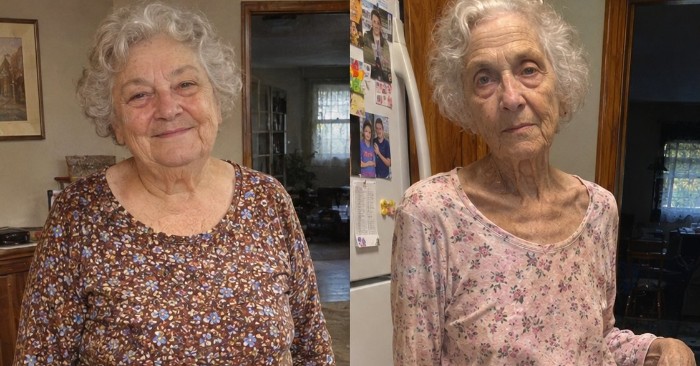
My 80-year-old mother had planned to spend a week with a longtime friend. But when I picked her up at the train station, she looked frighteningly thin and was dragging an enormous suitcase that didn’t even belong to her. When I called her friend, I discovered that the woman hadn’t lived at the address she’d given me for eight years. Where had my mother actually been?
I almost walked straight past my own mother at the train station.
She was standing beside a bench, gripping the handle of an enormous black suitcase.
Her gray hair was flattened against her forehead, and the cardigan she’d worn for years hung loosely from her shoulders.
“Mom?”
She turned and smiled.
“Hello, sweetheart.”
I hurried toward her.
“What on earth happened to you?”
“Nothing at all, Laura.”
Her cheeks looked hollow.
Even her voice sounded weaker than usual.
My mother, Evelyn, was eighty years old, always cheerful, and had always been a little plump.
She adored baking and never missed our Sunday family dinners.
Seven days earlier, she’d left to visit Margaret, a childhood friend she hadn’t seen in decades.
Now she looked as though she’d lost half her body weight.
“Are you sick?”
“I’ve just had a few stomach problems.”
“I’m taking you straight to the hospital.”
“You’re taking me home.”
Then I noticed the suitcase.
“Where’s your blue travel bag?”
“Margaret gave me this suitcase. My bag broke.”
Her grip tightened around the handle.
“Can we please just go now?”
I wanted to argue, but she looked utterly exhausted.
So I took the suitcase and helped her to my car.
It was much heavier than I’d expected.
And yet Mom had been so excited about this trip.
Margaret lived three hours away, and the two women had known each other since childhood.
When Mom told me that Margaret’s daughter had invited her for a visit, I’d been delighted.
“You two haven’t seen each other in forever,” I said.
“Twenty years,” Mom replied.
“Then you absolutely have to go.”
My mother hesitated.
“I don’t want to leave you with everything to manage on your own.”
“Mom, I’m fifty-two. I think I can survive one week without our Sunday dinner.”
That made her laugh.
The following Monday, I drove her to the train station.
She carried a small blue travel bag containing clothes, medication, and a box of homemade cookies.
Before boarding the train, she handed me a phone number.
“This is Margaret’s number. Just in case anything happens.”
I saved it in my phone.
During the week, we spoke briefly on the phone twice.
Both times, Mom assured me she was having a wonderful visit.
But she never passed the phone to Margaret.
And whenever I asked what the two of them had been doing, she changed the subject.
At the time, I didn’t give it much thought.
Only when I saw her again at the station did I realize something was terribly wrong.
Once we got home, Mom insisted on carrying the black suitcase upstairs herself.
She barely made it up the first two steps before she began to sway, so I took it from her.
“There’s absolutely no way you’re carrying this yourself.”
“Just put it in my bedroom.”
I did exactly that.
She followed me inside, waited until I’d left the room, and then locked the door.
My mother had never locked her bedroom door during the day before.
That evening, she barely touched the soup I’d made for her.
I checked her temperature, encouraged her to drink water, and asked again whether we should go to the doctor.
“Maybe tomorrow,” she answered.
“Mom, you really look awful.”
“Thank you very much, darling.”
“I’m serious.”
“So am I. I’m tired, but I’m not dying.”
She attempted a smile, but it did nothing to reassure me.
After she went to bed, I called Margaret.
A man answered.
“Hello?”
“Good evening. Could I please speak to Margaret?”
There was a pause at the other end.
“Margaret hasn’t lived here for eight years.”
I checked the number on my screen.
“Are you certain?”
“Absolutely. I’ve had this number for years.”
“Do you happen to know where she moved?”
“No, I’m sorry.”
I thanked him and ended the call.
Then I called my mother on her cell phone.
I could hear it ringing upstairs.
But she didn’t answer.
I stood at the bottom of the staircase, wondering why she’d given me a phone number that hadn’t belonged to her friend for years.
The next morning, I found Mom asleep in her armchair.
She was still wearing the same cardigan she’d worn the previous day.
On the small side table lay a train ticket dated three days before the day I’d picked her up.
Beneath it was a luggage tag.
The name written on it was Ellen.
Not Margaret.
And not Evelyn, either.
I glanced toward the hallway.
Mom’s bedroom door was open. The black suitcase stood beside her dresser.
I knew I shouldn’t go through her personal belongings without permission.
But my mother was clearly unwell, and she’d lied to me about where she’d been.
By then, I couldn’t shake the feeling that something serious must have happened.
I carried the suitcase into the hallway and opened it.
Inside were neatly folded clothes, a sealed brown envelope, and an old-fashioned digital camera.
The clothing looked far too large for my mother.
Beneath it, I discovered a faded yellow child’s sweater and a tiny wooden rolling pin.
Something about the rolling pin seemed familiar.
At least, I thought I recognized it.
There had been one very much like it in the kitchen of my childhood.
I picked up the camera.
Its battery was almost dead.
There were only four photographs stored on it.
The first showed my mother standing outside a modest brick house.
In the second, she was sitting beside a frail elderly woman in a bedroom.
The third picture showed a handwritten schedule attached to a refrigerator.
It listed mealtimes, medication reminders, and instructions for safely helping someone stand up and walk.
Then I opened the fourth photograph.
It was a picture of an old printed photograph.
A woman stood outside a small white house, holding a toddler wearing a yellow sweater.
I recognized the child immediately.
It was me.
And suddenly, the woman looked familiar too.
“Aunt Maggie,” I whispered.
I hadn’t spoken that name in decades.
An address had been written by hand along the bottom of the photograph.
I knew the street.
As a little girl, I’d spent countless afternoons there.
I reached for my car keys.
After making sure Mom was sleeping peacefully, I left her a note and drove across town.
The little white house was still standing, although the old porch had since been renovated.
I parked outside and stared at the front steps.
I remembered sitting there with a bowl of strawberries.
I remembered a woman who let me scatter flour all over her kitchen table.
And I remembered calling her Aunt Maggie.
Mom had always told me she’d been a family friend who had eventually moved away.
I’d assumed she’d died many years ago.
I walked up to the front door and rang the bell.
A middle-aged man answered.
“Can I help you?”
“I’m sorry to bother you. Did a woman named Margaret used to live here?”
He nodded.
“She owned the house before we bought it.”
“Do you know where she moved?”
He shook his head.
“That was quite a long time ago.”
I showed him the photograph.
He examined it and then looked at me.
“Is that you in the picture?”
“Yes.”
He gave me a small smile.
“I wish I could help you.”
I thanked him.
Back in my car, I examined the other photographs again.
Beside the front door of the brick house in the first photograph, I could make out a house number.
I entered the address from the luggage tag into my navigation system.
It was three hours away.
So that really was where my mother had been.
And if Margaret was the same woman I’d once called Aunt Maggie, I desperately wanted to know why Mom had never told me.
When I returned home, my mother was awake.
She was sitting at the kitchen table with a glass of water.
The black suitcase stood beside her chair.
“You opened it,” she said.
“Yes.”
She looked disappointed.
“I’m sorry, Mom. I was worried about you.”
“You could have simply asked me.”
“I did ask. But you wouldn’t tell me anything.”
She lowered her gaze.
I sat down across from her.
“Who is Aunt Maggie?”
My mother’s expression changed.
“Where did you hear that name?”
“I remember her.”
Mom pressed her lips together.
“The woman who taught me how to bake. The one who lived in the white house.”
Mom stared at the tabletop.
“Margaret,” I said slowly. “Aunt Maggie was Margaret.”
She nodded.
“Why did you keep that from me?”
“I didn’t think you’d still remember her.”
“Why would I forget someone who took care of me?”
Tears filled my mother’s eyes.
“Because you were so little back then.”
I brought out the old photograph.
“Why did she have this picture?”
“Because she kept everything.”
“Everything from what?”
Mom reached toward the photograph.
“From the time when she helped us.”
I waited silently.
Finally, she raised her head.
“Your father had just left us. You were four years old. I was working two jobs, and I had no idea how I was going to manage everything.”
Of course, I’d always known that my father had left when I was very young.
But I’d never truly understood how difficult the years afterward must have been.
“Margaret lived close to us back then,” Mom continued. “She watched you while I worked evenings. Sometimes you even spent the night at her house.”
“How long did that go on?”
“Almost two years.”
I stared at her.
“Two years?”
Mom nodded.
“She cooked for you, helped you learn your letters, and taught you how to bake little cakes. And she never asked for anything in return.”
I looked at the tiny rolling pin resting on the kitchen counter.
“That belonged to me?”
“Margaret had it made especially for you.”
Suddenly, I remembered standing on a chair, pressing dough flat with both hands.
All these years, I’d believed those memories came from our own kitchen.
In reality, they’d happened in Margaret’s kitchen.
“Then why did she disappear from our lives?” I asked.
Mom looked embarrassed.
“She moved away. Her husband found work in another area.”
“And you never spoke again after that?”
“Not right away.”
“What happened?”
My mother folded her hands on the table.
“Eventually, I began to feel ashamed.”
“Ashamed of what?”
“Of how much I depended on her help.”
I looked at her in confusion.
“Margaret loved taking care of you,” Mom said. “But I couldn’t stand feeling as though I wasn’t capable of raising my own daughter by myself.”
“So you pushed her away?”
“Not all at once. First, I started calling less often. Then I canceled a visit. Eventually, so much time had passed that I no longer knew how to reach out again.”
“Mom, that woman practically helped raise me.”
“I know.”
“Then why didn’t you ever tell me about her?”
“Because I wanted you to remember a mother who had managed everything on her own.”
I slowly leaned back in my chair.
For all those years, I’d believed Mom had somehow supported both of us completely by herself after my father left.
And she’d allowed me to continue believing it.
“That doesn’t make you a bad mother.”
She wiped her eyes.
“I understand that now.”
I wanted to ask more questions, but suddenly Mom bent forward and grabbed the edge of the table.
“Mom?”
“I’m dizzy.”
I caught her before she could stand.
This time, she didn’t object when I told her we needed medical attention.
At the hospital, a doctor examined my mother and ordered several tests.
She was dehydrated, weak, and had lost a noticeable amount of weight.
Her loose clothing and extreme exhaustion had made the change in her appearance seem even more dramatic.
The doctor wanted to keep her under observation initially and determine whether anything else might be contributing to her condition.
I sat beside her hospital bed.
“Please tell me what happened at Margaret’s house.”
Mom sighed.
“She hasn’t been doing particularly well for some time.”
“How bad is it?”
“She was only recently discharged from the hospital. Ellen needed help.”
“Ellen is Margaret’s daughter?”
“Yes.”
“Why didn’t you tell me?”
“Because you would have worried.”
“I’m worried now.”
My mother looked away.
“Margaret was always there when I needed her. When Ellen called me, I thought it was finally my turn to give something back.”
She explained that she’d originally expected a quiet, relaxing visit.
But Margaret needed help walking, preparing meals, and managing many everyday tasks.
Ellen had already been caring for her mother for months while continuing to work.
So Mom offered to give her a break for several days.
However, she’d underestimated just how physically demanding the responsibility would be.
At night, she lay awake listening for signs that Margaret needed assistance.
She skipped meals because she was either too busy or simply too exhausted to eat.
By the fourth day, she’d developed stomach problems and could barely eat anything.
“I even bought a ticket to come home,” she admitted.
“The one dated three days before you actually returned?”
She nodded.
“I really intended to leave. But Margaret was having a particularly difficult morning, and Ellen was at work. I just couldn’t bring myself to leave her alone.”
“So you missed your train?”
“Yes.”
“And stayed another three days?”
“I thought I could manage.”
I took her hand.
“Mom, you’re eighty.”
“I have noticed that myself.”
“Why didn’t you call me?”
She looked embarrassed.
“Because I knew exactly what you’d say.”
“That you needed help?”
“Precisely.”
My mother remained in the hospital for observation until the following day.
With fluids and rest, she gradually began feeling better. However, the doctor recommended follow-up examinations and explicitly warned her not to ignore persistent weakness or any further weight loss.
Once we were back home, I carried the black suitcase into the living room.
“Why did Ellen give you this suitcase?”
“Margaret wanted you to have it.”
“Me?”
Mom nodded.
“She knew I would be coming back to your house afterward. So she asked me to bring some things she’d kept all these years.”
I looked at the sealed brown envelope.
“What’s inside?”
“Open it.”
The envelope contained photographs, birthday cards, and letters.
Some had been written in Mom’s handwriting. Others were from Margaret.
There were pictures of me rolling out dough, sleeping on Margaret’s couch, and standing with both women in a park.
One particular letter immediately caught my attention.
Mom had written it when I was five years old.
“I don’t know what I would do without you. Laura asks about you every morning. You give her a safe place to be when I can’t always be there for her.”
I read those words twice.
Then I found Margaret’s reply.
“You are there for Laura in every way that truly matters. Working hard to keep a roof over her head doesn’t mean you’ve failed as a mother. Please stop apologizing for allowing me to love her.”
I looked at my mother.
“She understood you.”
Mom nodded.
“She always did.”
“Then why did you eventually stop accepting her help?”
“Because I didn’t understand it myself.”
She touched the little rolling pin.
“For years, I was convinced I owed her something.”
“And now?”
“I thought this trip would finally allow me to repay my debt.”
I shook my head.
“Mom, friendship isn’t a bill you eventually have to settle.”
She looked at me silently for a long time.
Then she began to cry.
The following afternoon, I called Ellen.
This time, Mom gave me her phone number without the slightest objection.
Ellen sounded relieved.
“How is Evelyn?”
“She’s slowly recovering. She was severely dehydrated and needed medical treatment.”
“Oh my goodness. I knew she was tired, but she kept insisting she was perfectly fine.”
“How is Margaret doing?”
“She’s resting. She asks about Evelyn every day.”
I hesitated.
“May I ask you something? How much assistance does your mother actually need?”
Ellen was silent for a moment.
“More than I’ve been willing to admit to myself.”
She explained that Margaret could still do some things independently, but she needed regular supervision during the day and practical assistance with daily activities.
Ellen had already reduced her working hours. But that arrangement wasn’t sustainable in the long term.
“I thought Evelyn would simply enjoy the visit,” she said. “I never expected her to take on so much.”
“My mother has a hard time saying no.”
“Unfortunately, so does mine.”
We talked about how Ellen might arrange dependable assistance so she wouldn’t have to shoulder every responsibility alone.
Of course, I couldn’t simply solve all her problems from three hours away.
But I could help her find appropriate services and encourage her to speak with Margaret’s doctors about suitable care options.
Before ending the call, I asked whether Margaret might like to see me again.
Ellen laughed softly.
“She’s been hoping for years that you’d come visit someday.”
Two weeks later, my mother and I set off together.
This time, I drove.
Mom had regained some of her strength, was eating regularly, and was following her doctor’s recommendations.
During the first hour, she complained several times about my driving. I took that as a good sign.
When we arrived at Ellen’s house, she opened the door for us.
Margaret was sitting in a comfortable armchair beside the window.
Beneath a knitted blanket, she looked small and fragile.
But the moment she saw me, her face brightened.
“Laura?”
I nodded.
She reached both hands toward me.
I crossed the room and wrapped my arms tightly around her.
For a moment, I caught a familiar scent.
Vanilla.
It was the same gentle perfume I remembered from childhood.
“My goodness,” she whispered. “Just look at you.”
I laughed through my tears.
“You always used to let me taste the cake batter.”
“You helped yourself to it.”
Mom sat down beside her.
Margaret took her hand.
“You gave us an awful fright.”
My mother smiled.
“I’ve been told that several times already.”
We spent the afternoon looking through old photographs.
Margaret remembered details I’d forgotten long ago.
The day I lost my first baby tooth.
The little yellow sweater she’d knitted for me.
And the birthday when I insisted on baking Mom a cake and accidentally used salt instead of sugar.
I listened in amazement as this woman shared childhood memories she’d preserved for so many years.
Before we said goodbye, I thanked her.
“For everything you did for us back then.”
Margaret shook her head.
“Your mother worked incredibly hard. All I did was make sure you had somewhere you were welcome after school.”
“But that wasn’t a small thing.”
She squeezed my hand.
“No,” she finally admitted. “I suppose it really wasn’t.”
Over the following months, Ellen arranged additional support for Margaret.
Mom visited her old friend again, but only for short stays and never again as her caregiver.
I regularly checked in with both women to see how they were doing.
And every Sunday, my mother still came over for dinner.
The only difference was that I was now the one doing the cooking.
At first, she protested.
But eventually, instead of bringing entire meals, she simply arrived with new recipes.
One afternoon, I found her in my kitchen, watching my daughter roll out pastry dough.
Between them lay the little wooden rolling pin Margaret had kept for decades.
“You’re pressing much too hard,” Mom told her.
My daughter laughed.
“You sound exactly like Grandma Maggie.”
Mom looked up in surprise.
I smiled.
My daughter had started calling Margaret Grandma Maggie, just as I’d once called her Aunt Maggie.
For twenty years, my mother had believed the only way to honor her old friend’s kindness was to repay every favor someday while refusing to accept help herself.
But Margaret had never expected anything in return.
All she’d wanted was to have her friend back.
And the black suitcase my mother had brought home wasn’t filled with an unpaid debt.
It held proof that neither my mother nor I had ever truly been alone.