The cassette clicked.
For one second, there was only static.
Then Mr. Whitmore’s voice filled the yard.
Weak.
Breathless.
Recorded not long before his death.
“If you found the box, then I failed to take this secret with me.”
I stared at the photograph in my lap.
My mother looked no older than twenty.
Her hair was tied back with a scarf.
She was standing beside Mr. Whitmore near an old station wagon.
In her arms was a newborn wrapped in the same faded blanket inside the box.
On the back of the photograph was a date.
My birthday.
“I know you were told your father died before you were born,” the recording continued. “That story was necessary once. It is not necessary anymore.”
I could barely breathe.
My father had always been a ghost in our family.
Whenever I asked about him, my mother gave the same answer.
He had died in a construction accident two months before I was born.
There were no photographs.
No letters.
No relatives.
Only a name.
Thomas Hale.
My mother had refused to discuss him.
She died when I was twenty-three, taking every answer with her.
The recording crackled again.
“Your father’s real name was not Thomas Hale.”
A floorboard creaked behind me.
I turned.
The back door of Mr. Whitmore’s house stood open.
An older man stepped into the light.
He was tall but stooped.
Gray hair.
A dark coat despite the warm morning.
In one hand, he held a silver key identical to the one in the box.
“He should never have left you that,” the stranger said.
I rose too quickly and nearly fell.
“Who are you?”
The man did not answer.
His eyes moved toward the cassette recorder.
“Turn it off.”
I gripped it tighter.
“No.”
He took one step forward.
“Your neighbor was confused near the end.”
“He knew my mother.”
The man’s face tightened.
“Many people knew her.”
“Why do you have that key?”
He looked down at it as if he had forgotten it was in his hand.
“Because that box was never his.”
My pulse hammered.
“Then whose was it?”
The stranger stared at me.
“Mine.”
Before I could speak, Mr. Whitmore’s voice continued from the recorder.
“If a man named Daniel Mercer appears, do not believe anything he says until you open the room beneath my house.”
The stranger froze.
I looked at him.
“Daniel Mercer?”
His jaw tightened.
“That name means nothing.”
The cassette played on.
“He will tell you I stole you. That is a lie. He will tell you your mother abandoned him. That is also a lie.”
The man moved suddenly.
He reached for the recorder.
I stepped back and raised the shovel between us.
“Stay away from me.”
He stopped.
For the first time, fear flickered across his face.
Not fear of me.
Fear of the recording.
Mr. Whitmore continued.
“Use the silver key on the cellar door. Inside, you will find the rest.”
The tape clicked off.
Silence returned to the yard.
The stranger stared at me.
Then he said quietly,
“If you go into that cellar, you will destroy what is left of your mother’s memory.”
I held the key so tightly it cut into my palm.
“You don’t get to warn me about my mother.”
He stepped back toward the house.
“I knew her better than you think.”
“Were you my father?”
The words came out before I could stop them.
He did not answer.
That silence was worse than a confession.
I raised my phone.
“I’m calling the police.”
His eyes hardened.
“Then call them.”
He turned and walked into Mr. Whitmore’s house as though it belonged to him.
I followed at a distance.
Every instinct told me to leave.
But for forty years, other people had decided what I was allowed to know.
I was finished obeying ghosts.
The house smelled of dust and old wood.
Mr. Whitmore’s furniture remained exactly as it had before the funeral.
His glasses sat beside an unfinished crossword.
A mug rested near the sink.
For a moment, the ordinary details made the nightmare feel even more unreal.
The stranger stood beside the cellar door.
It was hidden behind a narrow pantry cabinet.
He pulled the cabinet aside, revealing a steel door set into the wall.
There was no handle.
Only a keyhole.
“Last chance,” he said.
I inserted the silver key.
It turned smoothly.
The door opened with a heavy groan.
A narrow staircase descended into darkness.
I switched on my phone flashlight.
The stranger stayed behind me.
At the bottom was a small concrete room.
Not a storage cellar.
An archive.
Metal shelves covered every wall.
Boxes.
Files.
Photographs.
Cassette tapes.
A child’s red coat hung from a hook.
On a table in the center sat a portable crib.
My knees weakened.
The same faded blanket lay inside it.
“What is this place?” I whispered.
The stranger closed the door behind us.
The click echoed through the room.
“Evidence,” he said.
I spun around.
“Of what?”
He looked older in the harsh light.
Tired.
Ashamed.
“Of everything your mother tried to escape.”
I found a folder marked with her name.
Evelyn Carter.
My mother’s maiden name.
Inside were medical records, police reports, handwritten statements and photographs.
One image showed bruises on her face.
Another showed a broken window.
A third showed the stranger standing outside her apartment.
I looked at him.
“You hurt her.”
He closed his eyes.
“I was young.”
“That is not an answer.”
“I loved her.”
“You terrorized her.”
His face twisted.
“You don’t understand what happened.”
I held up one of the police reports.
“She filed three complaints against Daniel Mercer.”
He said nothing.
My stomach dropped.
“You are Daniel Mercer.”
He leaned against the wall.
“Yes.”
The room seemed to shrink around me.
“Are you my father?”
His eyes filled with something I could not read.
“I believed I was.”
“Believed?”
“Your mother was pregnant when she left me. She refused to let me near her. Then she disappeared.”
I opened another folder.
Inside was a paternity test.
The document was nearly forty years old.
My eyes moved to the conclusion.
Probability of paternity: excluded.
Daniel watched me read it.
“She knew,” he said bitterly. “She knew I was not your father.”
“Then why were you looking for us?”
“Because she had taken everything.”
“What did she take?”
He pointed toward the shelves.
“My records. Names. Payments. Proof.”
I looked around.
“What kind of proof?”
Before he could answer, a second light switched on.
My husband stood at the top of the stairs.
Behind him were two police officers.
I had forgotten that my phone call had connected before Daniel entered the house.
The dispatcher had heard enough.
Daniel raised his hands.
One of the officers ordered him away from me.
He laughed softly.
“You think Whitmore was a hero?”
No one answered.
“He helped her disappear because he was part of it.”
“Part of what?” I demanded.
Daniel looked toward the shelves.
“A private adoption network.”
The words struck harder than anything else.
The officer stepped forward.
“Keep your hands where we can see them.”
Daniel ignored him.
“Your mother worked at a clinic. Whitmore drove women across state lines. Babies were placed with families who paid cash. Records were changed. Names disappeared.”
I stared at the portable crib.
“No.”
“Your mother found out the clinic was selling children. She stole their records and tried to expose them.”
The officer restrained Daniel.
He did not resist.
“She came to me for help,” he continued. “I wanted the files. She wanted protection. Neither of us trusted the other.”
I turned toward the shelves.
Dozens of names were written on the boxes.
Dozens of lives.
Mr. Whitmore’s final secret was not only about me.
The police searched the cellar for hours.
They found evidence linked to more than thirty illegal adoptions.
Some families had knowingly paid for children.
Others had been deceived.
Birth mothers had been told their babies died.
Children had been given new names and false records.
Mr. Whitmore had spent four decades collecting documents, locating survivors and quietly returning information whenever he believed it was safe.
But he had never contacted me.
Not until he was dying.
A second cassette was found in a sealed envelope bearing my name.
I listened to it that evening at the police station.
Mr. Whitmore sounded weaker than before.
“Your mother was not innocent in the beginning.”
I closed my eyes.
“She worked at the clinic because she needed money. She changed forms. She accepted envelopes. Then she saw a woman begging to hold the baby she had been told was dead.”
His voice broke.
“That was the day she decided to expose everyone.”
I gripped my husband’s hand.
“Daniel Mercer discovered what she was doing. He followed her. Threatened her. She came to me because I had transported records for the clinic.”
There was a long pause.
“I helped her escape because it was the first decent thing I had done in years.”
The recording continued.
“Your mother was already carrying you. Your biological father was a young doctor who helped copy the files. He died in a car crash before you were born.”
My chest tightened.
There had been some truth in the story.
Only the name had changed.
“Daniel believed you were his child. We let him believe it because his obsession with finding you distracted him from the evidence your mother had hidden.”
I looked through the glass at Daniel sitting in the interview room.
He had spent forty years searching for a daughter who was never his.
Not from love.
From the fear that she might inherit the truth.
Mr. Whitmore’s voice softened.
“I moved beside you when you were ten. Your mother asked me to watch from a distance. She feared Daniel would return.”
Memories flooded back.
Mr. Whitmore fixing our broken gate.
Walking me home after my bicycle chain snapped.
Standing near the school bus stop on rainy mornings.
The twenty-dollar Christmas notes.
He had not been a lonely neighbor who happened to be kind.
He had been keeping a promise.
“Your mother wanted to tell you,” the recording said. “But she was ashamed of what she had done before she tried to stop it.”
I pressed my fingers to my lips.
“She believed the truth would make you hate her.”
The tape grew quiet.
“She was wrong.”
That was the final sentence.
The investigation lasted nearly two years.
Some of the people named in the files were dead.
Others denied everything.
Several families were reunited.
Others chose not to reopen wounds that had barely healed.
There were no perfect endings.
Too much time had passed.
Too many lies had become entire lives.
Daniel Mercer was charged with crimes connected to intimidation, evidence concealment and the old adoption network.
He never admitted responsibility for what happened to my mother.
But the files spoke louder than he did.
I eventually learned the name of my biological father.
Dr. Samuel Lane.
There was one photograph of him.
He was standing beside my mother outside the clinic, both of them tired but smiling.
I keep it now.
Not because a photograph can replace a father.
But because the truth, even incomplete, is better than an invented grave.
Mr. Whitmore’s house was later sold.
Before the new owners moved in, I returned to the apple tree.
The hole had been filled.
The soil was still darker than the ground around it.
My daughter asked why I was standing there.
I told her that someone had buried a secret because he was afraid of what the truth would do.
“What did it do?” she asked.
I looked toward the house next door.
“It hurt us.”
Then I took her hand.
“But it also found people who had been waiting their whole lives to know who they were.”
Mr. Whitmore was not the innocent man I once believed him to be.
He had helped build the system before he spent decades trying to repair the damage.
My mother was not the perfect victim I wanted her to be.
She had made mistakes before finding the courage to fight them.
And I was not protected by the lie.
I was only delayed from understanding my own life.
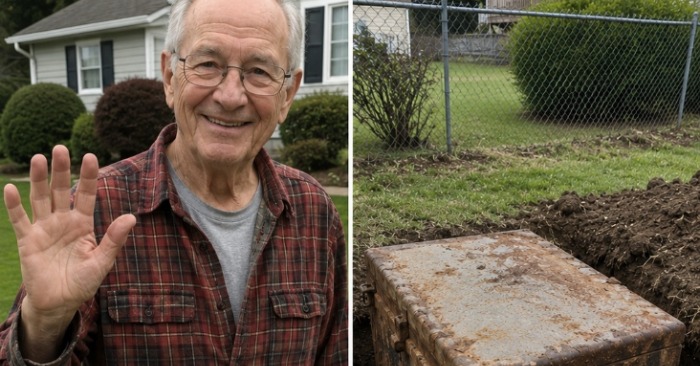
The rusted box beneath the apple tree did not contain treasure.
It contained something far more dangerous.
Names.
Proof.
Guilt.
And the final promise of a flawed old man who had watched over me from the house next door.
Sometimes the truth does not arrive as comfort.
Sometimes it arrives covered in dirt.
And when you finally open it, you do not get your old life back.
You get the chance to stop living inside someone else’s lie.