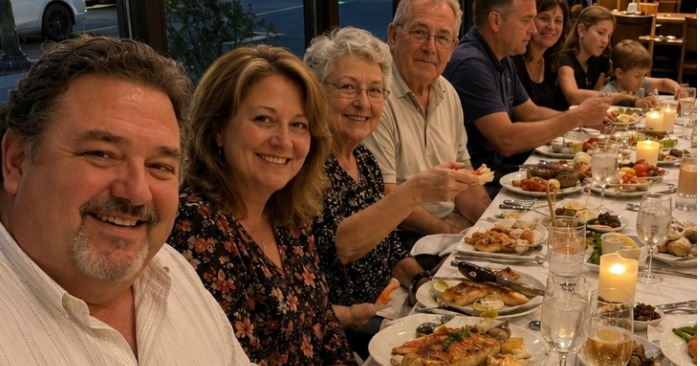
Chris stared at the papers inside the envelope.
Then he looked at me.
“Where did you get this?”
The noise around the table faded.
His sister Rachel still had one hand resting on her bill.
His brother Mark was looking from Chris to me.
My father-in-law, Richard, leaned forward.
“What is it?”
Chris folded the papers quickly.
“Nothing.”
I almost laughed.
For years, that had been his favourite word whenever I brought up money.
Nothing.
The dinners were nothing.
The jokes were nothing.
The fact that his family expected me to pay was nothing.
Apparently, the bank statements showing exactly where our joint savings had been going were also nothing.
Richard reached across the table.
“Let me see.”
Chris pulled the envelope closer.
“Dad, leave it.”
That was when I knew I had made the right decision.
Rachel frowned.
“What does any of this have to do with dinner?”
I looked at her.
“More than you think.”
The waiter stood several feet away, clearly trying not to become part of a family war.
I gave him a small nod.
He quietly stepped back.
Rachel tapped the bill with one finger.
“I’m not paying this.”
“You ordered it.”
“You invited us.”
“No, Richard invited everyone for his birthday.”
She looked at my father-in-law.
Richard blinked.
“I thought Chris arranged this.”
Chris said nothing.
Mark slowly put down his glass.
“I thought Rachel arranged it.”
For a few seconds, everyone looked at everyone else.
Then Rachel laughed nervously.
“Fine. Whatever. We all know how this works.”
Her eyes landed on me.
“You pay, and everyone sends you something later.”
“No one sends me anything later.”
“That’s not true.”
“It is.”
Chris finally spoke.
“Can we not do this here?”
I looked at him.
“Where would you prefer?”
“At home.”
“So you can tell me I’m overreacting again?”
His face tightened.
The table went quiet.
That was new.
Usually, Chris’s family had no problem laughing when I was the target.
But public discomfort apparently made everyone suddenly polite.
Richard looked at me.
“How long has this been happening?”
I turned toward him.
“Four years.”
His expression changed.
“What?”
Rachel rolled her eyes.
“Oh, come on. She has a better job than most of us.”
“That doesn’t answer the question,” Richard said.
Rachel sat back.
“Nobody forced her.”
I nodded.
“She’s right.”
That surprised her.
I continued.
“The first few times, nobody forced me.”
I had paid willingly.
That part mattered.
When I married Chris, his family welcomed me quickly.
At least I thought they did.
There were always gatherings.
Birthdays.
Graduations.
Sunday lunches.
Engagement dinners.
Someone always had a reason to celebrate.
And because I earned more than most of them, I never minded picking up a bill occasionally.
The problem was that occasionally became usually.
Usually became always.
And somewhere along the way, gratitude disappeared.
The jokes started instead.
Walking credit card.
Family sponsor.
Moneybags.
At first, I laughed because everyone else laughed.
Then one evening, after I had paid nearly £900 for a dinner I hadn’t even chosen, I told Chris it needed to stop.
He kissed my forehead and said:
“They’re just used to you being generous.”
That should have bothered me more than it did.
Instead, I tried setting small boundaries.
At the next dinner, I told everyone beforehand that we should split the bill.
When the bill arrived, Chris quietly took my card from my handbag and paid anyway.
I confronted him in the car.
He looked annoyed.
“I didn’t want Dad embarrassed.”
“You used my card.”
“Our card.”
It wasn’t.
The account was mine.
But that wasn’t the worst part.
The worst part was that he genuinely thought avoiding an awkward moment with his family mattered more than respecting what I had already said.
After that, I began paying closer attention.
And I noticed something else.
The family’s behaviour changed depending on who was paying.
If Mark organised dinner and everyone knew they were splitting the bill, he ordered pasta.
Rachel drank tap water.
Chris’s younger sister, Amy, skipped dessert.
But if they thought I was paying?
Suddenly everyone developed expensive taste.
They weren’t careless.
They were calculating.
That was what finally made me angry.
Still, I might have tolerated it longer if I hadn’t opened our joint savings account two weeks before Richard’s birthday.
Chris and I had been saving to renovate our kitchen.
At least, that was what I thought.
I logged in to check the balance.
Nearly £12,000 was missing.
At first, I assumed fraud.
Then I looked at the transfers.
They weren’t fraud.
They were Chris.
£800 to Rachel.
£1,200 to Mark.
£600 to Amy.
£2,500 to his mother.
More payments followed.
Some were labelled “temporary.”
Others had no description.
I printed six months of statements.
Then I waited until Chris came home.
“What is this?”
He barely looked at them.
“Family stuff.”
“What family stuff?”
“They needed help.”
“With what?”
He sighed.
“Why are you interrogating me?”
Because it was our savings.
Because I had contributed most of it.
Because we had agreed that anything above £300 required both of us to discuss it.
Because my husband had secretly transferred thousands to people who still joked about me paying for dinner.
Instead, I asked one simple question.
“Did you tell them the money came from both of us?”
He hesitated.
That hesitation was enough.
“What did you tell them?”
Chris rubbed his forehead.
“That I’d handle it.”
“Handle what?”
“Helping.”
“With whose money?”
He became defensive.
“Our money.”
“No. Our money means we decide together.”
His voice rose.
“They’re my family.”
“And I’m your wife.”
“I know that.”
“Do you?”
He walked away.
The argument never really ended.
He simply stopped talking.
Three days later, Rachel sent a family group message about Richard’s birthday dinner.
She chose one of the most expensive restaurants in town.
Then she added:
“Don’t worry, our favourite sponsor will be there.”
Three laughing emojis followed.
Chris reacted with one.
A laughing face.
I stared at my phone for a long time.
That was the moment something changed.
Not because of Rachel.
I already knew who Rachel was.
Because of Chris.
He knew I was upset.
He knew we had fought about money.
He knew I had asked him to stop letting his family treat me this way.
And he still laughed.
So I called the restaurant.
I spoke with the manager.
I explained that there would be a large party.
Everyone needed an individual bill based on exactly what they ordered.
No transfers.
No combined table bill.
And under no circumstances was my card to be used for anyone but me.
The manager was completely professional.
“Of course.”
Then I did one more thing.
I printed the bank statements again.
I highlighted every transfer Chris had made.
And I placed them inside an envelope.
That was what he was holding now.
Richard reached for it again.
This time, Chris didn’t stop him.
His father removed the pages.
The first one confused him.
Then his eyes widened.
“Chris.”
Chris stared at the table.
Richard looked through the next page.
Then another.
“You sent Rachel eight hundred pounds?”
Rachel immediately sat straighter.
“That was private.”
Richard ignored her.
“To Mark?”
Mark looked uncomfortable.
“To your mother?”
My mother-in-law, Diane, finally spoke.
“He was helping us.”
“With money his wife didn’t know about?”
Diane glanced at me.
“I assumed she knew.”
I believed her.
Not because Diane had always treated me well.
She hadn’t.
But the shock on her face looked real.
Richard put the statement down.
“What was the money for?”
No one answered.
Then Rachel said:
“I needed rent.”
Mark muttered:
“Car repairs.”
Amy quietly said:
“Mine was for my daughter’s school trip.”
I looked at Chris.
“And you?”
He frowned.
“What about me?”
“The £3,400 cash withdrawal.”
Every head turned toward him.
Chris looked at the statement.
Then at me.
“That’s personal.”
I felt something cold settle in my stomach.
“What does that mean?”
“Not everything has to become a family discussion.”
I almost admired the irony.
“For years, my bank card has apparently been a family discussion.”
“Please lower your voice.”
“I’m speaking normally.”
The waiter approached.
“Would anyone like boxes for the remaining food?”
Nobody answered.
Then Richard quietly said:
“Yes, please.”
The tension changed.
Until that moment, I had expected embarrassment.
Anger.
Maybe even accusations.
I had not expected Richard to look ashamed.
He turned toward me.
“I thought these dinners were being split.”
Rachel muttered:
“They usually are.”
I looked directly at her.
“No, they aren’t.”
She crossed her arms.
“Well, if it bothered you so much, why didn’t you say anything?”
“I did.”
She looked at Chris.
That silence said enough.
Richard followed her gaze.
“You knew she wanted this to stop?”
Chris exhaled.
“It wasn’t a big deal.”
Richard stared at his son.
“It was big enough for you to ignore your wife about it.”
Chris’s face hardened.
“Dad, stay out of this.”
Richard gave a humourless laugh.
“You made all of us part of it.”
Then something unexpected happened.
Amy pulled out her phone.
She opened her banking app.
“How much do I owe you?”
I blinked.
“You don’t need to do that tonight.”
“Yes, I do.”
“Amy—”
“I thought Chris was covering these things from his own money.”
Her eyes filled with embarrassment.
“I honestly didn’t know.”
Mark spoke next.
“Same.”
Rachel scoffed.
“Oh, please.”
Mark looked at her.
“What?”
“You all knew she usually paid.”
“Dinner, yes. I didn’t know Chris was taking money from their savings.”
“That’s different.”
“Yes,” I said.
“It is.”
Rachel turned toward me.
“So this whole thing was a trap?”
“No.”
“You let us order everything.”
“You’re adults.”
“You knew the restaurant was expensive.”
“So did you.”
Her cheeks flushed.
“You wanted to humiliate us.”
I shook my head.
“I wanted everyone to pay for what they chose.”
“That’s the same thing.”
“No. It only feels humiliating because you assumed someone else would cover it.”
She had no answer.
The waiter returned with takeaway containers.
One by one, people began reaching for their bills.
Mark paid his.
Amy paid hers.
Two nieces quietly divided theirs.
My mother-in-law paid for herself and Richard.
Rachel sat motionless.
Finally, she looked at Chris.
“Well?”
Chris blinked.
“Well what?”
“You’re paying mine.”
Something almost funny happened then.
For the first time in years, Chris looked offended by the expectation.
“Why would I?”
Rachel stared at him.
I nearly smiled.
There it was.
The entire problem in one sentence.
Why would I?
Apparently, expectations only became unreasonable when they landed on him.
Rachel pushed her bill toward him.
“You always take care of things.”
“No.”
She laughed.
“Are you serious?”
“Yes.”
“After all the money you’ve given everyone?”
The table froze.
Chris stared at her.
“What do you mean, everyone?”
Rachel realised too late what she had said.
Richard slowly turned toward Chris.
“How much have you actually given them?”
I answered.
“More than what’s on those pages.”
Chris looked sharply at me.
I had found older statements that morning.
Another £9,000 over the previous eighteen months.
Nearly £21,000 total.
Richard closed his eyes.
Diane covered her mouth.
Mark whispered:
“Chris…”
Rachel said nothing.
Then I asked the question I had been saving.
“Why?”
Chris looked at me.
“Why what?”
“Why were you secretly giving them so much?”
“They needed help.”
“No.”
I shook my head.
“That explains why they asked. Not why you lied.”
His jaw tightened.
I waited.
Then Richard spoke.
“Tell her.”
Chris’s head snapped toward him.
“Dad.”
“Tell her now.”
I looked between them.
“What does he mean?”
Richard’s face had gone pale.
“I think I know.”
Diane turned toward him.
“Know what?”
Richard stared at Chris.
“You’ve been doing this since the business failed.”
Nobody moved.
“What business?” I asked.
Chris looked away.
Richard answered.
“Chris invested in Mark’s company three years ago.”
Mark’s face changed.
“That was supposed to stay private.”
My stomach tightened.
“How much?”
Chris rubbed both hands over his face.
“Thirty thousand.”
I stared at him.
“Thirty thousand pounds?”
He nodded.
“From where?”
Silence.
Then I understood.
“Our savings?”
“Not all of it.”
“How much?”
“Twenty.”
I felt physically sick.
That money had disappeared before I ever started monitoring the account closely.
He had told me market losses had hurt one of our investment funds.
I believed him.
“You lied about the investment account.”
“I was going to replace it.”
“With what?”
He said nothing.
Richard continued.
“The business failed.”
Mark looked miserable.
“I tried to repay him.”
“But you couldn’t,” Chris snapped.
Then everything came out.
Chris had lost the money.
He was ashamed.
So instead of telling me, he created a strange cycle of secrecy.
He gave family members money when they needed it.
They helped him with small amounts when he was short.
He used credit.
Moved money between accounts.
Covered dinners.
Maintained appearances.
And because I earned well, he convinced himself the gaps would eventually disappear.
They didn’t.
The expensive meals weren’t the real problem.
They were just the part I could see.
I looked at him.
“Was I ever going to know?”
“Yes.”
“When?”
“When I fixed it.”
“And if you never fixed it?”
He had no answer.
I stood.
Chris looked up.
“Where are you going?”
“Home.”
“We need to talk.”
“We will.”
“Tonight?”
“No.”
That frightened him more than shouting would have.
I picked up my handbag.
Then I looked around the table.
“I’m paying for one thing tonight.”
Rachel gave a bitter laugh.
“Of course.”
I ignored her.
I walked over to Richard.
“Happy birthday.”
His eyes were wet.
“I’m sorry.”
I squeezed his shoulder.
Then I went to the waiter and paid for Richard’s birthday dessert.
One slice of cake.
That was all.
When I reached the car park, Amy followed me.
“Wait.”
I turned.
She held out her phone.
“I transferred you the money.”
“You didn’t have to.”
“I did.”
Then she looked back toward the restaurant.
“I think we got too comfortable.”
That was the first apology anyone in that family had ever given me.
Over the next week, several others repaid portions of what I had covered at previous dinners.
Not everything.
I didn’t ask for everything.
Money wasn’t the point anymore.
Chris stayed with his brother for several nights.
I met with a financial adviser.
Then an attorney.
Not because I had already decided to end my marriage.
Because I needed to know exactly what had happened to our finances.
The full picture was worse than I expected.
But not catastrophic.
We could recover.
The harder question was whether the marriage could.
Chris eventually asked to meet.
We sat in a coffee shop.
Neutral territory.
He looked exhausted.
“I’m sorry.”
I waited.
“I know that’s not enough.”
“No.”
“I thought being the person everyone depended on made me useful.”
That was the first honest thing he had said in weeks.
He told me that growing up in such a large family, money had always been chaotic.
Someone was always short.
Someone always needed rescuing.
Chris became the successful one.
The reliable one.
Then he married me, and because I also earned well, he began treating our combined financial stability as an endless safety net.
“For them,” I said.
He nodded.
“And for your ego.”
He looked down.
“Yes.”
I appreciated that answer.
It didn’t erase anything.
But it was true.
We separated our finances.
Completely.
We started counselling.
I told him there would be no more secret loans.
No touching my accounts.
No paying other people’s bills to avoid embarrassment.
And no laughing when someone reduced me to my income.
“If that happens again,” I told him, “I leave.”
He nodded.
This time, he didn’t tell me I was overreacting.
The next family dinner happened three months later.
A small Italian restaurant.
Nothing fancy.
Before anyone ordered, Richard cleared his throat.
“Just so everyone understands, we’re splitting the bill.”
Rachel rolled her eyes.
But she said nothing.
She ordered pasta.
No cocktail.
No lobster.
No expensive wine.
I noticed.
So did Chris.
Under the table, he reached for my hand.
I let him hold it.
Not because everything was fixed.
It wasn’t.
Trust doesn’t return because someone finally learns a lesson.
It returns slowly, if it returns at all.
When the bill came, everyone paid their share.
No phones suddenly became fascinating.
Nobody disappeared to the restroom.
Nobody joked about my salary.
And as I watched Rachel calculate her portion, I realised something.
I had spent years trying to prove I was generous enough to belong in that family.
But generosity without boundaries had taught them the wrong lesson.
It taught them that my kindness had no cost.
That my silence meant consent.
That my success belonged to everyone.
The night I finally refused to pay wasn’t really about dinner.
It was the night I stopped buying peace at my own expense.
And once everyone had to pay for what they ordered, they became very careful about what they put on the table.