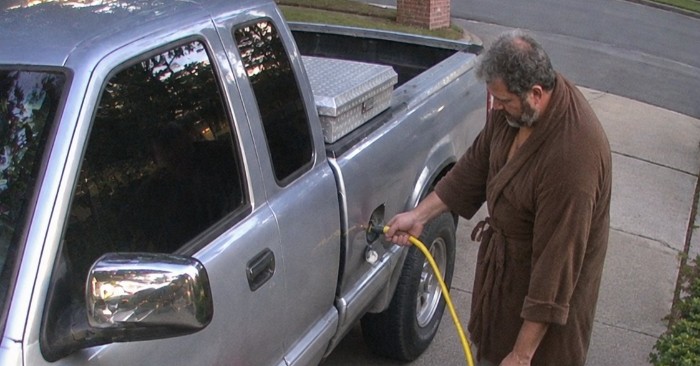
My neighbor had been stealing gasoline from my old pickup truck, and when I confronted him, he actually laughed in my face. According to him, I was seventy years old, retired, and spent most of my time sitting around the house anyway. That meant I didn’t need the fuel nearly as much as he did. Three nights later, he helped himself to my gas tank again. That was when I decided I’d been polite long enough—and left something on his front porch that he wasn’t expecting.
I’m seventy years old, retired, and a widower.
I still live in the modest suburban house that my wife, Nancy, and I bought together more than thirty years ago.
Nancy passed away six years ago.
Since then, the house has become a much quieter place. I spend more time at home than I used to, but that doesn’t mean I have nothing to do. Around our neighborhood, people know me as the older fellow with the pickup truck who usually responds to requests with, “Sure, I can take care of that.”
Every Thursday, I pick up groceries for Mrs. Patterson, who’s eighty-two now.
Whenever someone in the neighborhood needs help transporting something, I lend a hand with my truck. Twice a month, I also help our church collect food packages for families who need assistance.
My pickup is a 1996 Ford F-150.
It used to be dark green, but decades of sunshine have faded the hood. The driver’s seat is patched with duct tape, and the passenger window occasionally needs a little encouragement before it will close properly.
Nancy never particularly liked that truck.
But she did give it a name: Earl. To this day, I have no idea why she chose that name.
“Because he just looks like an Earl,” she’d always say.
Whatever that was supposed to mean.
Earl is old and certainly not much to look at, but I’ve owned him for thirty years. I recognize every rattle and strange noise he makes, and I have a pretty good idea of how much gasoline he normally burns through in a week.
That’s why I noticed immediately when fuel started disappearing much faster than usual.
The first time it happened, I assumed I’d miscalculated.
I’d filled the tank on Monday, driven maybe twelve miles, and then stayed home for the next two days. But when I checked the fuel gauge Thursday morning, it was barely above halfway.
I got down and looked underneath the truck for signs of a puddle.
Nothing.
When you reach seventy, you sometimes start blaming your age for everything. And sometimes you’re the one doing most of the blaming. Maybe I hadn’t actually filled the tank all the way. Maybe I’d driven farther than I remembered.
But the following week, it happened again.
At least that settled one question: I wasn’t imagining things. But if Earl wasn’t leaking gasoline, where on earth was it going?
This time, I knew there was a real problem.
I’d filled the tank on Sunday afternoon. Tuesday morning, I was supposed to take Mrs. Patterson to the pharmacy to collect a prescription because she preferred picking up her medication rather than having it delivered.
I opened the driver’s door, climbed inside, and turned the key.
The fuel gauge showed less than half a tank.
I was so angry that I actually smacked the steering wheel with my palm.
“You’ve got to be kidding me!”
While I was standing beside the truck, Mrs. Patterson called.
“Are you still coming, Frank?”
“Yes, I’m just running a little behind.”
“There’s no need to rush.”
“I told you I’d be there at nine thirty.”
“It’s all right.”
“No, it isn’t. I’ll be there, I promise.”
But first, I had to stop for gasoline. As a result, I arrived a full twenty-five minutes late.
Mrs. Patterson was already waiting on her porch when I pulled up. She slowly climbed into the truck and gave me a gentle smile.
“Don’t worry about me. You already do so much.”
That only made me feel worse.
When I give someone my word, I intend to keep it.
So the next day, I took Earl to my mechanic, Steve.
Steve has been looking after my truck for nearly fifteen years.
“I think I’ve got a leak somewhere,” I told him.
He peered under the hood.
“Do you smell gasoline?”
“No.”
“Have you noticed anything underneath the truck?”
“No.”
“How much fuel are we talking about?”
“Several gallons.”
Steve raised an eyebrow.
“That’s not a leak. That’s a disaster.”
“Very funny.”
He kept Earl at the shop for almost the entire afternoon. Around four o’clock, he called me.
“Frank, there’s nothing wrong with your truck.”
“The thing is thirty years old, Steve. There’s always something wrong with it.”
“You know what I mean. The fuel system is working properly, the tank isn’t leaking, and the lines are all fine.”
“Then where’s my gasoline disappearing to?”
Steve went quiet for a moment.
“Got any teenagers around the neighborhood who might be helping themselves?”
“No.”
“Well, if nobody else drives your truck, I’d suggest getting yourself a security camera.”
So that’s exactly what I did.
I bought a small surveillance camera that connected to my phone and positioned it so it faced my driveway.
The following morning, I made myself some coffee and checked the recordings.
At 1:17 a.m., someone had walked onto my property.
I leaned closer to the screen.
It was my neighbor, Clark.
The mystery was solved. What I couldn’t understand was why a man who lived only three houses down and was by no means struggling financially would need to steal gasoline from me.
Clark lived with his wife and their two children.
He was around forty-five, worked for an insurance company, drove a fairly new SUV, and still complained constantly about how expensive everything had become.
For years, he’d regularly borrowed things from me.
My ladder, my socket wrench set, my extension cord, and even my pressure washer.
Once, he borrowed my red gasoline can, too.
Trying to get anything back from him was like negotiating a hostage release.
“Clark, do you still have my ladder?”
“Yeah, yeah. I’ll bring it over in a minute.”
A week later, I’d have to ask again.
“Clark, what about my ladder?”
“Do you need it today?”
That question drove me absolutely crazy every time. Why should I need a special reason to want my own belongings returned?
Still, most of the time, I let it slide.
Now, on the camera footage, I watched Clark approach Earl carrying a gasoline can.
Then he pulled out a hose.
I actually whispered, “No. He wouldn’t.”
But he did.
He removed the gas cap, inserted the hose into the tank, and began siphoning out the fuel.
My mouth fell open.
There was no misunderstanding and no innocent explanation. My own neighbor was stealing gasoline from my pickup in the middle of the night.
Ten minutes later, I was standing on his front porch.
He answered the door wearing sweatpants and holding a cup of coffee.
“Morning, Frank.”
“Have you been siphoning gasoline out of my pickup?”
For a split second, his expression shifted. Then he burst out laughing.
“All right, yeah. Sometimes I take a little.”
There was my confession. But instead of apologizing, Clark acted as though I was the one who needed to explain myself.
I couldn’t believe how casually he admitted it.
“A little?”
“Have you seen what gasoline costs lately?”
“Have you completely lost your mind?”
He frowned.
“Oh, come on, Frank. You’re retired. You sit around at home most of the time. I’ve got to drive to work every day and take my kids to school.”
“And?”
“You don’t even need most of that gas.”
For a moment, I was genuinely speechless.
Then I said, “Clark, you don’t get to decide how much of my own property I need.”
He rolled his eyes.
“Good grief, you’re stingy!”
I actually laughed because the accusation was so absurd.
“I’m stingy?”
“It’s only a few gallons. We’re neighbors. We’re supposed to help each other out.”
That particular word bothered me more than anything else he’d said.
Help.
I’d helped Clark plenty of times. I’d lent him tools, jump-started his wife’s car, and hauled away fallen branches after a storm.
But sharing means someone willingly offers you something.
Clark simply took whatever he wanted, whether it belonged to him or not.
“Stay away from my truck,” I told him.
He shook his head.
“You’re making a much bigger deal out of this than it needs to be.”
“I don’t care how serious you think it is. Keep your hands off my pickup.”
Then I went home.
I honestly thought that would settle the matter.
But three nights later, he came back.
The next morning, I checked the security footage.
There he was again. At one point, he even glanced directly toward the camera.
He didn’t appear ashamed in the slightest.
And now I faced an entirely different problem: How do you stop someone who knows you have proof of what they’re doing but is convinced you’ll never actually use it?
I decided to give him one last chance.
I printed two still images from the surveillance footage, wrote down the dates and the amount of gasoline missing, and presented him with a bill.
Clark laughed.
“You’re seriously sending me an invoice? What are you going to do, call the cops over a couple of gallons?”
I looked him straight in the eye.
“Is that what it’s going to take to make you stop?”
For the first time, his smug grin briefly disappeared.
That tiny change told me my words had finally gotten through to him.
“That’s enough! Get off my porch and stop acting like some miserable old cheapskate!”
Then Clark slammed the door in my face.
I went home and spent the rest of the evening preparing something.
The following afternoon, I placed a cardboard box on Clark’s front porch.
Across the front, I’d written in thick black marker:
BECAUSE ASKING POLITELY DIDN’T WORK.
I made sure both the message and an enlarged security-camera photograph of Clark standing beside my pickup were clearly visible from the street.
The rest was inside the box.
Around five o’clock, Clark discovered the package.
I know exactly when he found it because I could hear him shouting from my kitchen.
The box immediately caught his attention. What I didn’t know at the time was that its contents were about to expose something far bigger than my missing gasoline.
“WHAT THE HELL IS THIS SUPPOSED TO BE?”
I stepped outside.
And suddenly, it seemed as though half the neighborhood had come out into the street as well.
Clark stood on his porch, his face bright red, holding the enlarged photograph in his hands.
Inside the box were additional security-camera pictures, my detailed gasoline bill, and a list of all the things he’d borrowed from me and never returned.
“You think this is funny?” he shouted.
“I think polite conversations in private clearly haven’t worked.”
Mrs. Delgado, who lived across the street, came closer and glanced at the list.
“Pressure washer?”
“He borrowed mine,” I explained.
Mrs. Delgado frowned.
“But he borrowed mine too.”
At that moment, the dispute stopped being just my problem.
Clark turned toward her.
“Yours didn’t even work properly.”
“It worked perfectly fine when I gave it to you.”
Then Tom walked over and looked at the list.
“A ladder?”
He glanced toward Clark’s garage.
“Hang on a second. That’s my ladder sitting in there!”
Everyone turned to look.
Sure enough, Tom’s yellow ladder was leaning against the garage wall.
Clark raised his hands defensively.
“I was going to bring it back.”
“When?”
“I don’t know. Soon.”
Mrs. Delgado pointed toward the garage.
“Is that my extension cord over there?”
Clark looked in the same direction again.
More and more neighbors began joining the conversation.
One had lent Clark a hedge trimmer.
Another had given him a socket wrench to borrow.
Someone else had lent him a folding table for a birthday party eight months earlier.
Every story sounded almost exactly the same.
Apparently, for years, each of us had believed we were dealing with our own isolated little annoyance.
Now we were comparing experiences.
Clark realized what was happening too.
“This is ridiculous! Everybody borrows things sometimes.”
Tom folded his arms.
“Borrowing usually involves giving things back.”
Clark pointed at me.
“This whole thing started because he got upset over a few gallons of gasoline.”
“Several gallons. And it happened more than once,” I corrected him.
“I have a family! Two kids! Everything keeps getting more expensive. Groceries, school, gasoline. None of you understand!”
For a moment, I actually hesitated.
Raising children is expensive.
I remembered those years very well.
But then Tom asked a question.
“Didn’t you just buy yourself a fishing boat?”
That pretty much destroyed whatever credibility Clark’s excuse had left.
So he returned to the same argument he’d used with me.
“That’s different. I work hard for my money.”
Mrs. Delgado answered immediately.
“So does everybody else.”
Then Clark pointed toward my driveway.
“He barely goes anywhere anyway! His truck just sits there half the week!”
By then, Mrs. Patterson had also come outside. She lived near the corner and had slowly made her way over with her walking cane.
“He gets my groceries every Thursday,” she said.
Tom added, “He hauled away my old washing machine.”
Mrs. Delgado spoke next.
“He helps collect food for our church.”
Another neighbor chimed in.
“He even picked up building supplies for me last month.”
I almost felt embarrassed hearing everyone list those things. I’d never thought of them as extraordinary favors worth mentioning.
But Clark was finally left without an answer.
He could no longer claim that I didn’t need my pickup.
Of course, that didn’t mean everything was suddenly all right.
After a moment, Clark pointed toward the cardboard box.
“And you all think this is normal?”
I looked around at my neighbors.
“No. What’s not normal is stealing from people and counting on them to keep quiet about it.”
Tom folded his arms again.
“This isn’t about the box anymore, Clark.”
Then Mrs. Delgado spoke.
“I want my pressure washer back.”
Clark sighed.
“Fine. I’ll bring it over later.”
“No,” she replied. “We’re already here. I’d like it back now.”
Tom nodded toward the garage.
“And I’d like my ladder returned too.”
Clark was now surrounded by people who weren’t yelling at him or threatening him.
They simply weren’t leaving.
His usual tactics had suddenly stopped working.
For the first time, saying “later” wasn’t enough to make everyone go away.
Eventually, he walked into the garage.
The first thing he brought out was Tom’s ladder.
Next came Mrs. Delgado’s pressure washer.
Then my extension cord and socket wrench set appeared. After those came another neighbor’s hedge trimmer and the folding table.
It was one of the strangest sights I’d ever witnessed: watching Clark’s garage slowly empty, one borrowed item at a time.
Finally, he carried out the last object.
“There. Everybody happy now?”
I looked at him.
“You still owe me for the gasoline.”
He opened his mouth to argue, but I held out one of the printed photographs.
“I documented every single date.”
He stared at me for a long moment.
Then he disappeared inside the house.
When he returned, he was holding cash. He shoved it into my palm.
“You’re unbelievable.”
I counted the money.
“Looks about right.”
With that, he slammed his front door shut.
The neighbors gradually began heading back to their homes.
Mrs. Patterson lingered beside me for another moment. She looked toward the cardboard box on Clark’s porch and smiled.
“Well, that’s like a ‘Get Out of Jail Free’ card from Monopoly! Nancy would’ve loved this. She would’ve been proud of you for finally standing up for yourself.”
Her words caught me by surprise.
I glanced toward my driveway.
Earl was parked there in the fading evening light, scratched and ugly as ever.
“Yeah,” I said quietly. “I think she would’ve been.”
Clark hasn’t touched my pickup since that day.
And he’s apparently finished borrowing tools and other belongings too. From what I can tell, he barely speaks to anyone in the neighborhood anymore.
I can live with that.
A week after the incident, I picked up Mrs. Patterson again to take her grocery shopping.
She slowly lowered herself into the passenger seat.
“Got enough gasoline in the tank this time?”
I smiled.
“More than enough.”
She fastened her seat belt.
“Good. I need to stop by the pharmacy too.”
I shifted the truck into gear.
“Sure,” I said. “I can take care of that.”