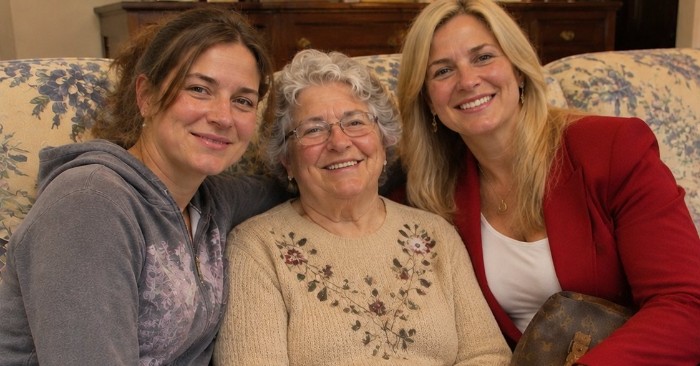
Amanda initially thought the most upsetting part of her mother’s 70th birthday was watching her wealthy sister slip a twenty-dollar bill into a card and joke that an elderly woman didn’t need much anyway. But by the following afternoon, she would discover that the money was actually the smallest surprise of the entire celebration.
My sister Melissa arrived at Mom’s 70th birthday party carrying a designer handbag that probably cost more than my monthly car payment.
She had always been the more successful one of us.
A beautiful house, luxurious vacations, and a husband who owned three dental practices.
Naturally, I expected her to make a big production out of Mom’s birthday present.
Instead, she pulled a twenty-dollar bill from her expensive purse and tucked it inside a birthday card.
“At her age, she doesn’t really need much,” Melissa said with a laugh.
Mom gave her a polite smile.
“Thank you, sweetheart.”
But I noticed how quickly she folded the card and slipped it beneath her plate.
It wasn’t the amount of money that bothered me.
After all, Mom had spent years helping Melissa.
She’d babysat her children without ever asking for payment, cooked meals when Melissa worked late, and even dipped into her retirement savings when Melissa and her husband purchased their first home.
I was furious.
I wanted nothing more than to say something right then and there.
But suddenly, I remembered the wooden box in Mom’s bedroom.
A few months earlier, she’d shown it to me while we were cleaning out her closet together.
It was filled with dozens of keepsakes from our childhood: school report cards, drawings, hospital bracelets, and old photographs.
There were also two small notebooks inside.
And that’s when an idea occurred to me.
“Mom,” I said, “I accidentally left your real birthday gift at home. Would you mind if we continued the celebration tomorrow?”
Melissa laughed.
“So now you’re making her wait an entire extra day?”
I ignored her.
The following afternoon, everyone gathered again to finish the leftover birthday cake.
I placed a large, carefully wrapped box on the table in front of Mom.
Melissa leaned back in her chair, looking amused.
Mom began removing the wrapping paper.
Inside was a handmade memory album I’d created using copies of all the things she’d saved over the years: family photographs, Mother’s Day cards, and little notes we’d written to her when we were children.
Mom pressed a hand over her mouth, visibly touched.
Then she reached the final page.
Her smile disappeared.
The strange thing was that I hadn’t included anything unusual there.
Just a photocopy of one page from one of her old notebooks.
Suddenly, Melissa jumped to her feet.
“Where did you get that?”
I looked at her.
“From Mom’s box. Why?”
She snatched the album from my hands and began frantically flipping through its pages.
Then she stopped, staring at a handwritten date.
Mom’s face turned deathly pale.
Without saying a word, she pushed back her chair and walked into her bedroom.
A few seconds later, she returned carrying a small brass key.
Melissa immediately stood up.
“Mom, no!”
But Mom ignored her and knelt in front of the locked bottom drawer.
Suddenly, Melissa rushed across the room.
“Don’t open that!”
I caught her by the arm.
“What is wrong with you?”
“Nothing. Amanda, just stay out of it.”
“You literally just tried to stop Mom!”
“I wasn’t going to hurt her!”
Mom looked up at both of us.
“Melissa.”
Something in her voice made us fall silent.
She unlocked the drawer.
Inside were several file folders, envelopes, and an old checkbook.
At first glance, none of it looked particularly interesting.
Mom took out one folder and placed it on the bed.
“Here.”
I opened it.
The first page contained a record of a bank transfer made fourteen years earlier.
The amount immediately caught my attention.
“Thirty-five thousand dollars?”
Melissa stared at the floor.
I turned to Mom.
“Was this for their house?”
She nodded.
I already knew Mom had helped Melissa and her husband financially when they bought their home.
But I’d never known exactly how much she’d contributed. And even that couldn’t explain why Melissa had reacted with such panic.
Then I noticed the date written in the corner.
It matched the entry in Mom’s notebook.
Beside it was another date, almost three years later.
“What does this mean?”
Melissa answered before Mom could speak.
“That’s when I was supposed to pay it back.”
I stared at her.
“So you borrowed the money?”
“It wasn’t like that.”
“This says thirty-five thousand dollars and gives a repayment date. That sounds pretty clearly like a loan to me.”
Mom rested a hand on my shoulder.
“Amanda.”
But I’d already spotted another document.
Eighteen thousand dollars.
A different year.
A different repayment deadline.
“And what was this one for?”
Melissa folded her arms.
“We were going through a difficult financial period.”
“Your husband owned a dental practice.”
“One practice, Amanda. And at the time, it was on the verge of closing.”
I pulled out the next sheet.
Twelve thousand five hundred dollars.
Then twenty-seven thousand dollars.
I glanced at Mom’s notebook again.
Every payment was recorded there.
Every amount.
Every date.
The seemingly meaningless rows of numbers I’d copied into the memory album as part of Mom’s personal keepsakes suddenly took on an entirely different meaning.
I sat down on the edge of the bed and began comparing the entries.
“Stop it,” Melissa said.
I pretended not to hear her.
One transfer dated back to around the time her second child was born.
Another had been made shortly before her husband opened his second dental practice.
I remembered how Melissa had constantly talked about how stressful that expansion had been.
I also remembered Mom suddenly deciding that her twelve-year-old car could last a few more years.
Another transfer came from the year Mom canceled a trip with her friends because she supposedly couldn’t justify the expense.
I looked at her.
“Mom, how much money have you given her altogether?”
She hesitated.
“I’d have to add everything up.”
“I’ve already done that.”
Melissa stepped toward me.
“Amanda, leave it alone.”
That only made me more determined to continue.
I entered every amount into the calculator on my phone.
When the total appeared, I checked the numbers twice.
Then a third time.
One hundred thirty-seven thousand five hundred dollars.
Nobody spoke.
I looked at Melissa.
Her designer handbag was still sitting on Mom’s dining table downstairs.
Only the day before, I’d listened to her spend several minutes describing how difficult it had been to find that exact model in the color she wanted.
And she’d given Mom twenty dollars for her birthday.
“You owe her $137,500?”
“No.”
I actually laughed.
“No?”
“That’s not what this is about.”
“There’s a repayment deadline written beside every single amount.”
“Mom never wanted the money back.”
“How convenient.”
“It’s true.”
I turned toward Mom.
“Is that true?”
She sat down beside me.
“Yes.”
Her answer completely threw me off.
“What?”
“I never expected Melissa to repay that money.”
I looked from her to the documents and back again.
“Then why did you write everything down?”
Mom gently took the notebook from my hands.
“Because I needed to keep track of how much she’d already received.”
“For what?”
She was quiet for a moment.
“For you.”
I couldn’t find the words to respond.
Mom opened the notebook to another page.
My name was written there.
Beneath it, there was almost nothing.
“I don’t understand.”
“Melissa needed help back then,” Mom explained. “You weren’t struggling financially at the time. But that doesn’t mean one of my daughters should ultimately receive more than the other.”
Melissa sank into a chair beside the window.
Mom continued.
“Some of that money was originally supposed to be loans. Melissa always said she’d pay me back once things improved financially. That’s why I recorded the amounts and repayment dates, because that was what we’d agreed on.”
“But you never asked her to repay anything.”
“No.”
“Why not?”
My question seemed to genuinely surprise Mom.
“Because eventually, I didn’t need the money anymore.”
“That’s not the point.”
“It is to me.”
She closed the folder.
“I have two daughters. Whatever I leave behind will belong to both of you anyway. Melissa needed part of her inheritance earlier in life, so I simply gave it to her early.”
I stared at the notebook.
“Then why did you keep recording the amounts?”
“So that when my estate is eventually divided, everything Melissa has already received will be taken into account. You’ll receive the appropriate amount first to balance things out, and then whatever remains will be divided between you.”
For several seconds, the only sound I could hear was the ticking clock in the hallway.
I’d wanted that drawer opened because I expected to find proof that Melissa had been taking advantage of our mother.
Instead, I was holding documents showing that Mom had been thinking about both of us all along.
Even when I hadn’t realized there was anything to consider.
“I don’t want $137,500,” I said.
Mom smiled faintly.
“I know.”
“That’s not what matters to me.”
“I know that too.”
I looked at Melissa.
“Did you know about this?”
“About what?”
“That Mom considered all that money part of your future inheritance?”
Melissa didn’t answer.
“Melissa.”
“Yes.”
My anger returned so suddenly that I stood up.
“You knew?”
“Mom told me.”
“So you knew she wasn’t expecting repayment. You knew she’d given you more than a hundred thousand dollars. And yesterday, you just handed her twenty bucks?”
“Amanda, this isn’t about the twenty dollars.”
“You’re right. It really isn’t.”
Mom stood up as well.
“That’s enough.”
“No, Mom.”
I turned back toward her.
“How many times have you told me there were things you couldn’t afford?”
“I never said I couldn’t afford them.”
“You said certain things were too expensive.”
“Sometimes they were.”
“Your car was practically falling apart before you finally replaced it.”
“It was still running.”
“You canceled that trip with your friends.”
“The trip wasn’t that important to me.”
“That’s what you always say.”
Mom’s expression changed.
What I saw in her face wasn’t anger.
It was something closer to sadness.
“Amanda, I made my own decisions about how to spend my money.”
Those quiet words finally silenced me.
“Nobody tricked me,” she continued. “Melissa didn’t steal from me. I helped my daughter because I wanted to.”
Melissa looked up.
Mom glanced briefly at her before turning back toward me.
“I was proud when they bought their house. I was proud when the dental practices became successful. I loved looking after her children while she worked. Please don’t turn the things I was happy to give into something ugly.”
I sat down again.
She was right.
I’d wanted Mom to be just as angry as I was.
But her feelings weren’t the same as mine.
Still, there was one question I couldn’t let go of.
I glanced toward the memory album Melissa had thrown onto the dresser earlier.
“Then why did you hide your birthday card under your plate yesterday?”
Mom froze.
Melissa looked at her.
“Mom?”
Our mother began carefully putting the documents back into their folder.
“It was nothing.”
“No,” I said. “That’s exactly what you always say.”
She gave me a warning look.
I softened my voice.
“Did yesterday hurt your feelings?”
Mom didn’t answer.
Melissa stood up.
“Mom, it was just a joke.”
“I know.”
“I didn’t mean anything bad by it.”
“I know that too.”
Mom pushed the drawer closed, but this time she didn’t lock it.
Then she turned toward Melissa.
“It wasn’t about the twenty dollars.”
Melissa’s shoulders relaxed slightly.
Mom noticed.
“Don’t look so relieved just yet.”
Melissa’s expression changed.
“You didn’t have to give me anything at all,” Mom said. “You could’ve written ‘Happy Birthday’ on a scrap of paper, and I would’ve been delighted.”
“Then what did I do wrong?”
Mom’s voice remained calm.
“You said, ‘At her age, she doesn’t really need much.'”
Melissa stared at her.
“It was only a joke.”
“I know.”
“Then why are we making such a huge deal out of it?”
Mom took a deep breath.
“Because I’m seventy, Melissa. But my life is far from over.”
Nobody moved.
“I still enjoy beautiful things. I still want to travel. I still like having something to look forward to. And sometimes, I simply want other people to think about me too.”
Tears began filling Melissa’s eyes.
Mom continued.
“I’ve spent years telling both of you not to worry about me. Perhaps I did a little too good a job of convincing you.”
I looked at Melissa.
She wiped beneath one eye.
“I wasn’t trying to say that you don’t matter.”
“I know you weren’t.”
Mom’s voice trembled slightly.
“But for a moment yesterday, that’s exactly how it felt.”
Melissa sat down again.
For the first time since Mom had unlocked the drawer, she stopped trying to defend herself.
Her gaze fell on the memory album.
She picked it up.
Several pages were bent because she’d grabbed it so roughly earlier.
Melissa carefully smoothed one page with the palm of her hand.
It showed a Mother’s Day card she’d made when she was seven.
The letters were crooked, and she’d drawn Mom with purple hair because, apparently, we’d only owned five colored pencils at the time.
Melissa laughed through her tears.
“You really kept this?”
“Of course I did.”
She turned another page.
A bouquet made from paper.
A photograph of us wearing matching pajamas.
A little letter I’d written apologizing to Mom for breaking a lamp and then blaming the cat.
Then Melissa discovered a tiny folded card she’d made when she was a teenager.
Nothing in that album had been expensive.
Most of the keepsakes were made from ordinary paper.
Some had faded so much they were barely recognizable.
But Mom had saved every single one.
Melissa studied the pages for a long time.
Then her eyes moved to the twenty-dollar bill that was still sticking out of the birthday card on the dresser.
“Now I understand.”
Mom sat beside her.
Melissa shook her head.
“No, I really do understand.”
She looked at me.
“I didn’t want you to see those documents because I knew exactly what you’d think.”
“What was I supposed to think?”
“That everything I own came from Mom.”
“That’s not what I think.”
“I thought you would.”
Her voice grew quieter.
“Every time she helped us, I told myself it was only temporary. Later, when we were doing better financially, she kept telling me not to worry about paying her back. And eventually…”
She stopped.
“Eventually what?” I asked.
Melissa looked at Mom.
“Eventually, I stopped thinking about what all that help had actually cost her.”
Mom reached for her hand.
Melissa began crying even harder.
“That’s awful.”
“It’s honest,” Mom replied.
Melissa shook her head.
“You made it so easy for me to just keep taking.”
Mom gave her a sad smile.
“Maybe that was my mistake.”
“No. It was mine.”
Melissa looked around the bedroom. Her eyes moved over the old furniture and the neatly repaired curtains Mom had never wanted to replace because, according to her, they were still perfectly good.
“I’ve heard you say so many times that you didn’t need anything. Eventually, I actually started believing it.”
She swallowed.
“And I don’t just mean money. I mean everything.”
Mom squeezed her hand.
“I’m sorry,” Melissa said. “Not because I gave you twenty dollars. But because somewhere along the way, I started acting as though you didn’t need anything from me simply because you never asked.”
Mom pulled her into an embrace.
I turned away for a moment because tears had suddenly begun filling my own eyes.
When I looked back, Melissa had opened the album again.
Near the beginning, she discovered an old photograph of Mom, probably taken when she was in her early twenties.
She was standing beside a lake, laughing, holding her shoes in one hand, with her jeans rolled up to her knees.
Melissa touched the picture.
“Where was this taken?”
Mom smiled.
“At Lake Briar.”
“You used to talk about that place all the time.”
“I still do.”
“I thought you hadn’t been there since we were kids.”
“I haven’t.”
Melissa studied her face.
“Do you still want to go back someday?”
Mom blinked in surprise.
“What?”
“To the lake. Would you still like to go?”
Slowly, a smile spread across Mom’s face.
“Of course I would.”
Melissa nodded.
“Then we’ll go.”
Mom laughed.
“All of us together?”
Melissa looked at me.
“If Amanda can put up with me for an entire weekend.”
“I’ll have to think about that.”
She rolled her eyes, and for the first time that afternoon, everything felt wonderfully normal again.
Mom placed the memory album in her lap.
Later, before we left, I watched her return the folders to the drawer.
Then she locked it.
“Are you still going to keep track of everything?” I asked.
“Of course I am.”
I smiled.
“You really want to make sure we both receive the same amount someday?”
Mom slipped the small brass key into her pocket.
“As fairly as I possibly can.”
I wrapped my arms around her.
For years, I’d believed Mom lived so modestly because she didn’t expect much from life.
Apparently, Melissa had thought the same thing.
We’d both been wrong.
Mom still had plenty of dreams and experiences she wanted to enjoy.
She’d simply spent her life making sure her daughters had everything they needed first.
And somewhere along the way, Melissa had mistaken that generosity for proof that Mom no longer needed anything herself.
It wasn’t the twenty-dollar bill that had revealed the real problem.
It was the sentence Melissa had used to justify her gift.
At seventy, Mom didn’t need less love, less attention, or fewer things to look forward to.
If anything, after all those years of giving us whatever we needed, it was finally time for us to start asking what she wanted for herself.