At 5 a.m., before the sun could scorch the dry land of northern Mexico, Teresa was already up. For 30 years, her body had functioned like a clock that was never allowed to stop. In silence, so as not to wake Goyo, she put on her worn apron, fed the chickens, milked the goats, and prepared the dough. Her hands, cracked and calloused, kneaded forcefully as she prepared gorditas, tamales de elote, and fresh cheese. By 7 a.m., she would walk 40 minutes along the dirt road to the village market in San Juan.
That was her only refuge. The only place where someone called her by name. Every Friday, without fail, Teresa set up her baskets. And many years ago, for three long years, a barefoot boy, dirty and with eyes sunken from hunger, stood in front of her. Teresa never asked his name. She would simply cut a piece of corn bread, hand it to him, and say six words: “Eat, my child, you’re so skinny.” One day, the boy disappeared. Teresa continued her life, trapped in a hell she called home.
Goyo, her husband, wasn’t a monster every day. But when he opened a bottle of mezcal, his demons awoke. Insults flew through the house, blaming Teresa for his own mediocrity. She stayed silent, cleaned up the broken plates, and kept her head down. She endured it all for their two children, Mateo and Sofía. But they too abandoned her. Mateo left for Monterrey at 18, and when Teresa traveled six hours by bus to bring him food, he hid her from his friends, saying, “She’s an aunt who came to visit.” Sofía left at 21 and simply stopped answering the phone. Her own children erased her from their lives.
The final blow came one Friday. The unbearable heat meant that Teresa sold almost nothing, so she returned home earlier. As she pushed open the wooden door, the smell of mezcal and cheap perfume hit her. In the bed she had paid for, Goyo was with a woman 20 years younger. Teresa didn’t scream. She just stood there, her hands empty, watching how 30 years of sacrifice crumbled. Goyo, with the audacity of a coward, staggered to his feet and shouted, “Get out of my house, useless old woman! I’m sick of you!”
Teresa grabbed an old suitcase, packed a sweater, and walked out into the cold desert night. She walked for hours in total darkness. The freezing air pierced her bones. In the distance, she saw the headlights of a truck. She raised her hand, begging for mercy, but the driver sped off, leaving her covered in dust. That was the real stab in the back. The whole world screamed at her that she was invisible, that she was worth nothing. By 11 a.m. the next day, dehydrated and under 40-degree heat, Teresa collapsed by the side of the road. She had no more tears. She closed her eyes, waiting for the desert to swallow her.
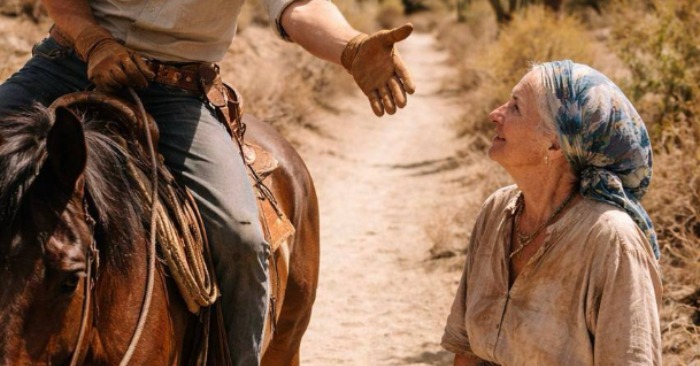
Suddenly, the sound of a horse broke the silence. A shadow covered her face. When she opened her eyes, she saw a young man, tall, dressed like the owner of a hacienda. The young man got off the horse, knelt on the scorching earth, and, looking at her with a heartbreaking intensity, said, “Don’t be scared, madam. I know you.” Feeling the world spinning and struggling to breathe, Teresa closed her eyes; she simply couldn’t believe what was about to happen.
Teresa had no strength to speak, let alone run. The young man lifted her in his arms with a gentleness she hadn’t felt in 30 years, put her on the horse, and took her to Hacienda Los Agaves, the largest and wealthiest property in the region. The place was imposing: iron gates, hundreds of cattle, and a massive stone house. However, as they crossed the door, Teresa noticed something familiar. Despite the fine furniture and luxury, the house was covered in dust, dishes piled up in the sink, and the air smelled of confinement. It was a house with money but no soul.
The young man, who introduced himself as Alejandro, prepared a soft bed for her, left water and food, and went to work in the fields without asking a single question. Teresa slept for 14 hours straight. When she woke up, her instinct as a devoted mother and wife took over. She couldn’t just sit there. She got up, found a broom, and cleaned the entire house. She washed the greasy dishes, opened the windows to let in the sun, and, upon searching the large pantry, found corn, beans, and chilies. With her expert hands, she prepared stewed beans, homemade flour tortillas, and a molcajete salsa.
When Alejandro returned at dusk, he froze in the doorway. The smell of hot food, the clean house, and the table set before him hit him like a lightning bolt. His eyes filled with tears he refused to shed. He sat at the table and ate in complete silence, closing his eyes with each bite, savoring the warmth of a home he had never had. For three weeks, they lived in peaceful routine. Alejandro treated her with reverential respect. He bought her perfumed soaps, brought her wildflowers for no reason, and sat with her in the courtyard to chat under the stars. For Teresa, who had come from a life of shouting and humiliation, this clean silence was paradise.
But the mystery broke one hot afternoon. Teresa was cleaning an old bookshelf in Alejandro’s office when she found a small wooden box. When she opened it, she saw cattle papers and, at the bottom, an old Polaroid photo. Her hands trembled as she pulled it out. It was a barefoot, dirty boy with messy hair, eating a piece of corn bread in front of a stand at the market. Teresa flipped the picture over. In childish, shaky handwriting, it said: “The lady of the corn bread.”
The air left her lungs. The hungry boy she had fed for three years, the boy who disappeared without a trace, was none other than Alejandro, the most respected patrón in the village. Now everything made sense. The look, the respect, the rescue on the road. That night, when Alejandro returned, Teresa was waiting for him with the photo in her hand, silently crying. “Was it you?” she asked in a broken voice. Alejandro took off his hat, nodded slowly, and replied, “It was always me, Mrs. Teresa.”
In that moment, Teresa understood that life is a perfect circle. The bread she had lovingly given 24 years ago was now returning to her as a refuge. But fear, that monster fed by Goyo’s insults, invaded her. She was 55 years old, wrinkled, and tired. He was 33, rich, and handsome. The town would call her crazy, a gold digger. Goyo had convinced her she was trash, and she still believed it. At 4 a.m., while Alejandro slept, Teresa packed her old suitcase, left a thank you note on the table, and walked toward the road. She didn’t want to ruin the young man’s life.
At 6 a.m., Alejandro woke up, saw the note, and felt the ground open beneath him. In two minutes, he saddled his horse and galloped down the dirt road. He caught up with her three kilometers from the hacienda. Teresa was walking with slow, heavy steps, hunched by the weight of her own guilt. Alejandro jumped off the horse and blocked her way. “I read your note,” he said, breathing heavily. “You say I deserve a woman my age, a young woman. But you don’t understand. I didn’t pick you up out of pity. I picked you up because you were the only one who saw me when I was trash to the rest of the world. My ex-wife left me because this ranch life bored her. I had money, but I didn’t have a home until you came and built it with your hands.”
Alejandro took another step, closing the distance, and with bright eyes, said, “I don’t care about your age, I don’t care what people say. Those cracked hands you hide are the most beautiful hands I’ve ever seen because they fed me when I was starving. You are my woman, and if you allow me, I want you to be my wife for life.” Teresa dropped the suitcase to the ground. For the first time in 30 years, she allowed herself to believe she was worthy of being loved, and she broke down in tears as he hugged her tightly against his chest.
The scandal erupted in the village weeks later. The gossip reached Monterrey, to Mateo and Sofía’s ears. Concerned about “the inheritance” and the family honor, the ungrateful children traveled to the ranch to “rescue” their mother from the young fortune hunter. Upon arriving in the village, they passed by their old house. They found Goyo drowned in his own misery, suffocated by mezcal, in a rotten house full of dead chickens and garbage. The mistress had abandoned him three days later when she saw there was no money. Doña Lupe, the neighbor, came out and spit the truth in the children’s faces: “Now you come around, huh? When your mother came looking for you, you treated her like trash. Your father threw her out like a dog. So get out, because she’s already found a real man.”
Filled with rage and shame, Mateo and Sofía arrived at Hacienda Los Agaves. They expected to find their mother scrubbing floors, but the scene froze them. Teresa was sitting on the porch, dressed in elegant clothes, well-groomed, and with a radiant expression. Next to her, Alejandro was drinking coffee. “What are you doing here, Mom? This is ridiculous, this man is a gold digger,” Sofía yelled. Teresa, without losing her calm, stood up. Her gaze was no longer that of the submissive woman they once knew.
“You left me alone,” Teresa said in a firm voice that echoed through the walls of the hacienda. “You, Mateo, denied me in front of your friends. You, Sofía, erased me from your life. And your father threw me out to put another woman in my bed. I walked through the desert, waiting for death, and none of you looked for me. This man, whom you call a gold digger, picked me up, respected me, and gave me the place my own family denied me. So don’t come here demanding rights you lost a long time ago. I love you because you are my children, but this is my house and he is my husband. I am no longer willing to apologize for existing.”
The children left in silence, carrying the weight of a guilt that would chase them forever. Goyo died years later, alone and bitter, clinging to a bottle. Alejandro and Teresa married in a small ceremony at the hacienda, under the sunset sun. He, in front of the judge, kissed her calloused hands and said, “My lady.”
But life, in its infinite and mysterious justice, had one last surprise prepared for them. Months after the wedding, Teresa began to feel dizzy and fatigued. She thought it was the toll of her 55 years catching up with her. Alejandro took her to the village doctor. When the doctor returned with the test results, he was pale. “It’s a miracle, there’s no other explanation,” he murmured. Teresa was pregnant. At 55, the universe was returning the children she had lost. When a healthy baby boy with big eyes was born, Teresa held him against her chest and, remembering the barefoot boy at the market, whispered, “Eat, my child, you’re so skinny.” Alejandro cried beside her.
Sometimes, life takes everything you thought you loved, only to give you what you truly deserve. And you, have you ever given everything for your family without receiving anything in return? Has anyone valued you when you least expected it? Share your story in the comments, I’m reading. If this story touched your heart, share it so the world knows that the bread you give to a hungry child today may be the salvation God has prepared for you tomorrow.