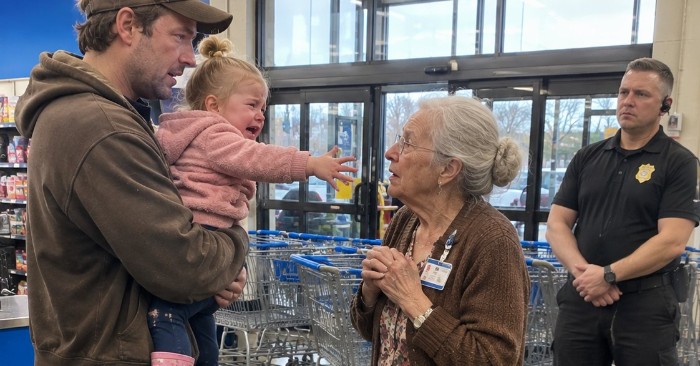
I was sixty-seven years old and working as a greeter at a large department store when, one afternoon, a man hurried toward the exit carrying a desperately screaming little girl. The three-year-old grabbed my vest and repeatedly cried, “You’re not my daddy!” The man insisted he was her father and demanded that I let him leave. My decision to intervene cost me my job. A few weeks later, he sued me for $250,000. But on the first day of the trial, a young woman suddenly stood up in the courtroom — holding that very same little girl in her arms.
My name is Mabel Truesdale.
For nine years, I had worked as a greeter at a large retail store in Joplin, Missouri.
I had retired from the postal service at sixty after spending many years on the job.
Initially, I had looked forward to having plenty of free time. Before long, however, I found myself growing bored.
Then my husband passed away.
Eventually, the silence inside my house became unbearable, and I decided to return to work.
That was how I ended up standing beside the entrance of a large department store.
My responsibilities were straightforward.
I welcomed customers, answered their questions, and wished them a pleasant day.
I always carried a roll of yellow smiley-face stickers in the pocket of my work vest.
Every child who walked through our doors received one.
Some families even returned every Saturday because their little ones were so excited about getting their smiley stickers.
I genuinely enjoyed my job.
Never could I have imagined that it would one day turn my entire life upside down.
It happened on a Tuesday afternoon in March.
A man was approaching the exit with a little girl in his arms.
The child appeared to be approximately three years old.
She had curly hair and was wearing pink rain boots.
The little girl was screaming at the top of her lungs.
But it wasn’t an ordinary childhood tantrum like the countless others I had witnessed throughout my years there.
This child sounded frightened.
Truly frightened.
I reached into my vest pocket and pulled out a smiley-face sticker.
“Hello, sweetheart,” I said gently.
“Would you like a happy-face sticker?”
The little girl reached toward me.
Then she grabbed my vest with both of her tiny fists.
“You’re not my daddy!” she screamed at the man.
“I want my mommy! I want my mommy!”
The man gave me a strained smile.
“She’s going through a terrible tantrum phase,” he explained.
“She’s tired. Please excuse us.”
He attempted to walk past me.
But I positioned myself in front of the exit.
“Sir, I’m sure you understand why this concerns me,” I said calmly.
“The little girl is clearly distressed. Could you at least tell me her name?”
His smile vanished.
“Get out of my way, old woman.”
I remained where I was.
“What’s your daughter’s name, sir?”
He hesitated.
Only for a moment.
But that moment lasted just a little too long.
“Piper,” he finally answered.
“Her name is Piper. And I’m her father.”
I turned toward the little girl.
“Piper, sweetheart. Is this your daddy?”
She shook her head furiously.
Then she started screaming again.
“NO! HE TOOK ME! HE TOOK ME AWAY FROM MISS ODESSA!”
The man’s face turned red.
“She’s three years old! She doesn’t even know what she’s talking about!”
He leaned toward me threateningly.
“Move aside right now, or I’ll move you myself.”
I didn’t budge.
I’m not a particularly tall woman.
But I had spent thirty-one years delivering mail in neighborhoods where you quickly learned how to stand your ground.
I had been chased by dogs.
Worked through blizzards.
And endured verbal abuse from men twice my size.
I wasn’t going to let this terrified little girl disappear through my doors without at least attempting to understand what was happening.
“I’m going to call my supervisor,” I said calmly.
“Just to make sure everything is all right.”
A short while later, Mr. Pruitt arrived.
He was our store manager.
Thirty-five years old.
Always dressed in a polo shirt.
And constantly nervous whenever a customer made a complaint.
The man pulled out his wallet and showed Mr. Pruitt his driver’s license.
Then he opened a photograph on his phone.
It showed him holding a baby in his arms.
“See?” he said.
“My daughter.”
He pointed toward me.
“This old woman is harassing me.”
Mr. Pruitt examined the driver’s license.
Then the photograph.
Finally, he looked at me as though I were the actual problem.
“Mabel, step aside immediately.”
I stared at him.
“But…”
“He’s the child’s father. You’re damaging the reputation of our store.”
I tried once more.
“Mr. Pruitt, the little girl says he took her away from a woman named Miss Odessa.”
My supervisor pronounced every word separately.
“Mabel. Step. Out. Of. The. Way.”
So I stepped back.
However, when the man left the store, I followed him toward the exit.
I took out my phone.
And captured three photographs.
One of his face.
One of the little girl visible through the car window.
And one of the license plate.
Then I called 911.
The following morning, I was fired.
Mr. Pruitt summoned me to his office.
“You caused a disturbance,” he explained.
“You followed a customer into the parking lot and photographed him.”
He pushed some paperwork across the desk.
“The man has submitted a formal complaint to corporate headquarters.”
I attempted to explain why I had acted the way I did.
But he refused to listen.
After nine years, I lost my job.
Three weeks later, a letter arrived from a law firm.
The man’s name was Dale Rutherford.
He was suing me for $250,000.
The lawsuit accused me of assault, defamation, and causing emotional distress.
His attorney alleged that I had grabbed Rutherford by the arm.
He also claimed I had publicly accused him of kidnapping a child.
In reality, I had never even touched him.
Not once.
The court date was scheduled for October.
I couldn’t afford an expensive attorney.
Fortunately, a young man from a legal aid organization agreed to represent me.
His name was Teddy Marsh.
Teddy looked as though he was barely twelve years old.
But he read every page of my case file at least twice.
And unlike other people, he never casually dismissed my concerns by telling me not to worry.
On the first day of the trial, Dale Rutherford sat across from me.
He wore a meticulously pressed suit.
His attorney described me as a confused elderly woman desperate to imagine herself as some kind of hero.
I folded my hands in my lap.
And remained silent.
After all, thirty-one years on a postal route had also taught me when it was better to keep my mouth shut.
Before the opening statements began, the judge asked whether any additional witnesses were present.
At that moment, a young woman stood up in the back row.
She was holding a little girl in her arms.
The child was wearing pink rain boots.
“Your Honor,” the woman said in a trembling voice.
“I’m Piper’s mother.”
Everyone in the courtroom turned toward her.
Dale Rutherford’s face went deathly pale.
The little girl spotted me.
She extended her finger in my direction.
“The sticker lady!”
My heart leaped in a way I can scarcely describe.
I hadn’t seen the child since that terrifying afternoon.
And now there she was.
Wearing clean clothes.
With neatly combed hair and a beautiful little bow.
She was beaming at me as though we were longtime friends.
The judge was a silver-haired woman named Alvarado.
She invited the young mother to come forward.
The woman introduced herself as Marisol Vance.
She was twenty-six years old and worked as a nursing assistant at a long-term care facility.
“Your Honor,” she began.
“This man is indeed Piper’s biological father.”
She pointed toward Rutherford.
Then she continued.
“But he lost custody when our daughter was one year old.”
Her voice shook.
“After he injured me so severely that I had to be hospitalized.”
An outraged murmur spread through the spectators.
Marisol swallowed.
“There has also been a protective order against him for the past two years.”
Rutherford’s attorney immediately jumped to his feet.
“Your Honor, this is highly irregular! We were never informed that this woman would be appearing…”
The judge interrupted him.
“Sit down, counsel.”
She didn’t even look in his direction.
Then she turned her attention back to Marisol.
“Ms. Vance, please continue.”
The young woman took a deep breath.
“On March fourteenth, he went to the private daycare where Piper was being looked after.”
She held her daughter more tightly.
“He told her caregiver, Miss Odessa, that there was a family emergency.”
Then she swallowed.
“And he simply took my child.”
The caregiver hadn’t been aware of the court order.
Marisol only discovered what had happened an hour later when Miss Odessa called her at work.
The police were immediately contacted.
A public missing-child notification, known as an Amber Alert, was issued.
Marisol looked across the courtroom toward me.
“But by the time that alert was released, the police already had his vehicle’s license plate number.”
Her voice cracked.
“And a photograph of his face.”
She began crying.
“And a picture of my daughter sitting in his back seat.”
I covered my mouth with my hand.
Marisol pointed toward me.
“Because this woman refused to move away from a door.”
She sobbed.
“And asked my little girl what her name was.”
The courtroom became so quiet that I could hear the clock above the jury box.
Marisol continued telling her story.
Her voice was steadier now.
It was the voice of someone who had already been forced to recount the same horrifying experience countless times to police officers and investigators.
Ninety minutes after Rutherford had left the store, state troopers intercepted his vehicle on the highway.
He had been heading toward the Oklahoma state line.
Piper was asleep in the back seat.
There was no child safety seat.
A fast-food bag and a bottle of cough medicine were lying on the floor.
An officer later testified that the little girl had apparently been given medication that wasn’t intended for her.
Piper had slept during two hours of the journey.
I felt physically sick.
That afternoon, I had been absolutely certain something wasn’t right.
But I had never imagined just how dangerous the situation actually was.
Several criminal charges had been filed against Rutherford.
Kidnapping.
Custodial interference.
And violation of a protective order.
He had been released on bail while awaiting his criminal trial.
And during that waiting period, he had filed a lawsuit against me.
Suddenly, I understood everything.
“He wanted to frighten me into changing my testimony,” I whispered.
I had intended to keep that thought to myself.
But the judge heard me.
“Mrs. Truesdale,” she said.
“You’ll have an opportunity to speak shortly.”
Then she turned toward Rutherford and his attorney.
She studied the man for a long time.
“Mr. Rutherford,” Judge Alvarado began.
“I’ve presided over this courtroom for nineteen years.”
Her voice remained composed.
“During that time, I’ve seen defendants attempt all sorts of things.”
She paused.
“But rarely have I encountered a man facing kidnapping charges who files a civil lawsuit against the most important witness in his case.”
Rutherford’s attorney sprang to his feet again.
“Your Honor, my client was the victim of a false accusation…”
The judge raised her hand.
“Your client’s license plate was photographed by the very woman he’s now suing.”
She gestured toward the case file.
“A photograph of his face is also included among the evidence collected during the missing-child investigation.”
Her voice became sharper.
“Counsel, I strongly advise you to remain silent.”
Beside me, Teddy Marsh stood up.
My young attorney was holding a single sheet of paper.
“Your Honor, the defense moves to dismiss this lawsuit with prejudice.”
The judge responded immediately.
“Motion granted.”
She delivered those words so casually that, at first, I didn’t understand what had just happened.
Then she looked at me kindly.
“The lawsuit is permanently dismissed, Mrs. Truesdale.”
She explained:
“That means Mr. Rutherford cannot bring these same claims against you again.”
I stared at her.
“You’re free to go.”
Then she turned back toward Rutherford.
“Mr. Rutherford, attempting to intimidate a witness in a criminal proceeding through a civil lawsuit may itself constitute a criminal offense.”
She looked toward the officers.
“I will refer this matter to the appropriate prosecutor’s office for further review.”
Then she addressed Rutherford directly.
“You will remain seated until the bailiff has spoken with you.”
Two officers were already approaching him.
I stood up.
My legs felt as though they belonged to somebody else.
Teddy squeezed my arm.
He was grinning like a little boy who had just won the biggest prize at the county fair.
Then Marisol approached me.
Piper was still sitting in her arms.
Tears streamed down the young mother’s face.
She didn’t even bother wiping them away.
“Mrs. Truesdale,” she began.
“I’ve never had the opportunity to thank you.”
I shook my head.
“Oh, sweetheart. You don’t have to do that.”
“Yes, I do,” she insisted.
She shifted Piper onto her other hip.
Then she took both of my hands.
“I was at the state police station when the call came through.”
Her voice trembled.
“I’d been sitting in a plastic chair for two hours.”
She swallowed.
“And at some point, I’d lost all feeling in my hands.”
Then she continued:
“The officer said, ‘We’ve found your daughter.’”
She started crying again.
“And then he explained that a woman at a store had stopped the man and photographed everything.”
I looked at her.
“I immediately asked who that woman was.”
Marisol smiled through her tears.
“He just said, ‘A store greeter. Somewhere in her sixties.’”
She squeezed my hands.
“I knew right away that I needed to find you.”
Then she whispered:
“But I didn’t even know your name.”
My voice broke.
“Mabel.”
I smiled.
“Everybody calls me Mabel.”
Marisol repeated my name very slowly.
“Mabel.”
Then she said:
“For the rest of my life, I’ll say your name in my thoughts every single night.”
Piper reached out her tiny hand.
She rested her warm palm against my cheek.
Then she asked hopefully:
“Sticker?”
I started laughing.
I simply couldn’t help myself.
It was a trembling, tear-filled laugh.
And suddenly, almost half the courtroom was laughing along with me.
I reached into my vest pocket.
Inside was the same roll of smiley-face stickers I had carried throughout my years at the store.
I peeled off one yellow sticker.
Piper accepted it carefully.
Then she placed it on her jacket.
Directly over her heart.
In December, Dale Rutherford’s criminal trial began.
I was required to testify for two hours.
And I was absolutely terrified.
Never before in my entire life had I sat on a witness stand.
But Teddy had prepared me.
We had practiced at his kitchen table.
His wife had played the role of the prosecutor.
When the actual prosecutor asked what I had witnessed that afternoon, I recounted everything exactly as I had described it to the emergency dispatcher.
The little girl’s desperate screaming.
The man’s brief hesitation before providing her name.
And the expression on his face when Piper cried:
“He took me!”
The jury deliberated for fewer than three hours.
Then their verdict was announced.
Guilty on every count.
Rutherford was sentenced to twelve years in prison.
He would not become eligible for early release until he had served at least eight years.
I wasn’t inside the courtroom when his sentence was announced.
But Marisol called me afterward from the courthouse hallway.
I slowly sank onto my kitchen floor.
I pressed one hand firmly against my chest.
Over the phone, I could hear Marisol crying and laughing at the same time.
“He can’t hurt her anymore,” she repeated.
“He won’t be able to hurt her for a very, very long time.”
I closed my eyes.
“No, sweetheart.”
My voice trembled.
“He won’t.”
Then something rather unexpected happened.
Suddenly, countless people wanted to speak with me.
A reporter from the Joplin Globe contacted me for an interview.
Shortly afterward, a television station in Springfield reached out.
I turned down most of the requests.
Eventually, however, Teddy persuaded me to give an interview to a local station.
The television crew came to my house.
They even filmed me making coffee.
Then the reporter asked me a question.
“What made you decide to stand in front of that door?”
I considered her question briefly.
Then I answered honestly.
“I simply listened.”
The reporter looked at me.
I continued.
“That little girl said the man wasn’t her daddy.”
Then I added:
“Somebody ought to believe a child.”
That sentence aired on the evening news that very same day.
By the weekend, an entire stack of cards was sitting on my kitchen table.
They had been sent by people I had never met.
A grandmother from Tulsa.
A school bus driver from Kansas.
And a woman who wrote me a particularly moving message.
She explained that she herself had been kidnapped at the age of four.
Back then, nobody had stopped the man who took her.
And she wrote about how desperately she wished a woman like me had been standing at that doorway.
I read her card three times.
Then I placed it inside the drawer beside my bed.
Right next to my late husband’s old wristwatch.
One week after the civil lawsuit was dismissed, I received a phone call from my former employer’s corporate headquarters.
A vice president was on the line.
Her name was Carolyn Whitaker.
For approximately twenty minutes, she apologized to me.
I almost got the impression that she hadn’t stopped to breathe once throughout the entire conversation.
“Mrs. Truesdale,” she began.
“What happened to you was completely unacceptable.”
I remained silent.
“You acted exactly as we would hope any of our employees would act.”
Her voice became serious.
“And you were punished for doing so.”
Then she made me an offer.
“We’d like to reinstate you to your former position.”
She continued listing the details.
“With back pay for the time you lost, a salary increase, and an official letter of recognition.”
I was speechless.
But Carolyn wasn’t finished yet.
“There’s also something we’d like to ask of you.”
I frowned.
“What would that be?”
“We’re introducing a new safety protocol across every store in our region.”
She explained the details.
Whenever a child explicitly states that the adult accompanying them is not their mother or father, employees must immediately contact the police.
Every single time.
Regardless of the identification documents the adult presents.
And regardless of how calm or convincing that person appears.
Then Carolyn said:
“We would like to call this policy the Truesdale Rule.”
I remained silent for a moment.
Eventually, I shook my head.
“I’d rather you didn’t.”
Carolyn sounded surprised.
“Why not?”
I took a deep breath.
“This isn’t my rule.”
Then I explained.
“It should be a rule protecting every little child.”
I thought about it briefly.
“Call it ‘Believe the Girl’ instead.”
Then I added:
“Or ‘Believe the Boy.’”
I smiled.
“It doesn’t matter which child it is. Believe the child.”
There was a brief silence on the other end of the line.
Then Carolyn Whitaker replied softly:
“We can certainly do that.”
Mr. Pruitt was transferred to a store in another state.
I heard that he was required to complete mandatory training in child protection and appropriate responses to suspected abductions.
I hope he learned something from it.
Perhaps he genuinely did.
Because approximately one month later, a regional manager visited our store.
He told me that Mr. Pruitt had asked him to deliver a message.
It consisted of a single sentence.
“I should have listened to her.”
I folded the little piece of paper.
And kept it.
It wasn’t much.
But it was honest.
And sometimes, that’s enough.
On a Saturday in January, I returned to my old job.
The store looked exactly as it had before.
The same blue carpeting.
The same squeaky shopping carts.
And the same blast of cold air that swept inside whenever the automatic doors opened.
Many of the customers I had welcomed for nine years stopped to shake my hand.
A man I had never met pressed a twenty-dollar bill into my palm.
I attempted to return it.
But he refused to take it back.
A teenager wearing a hooded sweatshirt stopped in front of me.
“Hey, aren’t you the sticker lady from the news?”
I smiled.
“Yes, that’s me.”
He grinned.
“What you did was seriously awesome!”
I decided to interpret that as a compliment.
At ten o’clock that morning, the automatic doors slid open.
A little girl wearing pink rain boots came running inside.
Her mother followed closely behind her.
“STICKER LADY!”
I turned around.
Piper.
She was almost four years old now.
She had grown a little taller.
Her cheeks weren’t quite as round as they had once been.
And she had learned how to pronounce my name.
Well, almost.
She called me “Miss Mabber.”
If she had asked me for it, I probably would have given her the entire store.
Piper stopped directly in front of me.
Then she extended her hand.
Her little palm was facing upward.
She looked at me with the solemn seriousness of a child who knew exactly what she was entitled to receive.
I peeled a smiley-face sticker off the roll.
Then another.
And because it was such a special occasion, I finally handed her the entire roll.
Over Piper’s head, I met Marisol’s gaze.
She was wearing a new coat.
Bright yellow.
And for the first time, she looked genuinely well-rested.
The dark circles beneath her eyes had disappeared.
She silently mouthed the words:
“We’re doing well.”
I smiled.
“I can see that.”
At that moment, Piper took one of the stickers.
She rose onto her tiptoes and attached it to my work vest.
Directly above my name tag.
“Now you’ve got one too,” she announced.
I looked down.
A tiny yellow face was smiling back at me from my chest.
Suddenly, my vision became blurred with tears.
For nine years, I had handed out those smiley-face stickers simply out of habit.
They had been nothing more than a small gesture intended to brighten children’s days.
Never had I imagined that the roll of stickers in my pocket and the determination that made me stand my ground that afternoon would one day become so closely connected.
I could never have imagined that a yellow smiley face and a stubborn elderly woman standing at a department store entrance could help prevent a man from disappearing down the highway with an abducted child.
But perhaps that is precisely what everyday courage looks like.
It doesn’t require a superhero’s cape.
An impressive speech.
Or an extraordinary title.
Sometimes, all it takes is an older woman carrying a roll of stickers in her pocket.
A woman who remains standing exactly where she is needed.
Who asks a frightened child one simple, gentle question.
And who refuses to step aside, even when everyone else demands that she do precisely that.
Piper gently tugged on my sleeve.
“Miss Mabber?”
I looked down at her.
“Yes, sweetheart?”
She smiled hopefully.
“Can I have another sticker?”
I burst out laughing.
Then I wiped the tears from my eyes.
And reached into my vest once again.
Because in the other pocket, I had another roll.
Ever since that unforgettable day, I had always carried a spare.