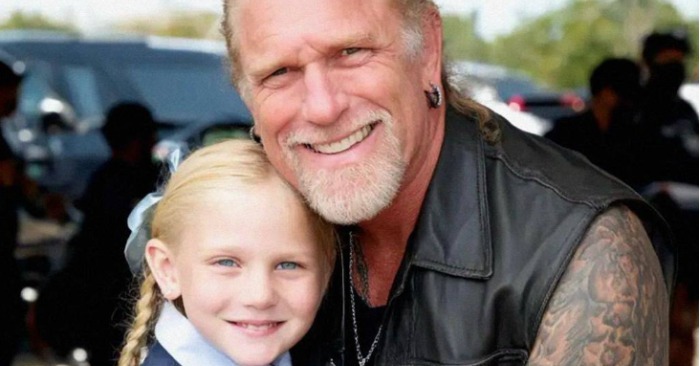
For two years, after my night shift ended, I walked my neighbor’s little girl to school every morning. She called me Dad. And then, one morning, a man showed up who looked exactly like her, grabbed her hand, and told me he had an offer that would change everything.
Two years ago, I was on my way home after my overnight shift when I heard a child crying.
It wasn’t loud sobbing. It was that quiet, worn-out kind of crying you hear from someone who has been crying for a long time and doesn’t even have the energy to be dramatic anymore.
I followed the sound. What else was I going to do?
It led me behind a small apartment building, next to a dumpster, where a little girl sat on the ground.
She was wearing a school uniform. Her knees were pulled to her chest. Her backpack lay beside her like she’d dropped it and forgotten it existed.
“Hey,” I said carefully. “Are you okay?”
She looked up like she’d forgotten other people were real. Her eyes were red and swollen. For a second I thought she might run.
“Everyone has their dads today,” she whispered.
I crouched down a few steps away, keeping my distance so I wouldn’t scare her. “Everyone who?”
“Everyone at school,” she sniffed, wiping her nose on her sleeve. “Today is Father-Daughter Day.”
Then her face crumpled again. “And I don’t have anybody.”
“Oh,” I said, and something in my chest tightened. “I’m sorry.”
“My dad is in prison,” she said, nudging a pebble with the tip of her shoe. “And my mom’s been dead for a long time. I live with my grandma, but she can’t walk well. She told me I have to go by myself.”
In that moment, something in me cracked.
I had always imagined myself as a family man. I was fifty-six now, but there was a time — long ago — when my life felt full and hopeful.
I was engaged once. Her name was Rebecca. We’d set a date, talked endlessly about the future, argued playfully over baby names, and imagined a home filled with noise, chaos, and warmth.
In my mind, I saw slow Sunday mornings — pancakes on the stove, cartoons humming in the background, a small voice calling out for Dad.
That future vanished in a single conversation.
One week before our wedding, Rebecca sat down across from me and told me she was pregnant. Not with my child — but with her boss’s. She packed a bag that same day and walked out without looking back.
Everything I believed in collapsed in that moment.
I fell into a darkness that took years to climb out of. Eventually, I stopped believing that family was something meant for me at all. To be honest, I stopped believing in much of anything.
Motorcycles saved me.
There’s almost nothing that makes you feel more alive than tearing down a road on a bike, the wind hitting your face like proof you’re still here. The strict rules of the biker community gave me structure, and the open road gave me freedom.
For thirty years, that was my world.
I worked nights as a security guard. On weekends, I had just enough time to pretend the empty space in my heart wasn’t there.
But standing in front of that little girl, I felt something I thought had died a long time ago.
It scared me, because I had spent three decades doing everything I could to bury that feeling.
“What’s your name?” I asked.
“Marissa.”
“And your grandma,” I said gently. “Is she home?”
She nodded. “She’s tired a lot. Sometimes she can’t even get up from her chair.”
I hesitated for barely a second.
Maybe I should have thought longer. Maybe I should have worried about how it would look, or what people might assume. But I didn’t.
What I said next changed my life forever.
“Listen,” I told her. “I can walk with you. Just today. If you want.”
Her whole face shifted, like a light turned on inside her.
“Really?” she gasped. “You would do that?”
I nodded. “If your grandma is okay with it.”
Marissa jumped up and grabbed my hand. Her fingers were small and warm, and she held on like she was afraid I’d disappear if she let go.
We walked to her house and she knocked on the door with her free hand.
Her grandmother answered the door. She looked delicate, worn down by years, her hands trembling as she leaned against the frame. When she noticed Marissa holding my hand, something unreadable crossed her face, and for a brief moment I expected the door to close again.
“I want him to come to Father-Daughter Day,” Marissa said suddenly.
She tilted her head up, eyes wide and hopeful. “Please, Grandma. Can he come with me?”
The older woman didn’t answer right away. She examined me carefully, as if weighing something far heavier than my presence.
Then she gave a slow, careful nod.
“Thank you,” she said softly.
At school, Marissa never left my side. Not during breakfast, not during the activities, not even when the other children raced off together. Her fingers stayed locked around mine, as though letting go might make me disappear.
Whenever someone asked who I was, she beamed and said, “That’s my angel man.”
Later that day, I walked her back home. Her grandmother was waiting inside, settled into a worn recliner by the window, oxygen tubing looping gently beneath her nose.
“I appreciate you,” she said again. “I don’t have much strength left these days.”
As I turned to go, Marissa threw her arms around me, hugging with everything she had.
“When will you come again?” she asked.
“I’m… not sure,” I told her honestly.
She leaned close and whispered, “Please don’t stay away too long, angel man.”
It hit me all at once. The weight of it. The attachment. The responsibility.
On the walk home, I promised myself I wouldn’t return.
And then I broke that promise.
I came back anyway.
The morning after that, I showed up.
And then I did it again the next day.
By seven o’clock, I was walking toward her house every morning. She was always there already — backpack on, standing at the edge of the porch, eyes fixed on the street like she was bracing herself for disappointment.
The first time she saw me and broke into a smile, I knew I was in trouble.
Her grandmother never asked questions. She’d simply lift a hand in a quiet wave from the window, relief written all over her face.
Marissa slipped her hand into mine, and we headed off together. She filled the walk with stories — about school projects, playground drama, and a neighborhood cat she was absolutely convinced needed rescuing.
Half a year later, during a school breakfast event, she climbed onto a chair and pointed straight at me across the room.
“That’s my Dad Mike!”
I instinctively started to speak — to correct her — but her grandmother, who had come that morning with the help of a walker, reached out and held my arm.
“Mike,” she said gently, “if calling you Dad helps her feel safe… please don’t take that from her.”
And just like that, I became Dad Mike.
Not on paper.
Not legally.
Only in the place that mattered most — her heart.
And, quietly, mine too, even if I wasn’t ready to admit it yet.
Every morning as we walked, she’d glance up at me and ask the same question.
“You’re not going to leave me like my real dad did, right?”
“Never,” I’d answer.
I believed it with everything I had. I just didn’t realize how much that promise would be tested.
She gave me as much as I gave her — maybe more.
Those walks showed me a version of life I’d long convinced myself wasn’t meant for me. They filled a hollow space I’d been ignoring for years.
And then, one ordinary morning, everything shifted.
I went to her porch at seven like always.
This time a man was standing there, holding Marissa by the hand. She was tugging, trying to pull away from him.
“Hey!” I shouted, hurrying toward them. “What are you doing?”
Marissa saw me and screamed, “Dad!”
The man turned to face me.
He looked shockingly like her — same eyes, same nose — but his expression was hard, like he had already decided he didn’t care how this went.
“You must be Dad Mike,” he said. “Come here. We need to talk. I have an offer for you.”
My heart dropped straight into my stomach.
I stepped aside with him. Behind me Marissa was crying now, sobbing my name.
The man didn’t waste time with manners. He crossed his arms like he’d rather be anywhere else.
“I’m Marissa’s uncle,” he said. “Her father’s brother. I’m here to take her.”
“Take her?” I repeated, like my brain couldn’t hold the words.
“She’s alone now,” he continued. “My mother — her grandmother — died this morning. Hospice called.”
My throat tightened. “She’s… gone?”
“Yes.” He glanced at his watch. “I flew in, rented a car, came straight here. I don’t have much time.”
Behind us, Marissa’s crying turned into full panic. “Dad Mike, don’t let him take me!”
I turned toward her immediately.
“Hey,” I said, dropping to her level. “I’m here.”
She grabbed my shirt with both hands like she was holding onto a cliff edge.
The uncle let out an impatient sigh. “Can we not do this part right now?”
I stood slowly. “This part?”
He motioned vaguely toward Marissa. “The scene. I didn’t choose this. I’ve got a life back home. Kids. A job. I’m only here because I legally had to be.”
Anger rose in me like bile.
“So what’s your ‘offer’?” I asked, my voice low.
He said it flatly, like he was discussing a car lease.
“I can take her,” he said flatly. “That’s one option. Pull her out of school, move her to another state. She’ll adapt — kids always do. Or you keep her.”
I looked at him in disbelief. “You’re talking about her like she’s an object.”
He gave a careless shrug. “I’m talking about facts. And ever since I showed up, she keeps saying that Mike will take care of her.”
“And what exactly is that supposed to imply?”
“That she’s bonded,” he replied. “And bonds complicate things.”
I laughed once, sharp and humorless. “Yeah. Heaven forbid.”
He didn’t react.
“Listen,” he said, unfazed. “I don’t want her.”
The words came out clean. No pause. No guilt.
“I never did. Her father wrecked his life, my mother stepped in, and now she’s somehow my responsibility. I’m just trying to pass her to someone who actually wants her.”
The way he kept referring to her as her — never using Marissa’s name — made my hands tighten at my sides.
“So you’re giving her up.”
“I’m offering you a solution,” he corrected. “You keep her. Make it official. I’ll sign whatever papers are needed. No strings.”
My chest tightened — not from relief, but from dread.
What if I couldn’t do this?
I was fifty-eight. Not young. What if I got sick? What if something happened to me? What if she ended up abandoned all over again — standing somewhere unfamiliar while adults debated her life like it was a contract?
I closed my eyes. Thought about decades spent choosing comfort over risk. About all the years I’d avoided hope because it felt dangerous.
Then I looked at Marissa.
Still in her school uniform. Tear-streaked. Watching me like I was the last steady thing she had.
“I’ll keep her,” I said.
The tension drained from his face immediately. “Good. I’ll have my attorney handle the details.”
Marissa rushed forward and wrapped her arms around me so tightly it took my breath away.
“I’ve got you,” I whispered into her hair. “You’re safe.”
That night, as I tucked her into the bed in my house — our house — she gripped my hand with surprising strength.
“You won’t leave, right?” she whispered.
I squeezed back.
“No. I’m here. And you’re staying with me.”
Her breathing evened out. Her eyelids fluttered closed.
But she didn’t release my hand, so I stayed beside her in the dark until sleep fully claimed her.
The next morning, we walked to school the same way we always had — but nothing felt the same anymore.
At the office, the secretary slid a clipboard across the counter.
“Relationship?” she asked.
“Guardian,” I said, signing my name.
And for the first time since my life unraveled thirty years earlier, that word didn’t scare me.
It felt like it finally belonged.
What would you do in this situation? Share your thoughts in the Facebook comments.